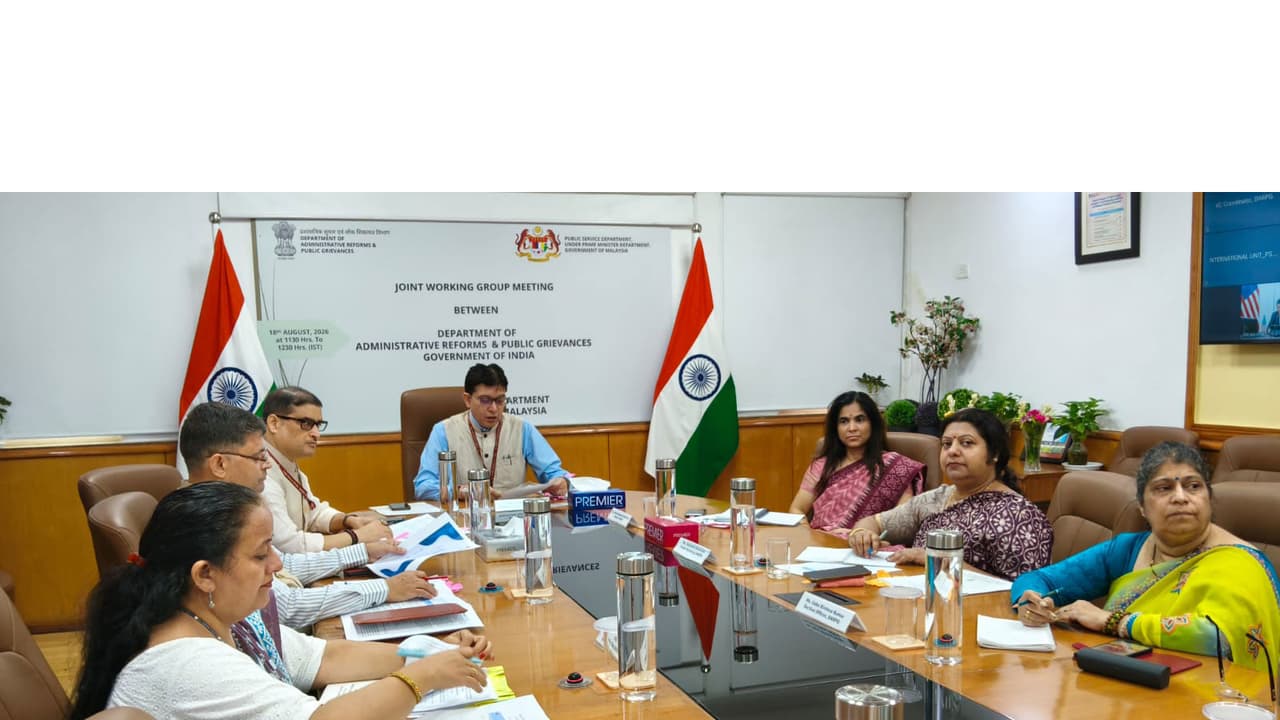
India and Malaysia held their 2nd Joint Working Group meeting on public administration and governance reforms. They reviewed progress, discussed capacity-building programs, and exchanged best practices on digital governance and public service delivery.
The 2nd India-Malaysia Joint Working Group (JWG) Meeting on ‘Cooperation in the Field of Public Administration and Governance Reforms’ was held on August 18, 2026. According to the release, the meeting was co-chaired by Puneet Yadav, Additional Secretary, Department of Administrative Reforms and Public Grievances (DARPG), and Datuk Dr. Mohd Bakhari bin Ismail, Deputy Director General of Public Service (Development), Malaysia. Senior officials from DARPG, Ministry of External Affairs (MEA), including HCI, Kuala Lumpur and the National Centre for Good Governance (NCGG) participated in the meeting from the Indian side.
Bilateral Ties and Strategic Partnership
Welcoming the Malaysian delegation, Puneet Yadav highlighted the long-standing and multifaceted relationship between India and Malaysia, rooted in strong people-to-people ties, shared values and mutual interests. He noted that the bilateral relationship was elevated to a Comprehensive Strategic Partnership in August 2024 and that the visit of Prime Minister Narendra Modi to Malaysia in February 2026 provided further impetus to bilateral cooperation.
Review of Progress
The JWG reviewed progress since its first meeting held on November 13, 2024. The minutes of the inaugural meeting were confirmed and adopted, and Points of Contact from both sides were designated to facilitate coordination and implementation of agreed activities, as per the release.
Cooperation in Capacity Building
The present capacity-building cooperation under the Indian Technical and Economic Cooperation (ITEC) Programme was discussed. The Malaysian side shared positive feedback on the academic modules, institutional and field visits, programme coordination and hospitality extended to participants.
The proposed capacity-building programmes for 2026 and 2027 cohorts were also discussed. The Malaysian side welcomed the proposal to explore specialised programmes for senior Malaysian officials.
Exchange on Governance Reforms and Modernisation
The meeting also witnessed an exchange of experiences on public sector Modernisation and governance reforms. Malaysia shared its approach to public sector transformation based on People, Process and Technology, with innovation as a key enabler. Discussions covered digital government, Artificial Intelligence, cloud services, shared digital infrastructure, cybersecurity, blockchain, data-driven decision-making and connected government, with emphasis on delivering simpler, faster and more citizen-centric public services.
India’s Citizen-Centric Initiatives
The Indian side shared Centralised Redressal of the Citizens’ Grievance under the Centralised Public Grievance Redressal and Monitoring System (CPGRAMS), the world’s largest 24×7 digital citizen interface platform for Grievance Redressal. Samadhan Didi represents DARPG’s efforts to leverage Artificial Intelligence and emerging technologies for more responsive, transparent and citizen-centric governance.
The AI-enabled voice chatbot ‘Samadhan Didi’, launched on May 30, 2026, makes CPGRAMS more accessible, multilingual and citizen-centric. The chatbot uses conversational AI to provide quick, simple and user-friendly responses to citizens.
Future Strategic Roadmap
The Malaysian side presented the Action Plan for the Malaysia-India Governance Partnership: 2027-2029 Strategic Roadmap, which was discussed, thereby laying the Governance & Implementation Framework and creating a three-year roadmap for implementation of areas under the MoU. The Malaysian side appreciated the support extended by DARPG, NCGG and the High Commission of India.
Both sides welcomed the exchange of experiences and best practices and agreed to identify concrete, practical and outcome-oriented areas of cooperation. The meeting concluded with a shared commitment to deepen institutional engagement, knowledge sharing and capacity building, with the objective of strengthening public institutions, improving public service delivery and enhancing citizen experience. (ANI)
(Except for the headline, this story has not been edited by Asianetnews Editorial staff and is published from a syndicated feed.)