India and Japan unveiled a broad roadmap to boost defence ties, focusing on a free and open Indo-Pacific. Key outcomes include a maritime security pact, joint shipbuilding, tech cooperation, and expanded military exercises.
From a new maritime security pact and greater naval coordination to defence technology cooperation, joint shipbuilding and the expansion of the Indo-Pacific Logistics Network, India and Japan on Thursday unveiled a broad roadmap to take their defence partnership into new domains, with a focus on a free and open Indo-Pacific.
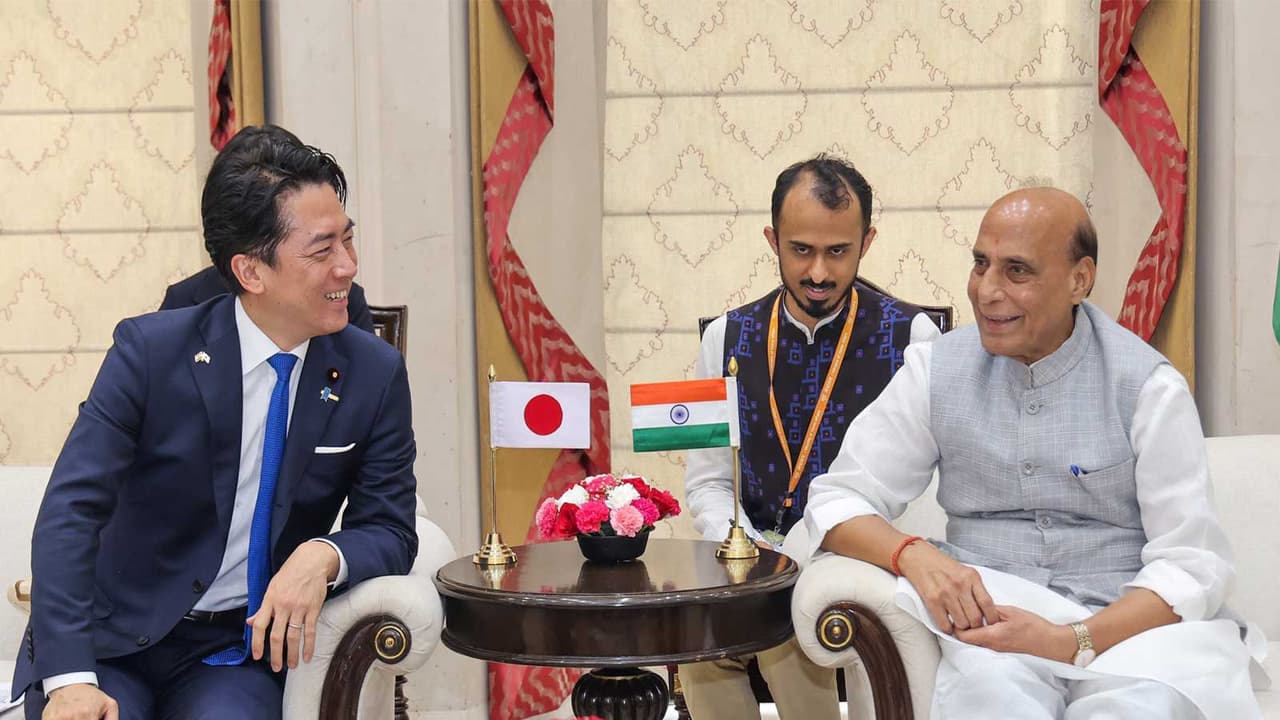
The developments came during Japanese Defence Minister Shinjiro Koizumi’s two-day maiden visit to India and his meeting with Prime Minister Narendra Modi and Defence Minister Rajnath Singh in the national capital. The two defence ministers held the Japan-India Defence Ministers’ Meeting and reaffirmed their commitment to further deepen defence cooperation under the Japan-India Special Strategic and Global Partnership.
Deepening Maritime and Naval Ties
A key outcome of the meeting was the signing of a Memorandum of Arrangement on Maritime Security Cooperation, which provides a framework for closer cooperation between the Indian Navy and the Japan Maritime Self-Defense Force. The agreement envisages greater information sharing in Maritime Domain Awareness (MDA) and enhanced cooperation in Search and Rescue (SAR) as well as Humanitarian Assistance and Disaster Relief (HADR).
India and Japan also agreed to strengthen coordination for protecting Sea Lines of Communication through naval ship visits, joint exercises, personnel and subject-matter expert exchanges and logistical support, including the use of ports and maintenance and repair facilities.
The two ministers also agreed to explore joint development in naval shipbuilding and design, leveraging Japan’s technological expertise and India’s production capabilities. Discussions also continued on Japan’s use of Indian production capabilities under the ‘Make in India’ framework, while both sides work towards reciprocal provision of ship repair facilities.
Enhanced Military Exercises and Exchanges
The meeting also gave fresh impetus to bilateral military exercises. India and Japan welcomed the continued expansion of Dharma Guardian and JAIMEX, while noting progress towards Veer Guardian 26, under which Japanese Air Self-Defence Force fighter aircraft will visit India and participate in the exercise for the first time.
The two sides also agreed to increase the complexity of exercises, integrate unmanned systems and explore joint exercises at short notice. Cooperation among the armed forces will also be expanded through exchanges between the two countries’ Special Operations Forces, while Japan and India will explore cooperation with India’s integrated theatre commands following their establishment.
Defence Equipment and Technology Partnership
The two sides also discussed defence equipment and technology cooperation, with particular focus on the shipborne UNICORN integrated communications antenna system. The project is the first defence equipment transfer project between India and Japan and has been described by both sides as a symbol of their deepening defence technology partnership.
India’s DRDO and Japan’s ATLA will deepen cooperation in advanced defence technologies and research and development, while the two countries also agreed to convene a Defence Industry Forum, as per the joint press statement.
Expanding Cooperation in the Indo-Pacific
The partnership is also expanding beyond bilateral cooperation. India, Japan and Indonesia conducted their first trilateral naval PASSEX exercise in February this year, and the two ministers agreed to deepen cooperation with third countries through high-level exchanges, exercises and other initiatives aimed at contributing to peace and stability in the Indo-Pacific.
Another focus area is the Indo-Pacific Logistics Network (IPLN), through which India and Japan will work to support partner countries during natural disasters by transporting personnel and supplies. The two sides welcomed plans for the second IPLN tabletop exercise, scheduled to be held at Japan’s Ministry of Defence in September.
New Delhi and Tokyo also expressed strong opposition to unilateral actions that impede the freedom and safety of navigation and overflight, as well as attempts to change the status quo through force or coercion. The two sides agreed on the importance of sharing assessments of the regional and international security environment amid heightened global tensions. The ministers further agreed to accelerate discussions towards convening the Fourth India-Japan Foreign and Defence Ministerial Meeting, or ‘2+2’, in Tokyo later this year. They also agreed to establish a Working Group headed at the Director-General/Joint Secretary level to coordinate cooperation across operational, intelligence, equipment, technology and industrial domains and accelerate implementation of decisions taken by the two ministers.
Koizumi’s Meeting with PM Modi
During his visit, Koizumi also called on Prime Minister Narendra Modi here. PM Modi recalled his discussions with Japanese Prime Minister Sanae Takaichi during her recent visit to India for the 16th India-Japan Annual Summit in July and appreciated the steady momentum in defence cooperation between the two countries.
The Prime Minister also outlined his vision for further strengthening the Special Strategic and Global Partnership and highlighted the importance of India-Japan defence and security cooperation in promoting peace, stability and prosperity in the Indo-Pacific and beyond.
The Prime Minister also highlighted opportunities for Japanese companies to partner with Indian companies and start-ups in the defence sector, particularly in co-development and co-production under the ‘Make in India’ framework. Koizumi briefed PM Modi on progress in bilateral defence cooperation and reaffirmed Japan’s continued commitment to deepening defence ties.
“Pleased to receive the Defence Minister of Japan, Shinjiro Koizumi. Had an excellent conversation on deepening defence and security ties between India and Japan. Our Special Strategic and Global Partnership is an important anchor for peace, stability and prosperity in the Indo-Pacific and beyond,” the Prime Minister said in a post on X.
Japanese Minister’s Engagements in India
Koizumi arrived in India on Wednesday for his maiden official visit, beginning a two-day programme focused on strengthening defence ties and advancing maritime security cooperation. Before his meeting with Singh, he visited the Western Naval Command in Mumbai, where he held discussions with Chief of the Naval Staff Admiral Krishna Swaminathan and Flag Officer Commanding-in-Chief, Western Naval Command Vice Admiral Sanjay Vatsayan.
He was briefed on the Indian Navy’s roles, responsibilities and operational capabilities. At the Western Naval Command, Koizumi inspected a Guard of Honour, laid a wreath at the Gaurav Stambh at the Naval Dockyard, and visited the indigenous Indian Navy warship INS Chennai.
In New Delhi, prior to his meeting with Rajnath Singh, Koizumi paid homage to India’s fallen heroes by laying a wreath at the National War Memorial and received a ceremonial Tri-Service Guard of Honour.
The visit, coming weeks after Japanese Prime Minister Sanae Takaichi’s India visit for the annual summit with PM Modi, underscores the growing momentum in the India-Japan strategic and defence partnership, with both countries seeking to expand cooperation from traditional military exercises to maritime security, defence manufacturing, technology, logistics and wider Indo-Pacific coordination.
(Except for the headline, this story has not been edited by Asianet Newsable English staff and is published from a syndicated feed.)