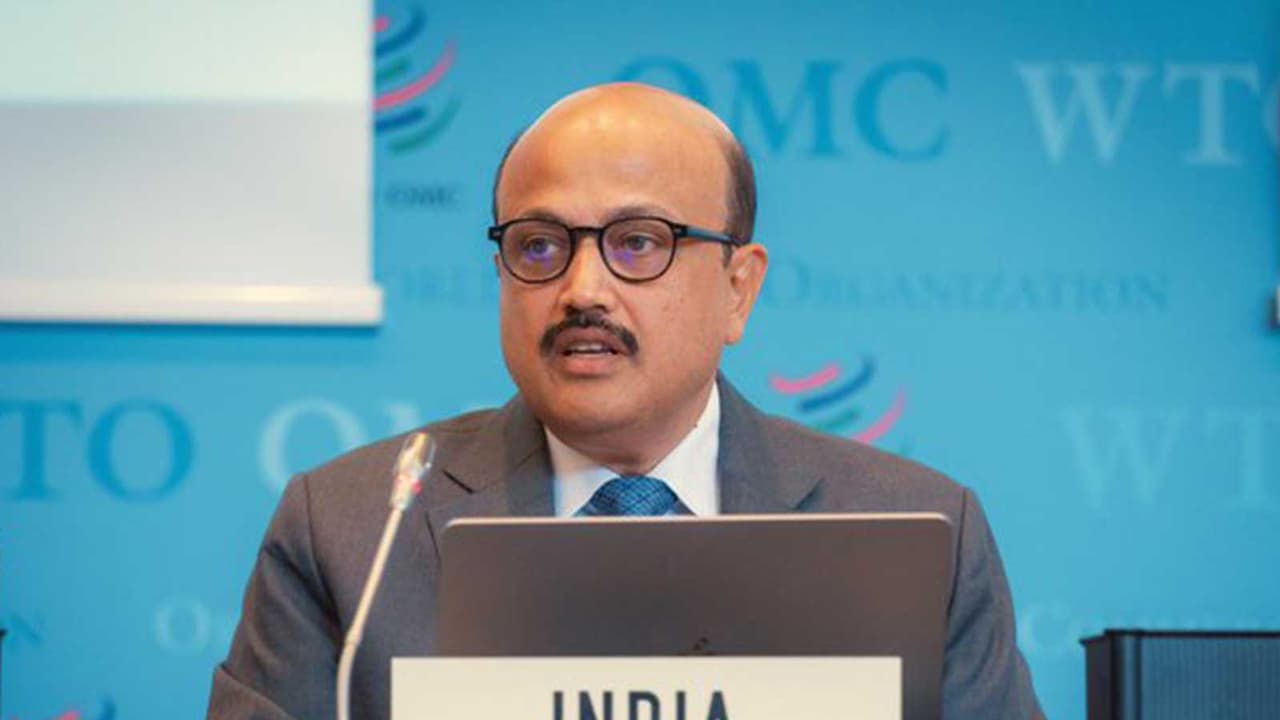
India concluded its eighth Trade Policy Review at the WTO, defending its PLI schemes and Quality Control Orders. Commerce Secretary Rajesh Agarwal said the policies are WTO-consistent and balance the developmental needs of a large developing economy.
India concluded its eighth Trade Policy Review (TPR) at the World Trade Organization (WTO), with member countries seeking clarifications on issues ranging from production-linked incentive (PLI) schemes and Quality Control Orders (QCOs) to trade remedies, while India defended its policies as being consistent with WTO rules and the needs of a developing economy.
According to a Ministry of Commerce and Industry release, the two review sessions held on July 21 and 23 saw participation from 68 WTO members, reflecting strong global interest in India’s trade policies and economic transformation. During the review, India received 1,094 written questions from 44 WTO members, while 68 members made interventions covering India’s trade and investment policies.
India Defends its Trade and Tariff Policies
Responding to the issues raised, Commerce Secretary Rajesh Agarwal said India’s trade policies are guided by “WTO-consistent principles while balancing the developmental needs of a large developing economy.” He said India’s agricultural tariff structure is designed “to safeguard the livelihoods of millions of small, low-income and resource-poor farmers, ensuring fairness and equity,” while industrial tariffs support “supply chain resilience, diversification and domestic manufacturing capabilities in an evolving global economic environment.”
Response on Technical Regulations and Trade Remedies
On questions related to sanitary and phytosanitary measures, technical regulations and trade remedies, Agarwal said India remains committed to transparency and adherence to WTO rules. He said India’s Quality Control Orders “are intended to achieve legitimate public policy objectives,” while trade remedy investigations are conducted “transparently, based on objective evidence, due process and judicial oversight.” The Commerce Secretary added that “the overall trade coverage of India’s trade remedy measures remains limited” and that India continues to apply the Lesser Duty Rule in its anti-dumping framework.
WTO Members Appreciate India’s Reforms
The release said several WTO members appreciated India’s engagement with the multilateral trading system and highlighted the country’s progress in Digital Public Infrastructure, customs and trade facilitation reforms, innovation and startup initiatives, expansion of regional trade agreements, and efforts to integrate MSMEs into global value chains. Members also welcomed India’s acceptance of the WTO Agreement on Fisheries Subsidies.
India’s Broader Trade Policy Approach
Reaffirming India’s broader trade policy approach, Agarwal said the country remains committed to “an open, transparent and predictable trade and investment regime.” He added that tariff reforms, customs simplification measures and India’s free trade agreement strategy have strengthened integration with the global economy while supporting domestic development objectives.
Commitment to WTO Reform
On WTO reform, Agarwal reiterated India’s commitment to “an open, inclusive, transparent and rules-based multilateral trading system,” adding that reforms should “remain development-oriented, preserve policy space for developing countries, strengthen the Organization’s credibility and deliver on existing mandates.”
The review concluded with India reaffirming its commitment to transparency, dialogue and constructive engagement at the WTO, while WTO members acknowledged the country’s growing role in the global trading system and expressed expectations that it would continue contributing to strengthening the rules-based multilateral trading framework. (ANI)
(Except for the headline, this story has not been edited by Asianetnews Editorial staff and is published from a syndicated feed.)