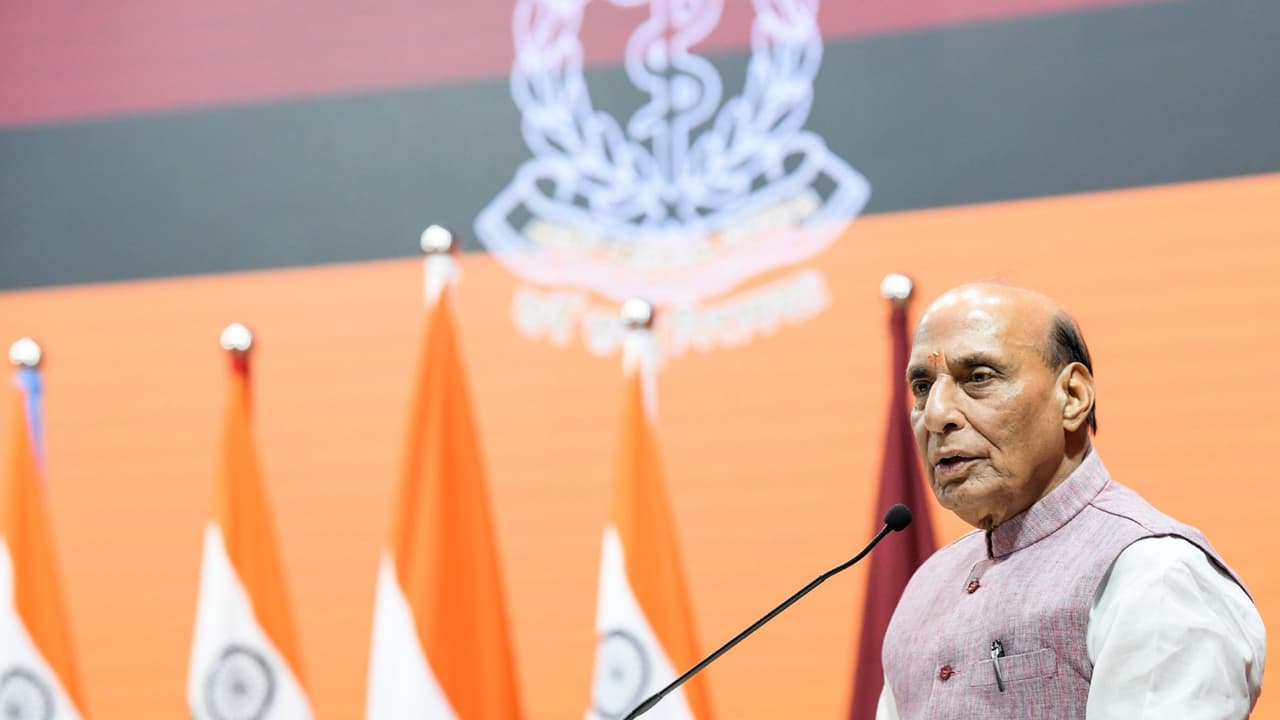
The Defence Acquisition Council, chaired by Defence Minister Rajnath Singh, has granted Acceptance of Necessity (AoN) for defence procurement proposals worth about ₹52,000 crore. The approvals cover advanced systems for the Army, Navy and Air Force, including anti-drone technology, missiles, naval drones and high-altitude pseudo satellites.
New Delhi: Defence Minister Rajnath Singh-chaired Defence Acquisition Council (DAC) on Friday granted in-principle clearance to a set of capital acquisition proposals worth an estimated Rs 52,000 crore, intended to strengthen the army, navy and air force. An AoN is the first formal step for the defence procurement process. It clears a proposal to proceed to subsequent stages, including technical evaluation, trials and price negotiations with vendors, but it does not amount to a signed contract.
Scroll to load tweet…
Approvals for ,Indian Army
For the army, approval was given for six systems. Among them is an anti-drone electronic warfare system named Akash Tarang, intended to protect army formations from unmanned aerial threats, and Man Portable Anti-Tank Guided Missile (MPATGM) systems, meant to help infantry counter enemy armour.
The council also cleared the Medium Range Surface-to-Air Missile (MRSAM) weapon system, for defence against aerial threats at medium range, and the Very Short Range Air Defence System (V-SHORADS), which uses multi-spectral sensors to improve resistance to enemy countermeasures. Rounding off the army’s list are an active protection system for tanks, designed to intercept incoming projectiles before they strike, and a jet-based kamikaze drone system, a loitering munition intended to combine electronic warfare capability with lower running costs than comparable systems.
Approvals for ,Indian Navy
For the navy, the DAC approved procurement of a Multi Influence Ground Mine (MIGM), a sea mine designed to restrict the movement of adversary vessels, and a Naval Shipborne Unmanned Aerial System (NSUAS), fitted with sensors to improve situational awareness at sea.
It also cleared the setting up of a Land Based Testing Facility (LBTF) for electric propulsion systems, to test motors and associated propulsion equipment meant for naval vessels.
Approvals for ,Indian Air Force
For the air force, approval was accorded for a Fixed-Wing High Altitude Pseudo Satellite (FW-HAPS), among other proposals. HAPS are solar-powered, high-endurance unmanned aircraft that operate in the stratosphere, typically 18 to 20km above the earth, and can remain airborne for extended periods, offering satellite-like surveillance and communication coverage at a fraction of the cost of an actual satellite.
According to the defence ministry, the platform is meant to be used for persistent intelligence, surveillance and reconnaissance, as well as telecommunication and remote sensing.
Friday’s clearance is one of several such approvals the DAC has made this year. In August 2025, the council cleared proposals worth about Rs 67,000 crore, including compact autonomous surface craft and BrahMos fire-control systems for the navy.
The ministry has said that in the 2025-26 financial year, the DAC granted AoN for 55 proposals worth a cumulative Rs 6.73 lakh crore, while capital procurement contracts worth Rs 2.28 lakh crore were signed in the same period, the highest for any financial year on record.