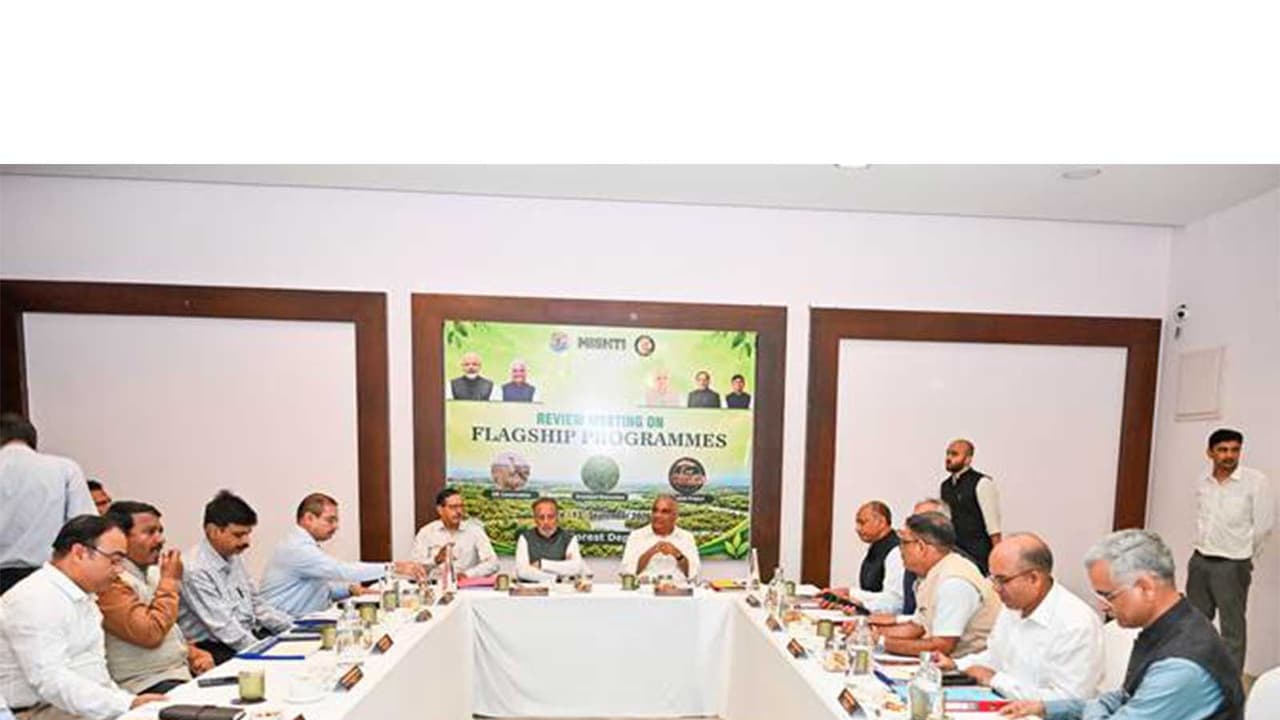
Union Minister Bhupender Yadav chaired a review meeting in Bhuj, Gujarat, on the Great Indian Bustard, grassland restoration, and Project Cheetah. He stressed a shift to landscape-level conservation and released the Gujarat Action Plan for GIB.
Union Minister for Environment, Forest and Climate Change, Bhupender Yadav, today chaired a Review Meeting of Flagship Programmes at Bhuj, Kachchh (Gujarat), covering the conservation status of the Great Indian Bustard, grassland restoration and Project Cheetah. The Review Meeting was also attended by Arjun Modhwadia, Cabinet Minister for Forest and Environment, Climate Change and Science & Technology, Government of Gujarat. Senior officials of the Union Ministry of Environment, Forest and Climate Change, the Gujarat Forest Department, the Wildlife Institute of India, and the National Tiger Conservation Authority were also present.
Shift to Landscape-Level Conservation
According to the Ministry of Environment, Forest and Climate Change, “On the occasion, the Union Minister emphasised that conservation must move beyond individual species to the restoration of entire landscapes, combining scientific management, habitat restoration and community participation, and said India is working towards becoming a global benchmark in landscape-level conservation.”
Gujarat Action Plan for GIB Conservation
Yadav highlighted renewed efforts to conserve the Critically Endangered Great Indian Bustard (GIB) in Gujarat, where, he noted, Kachchh supports an important but small and isolated population. Releasing the Gujarat Action Plan for GIB Conservation, prepared by the Wildlife Institute of India in collaboration with the Gujarat Forest Department, the Minister said it provides a science-based roadmap to establish a minimum viable population of over 30 birds and secure 200–500 sq. km. of safe, contiguous habitat. He added that the immediate focus is on the approximately 200 sq. km. Lala–Rawa landscape, with interventions including habitat restoration, grazing management, invasive species removal, predator management and mitigation of infrastructure-related threats.
On-Ground Action and Habitat Restoration
Yadav informed that significant on-ground action has already been undertaken to secure this population. He noted that in Naliya, around 11 sq. km. of grassland infested with the invasive Prosopis juliflora has been restored, and the enclosure secured with 30 km of predator-proof fencing covering 15 sq. km., alongside targeted management of nest predators.
Yadav further emphasised that GIB conservation is ultimately the conservation of Kachchh’s open natural ecosystems, which, he said, also support the lesser florican, chinkara, desert cats, raptors, vultures and other specialised wildlife. (ANI)
(Except for the headline, this story has not been edited by Asianet Newsable English staff and is published from a syndicated feed.)