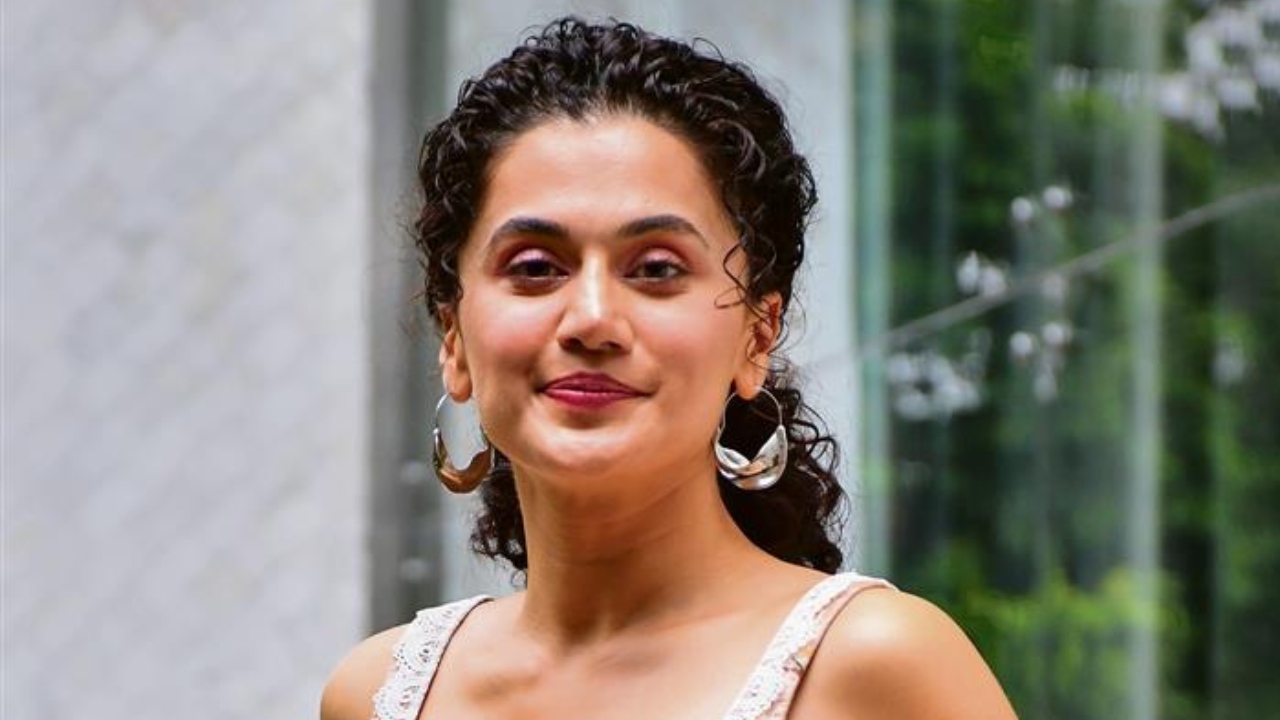
Actor Taapsee Pannu has consistently broken the template of the conventional Bollywood heroine. From Pink to Thappad, she has built a repertoire of women defined by their resilience rather than their need for rescue. In her latest outing, Gandhari, Taapsee pushes this boundary further, delivering a raw, survival-driven performance that blurs the line between physical combat and emotional vulnerability. In this conversation, the actor reflects on her collaboration with writer-producer Kanika Dhillon, how early criticisms about her looks ultimately shaped her journey, and about navigating an unpredictable industry.
Gandhari is your fourth collaboration with Kanika, after Manmarziyaan, Haseen Dillruba, and Phir Aayi Haseen Dillruba. What does a creative shorthand let you do on set that you couldn’t with another writer?
Actually, this is my sixth collaboration with Kanika, because apart from Manmarziyaan and Haseen Dillruba and Phir Aayi Haseen Dillruba, she had also written dialogues and additional screenplay for Rashmi Rocket and Dunki. And what really helps is because we know each other at a personal level very well, so it helps her push me to newer limits, and it also gives me confidence that she knows how to make me do certain things which are new and different, and make sure it works on screen. So, that comfort we have with each other, that Kanika feels she can always throw an oddball challenge, something that is very out-of-the-box kind of a situation, story or a character, and I will grab it.
Gandhari sits in a space between action and raw emotional drama. How do you personally draw the line between physical performance and emotional truth when a scene demands both at once?
There is no line to draw actually, and that’s when it gets messy, and that’s when that mess is shown on camera very raw and authentically is what I think works. Because too much of finesse in action would have made this look fake, would have made it look like very designed. It had to look messy because it is not really designed kind of an action. It should look like someone who is just there for survival, and not on a mission as per se, and with no kind of arms and ammunition.
So, it has to have an emotionally driven action sequence. It had to look messy. So, I think that was exactly the idea to not to keep any sharp line between that emotional force and the physical action. And that makes the action a little more challenging because you are constantly worried about your face in terms of how you are depicting that emotion and not just reacting to the action.
You’ve often picked characters defined by resilience rather than rescue—Pink, Thappad, and now Gandhari. Is that a conscious pattern, or do it just keep finding you?
I think it’s a snowball effect. When you do certain films which have that fighting-back feeling of the character or the takeaway feeling from the film, then people want to come back to you with something similar. The good thing is that I got to probably try a lot of variations of this someone who can come to her own rescue kind of a character. I have tried all shades and means and methods of doing that. I really hope now someone gives me something which is beyond conventional for me now.
From being told early on that your look didn’t fit the conventional heroine mould to becoming one of the industry’s most consistent performers, what part of that journey still shapes the choices you make today?
It’s still the same. I still keep hearing this that I don’t have that angel descended from heaven kind of a look. Hence, I’m not appropriate to be the conventional heroine. So, I had to find my version of the heroine and stick to it. And the only way to survive for me was to consistently keep giving good performances. At least give my best regardless of what kind of film it is, because there’s only so much in my capacity.
That’s the unfairness of my job that, this is a team sport, but I can only control how I work. So, I do try to do that to the best of my ability, and hoping that the remaining cast and crew do their best as well, and then hoping audience plays their part because they are all so equally responsible in this team sport to make sure they watch such films, to encourage this these films.
Only then these kinds of films will be made where we can actually challenge our very obvious decisions, like in the sense like we know what’s going to happen next in most of the films, or what eventually they’re going to do or say or show in the film. Every film cannot be this obvious, and it’ll happen only when you start liking films that don’t show you the obvious.
Finally, how do you look back and define your journey?
It’s been a very go-by-the-day kind of a journey. I’ve never had a very solidified plan, and I’ve come to terms with that now because life is what happens when you’re busy making plans. So, whenever I’ve tried to even make a plan, “Okay, this is going to be my plan for the next one or two years that I’m going to do this film, that film, and that film,” something or the other has gone wrong, and my entire plan has come crashing down.
So, now I’ve stopped making plans. I have tried to understand that I need to just make most of the opportunities I get. So, I need to just choose the best out of the options that I have, because that’s the only thing that’s in my control, and decide if I want to do a film basis if it really makes me happy. God has been really kind, I feel. It’s not like I need to earn money for survival right now. Thankfully, I’ve crossed that stage where it’s not like I have to constantly keep working to run my kitchen. So, now I can afford to have breaks if I don’t like something.
So, I just need to stick to what I really enjoy doing and would want to be associated without thinking about, you know, I need to get a certain salary back home or I need to be constantly seen in the market. So, these are not the reasons for me to work anymore. So, that is quite a privilege, I feel, and it took me 15–16 years to earn that privilege, and I think it’s time that I start enjoying that privilege a little bit.