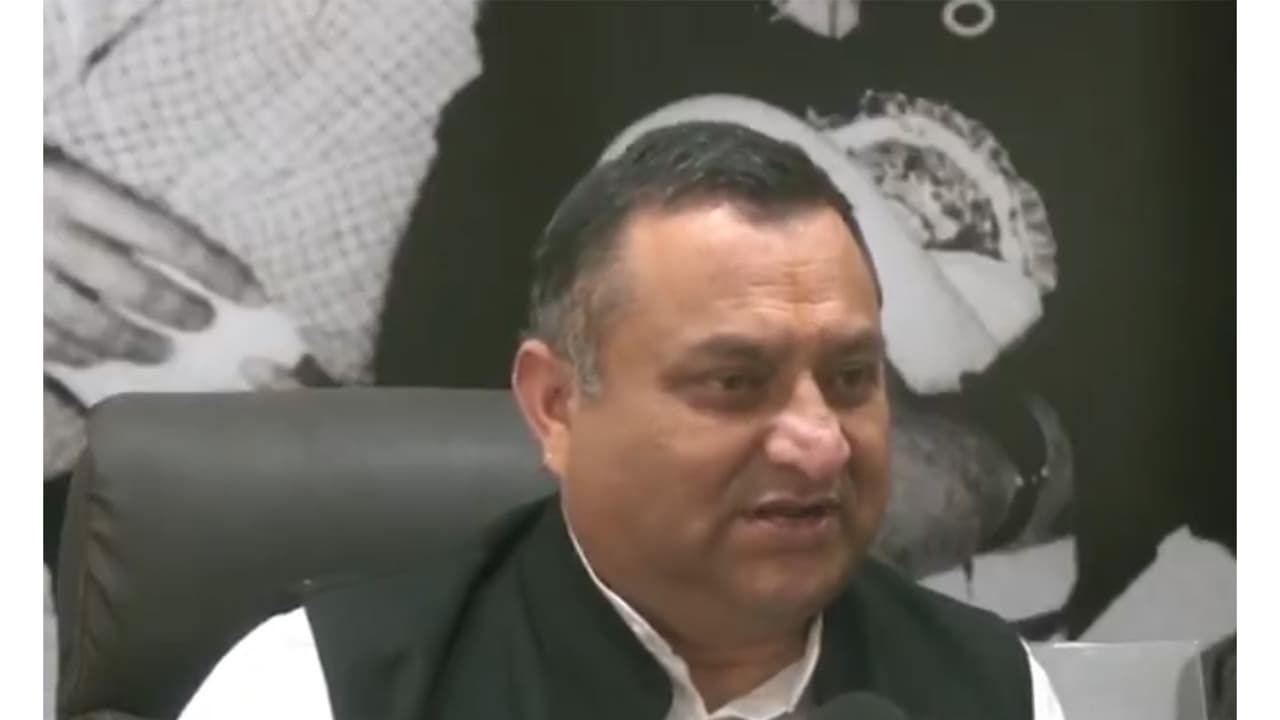
HP Congress chief Vinay Kumar announced a ‘red zone’ for non-performing officials who will be removed. This follows a training camp with Rahul Gandhi to rebuild the party’s grassroots strength and introduce a performance-based system.
Himachal Pradesh Congress Committee (HPCC) president Vinay Kumar on Saturday said that any block president or party functionary falling into the “red zone” due to non-performance will be removed from the post, stressing that active workers will be given priority, as he highlighted outcomes of the recently concluded 10-day district presidents’ training camp in which party leader Rahul Gandhi also spoke.
Vinay Kumar said the party in the state has categorised a performance model based on colours ‘Green’, ‘Yellow ‘ and ‘Red’. It will decide the performance and also the format for attending the meetings of the party.
Rebuilding Grassroots Strength
Speaking with ANI in Shimla after returning from Kangra, Kumar said the training programme organised under the ‘Sangathan Srijan’ initiative for district presidents from three states of Himachal Pradesh, Jammu and Kashmir and Punjab was aimed at rebuilding the Congress’ grassroots strength and addressing organisational weaknesses. “The core objective was to understand why Congress, which once had a strong nationwide presence, has weakened in certain regions and how we can reconnect with people at the grassroots,” Kumar said.
Practical Exposure and Village Engagement
He added that the camp focused on taking leaders out of conventional settings and placing them directly in village environments. According to Kumar, participants were trained to engage closely with rural communities, understand their daily lives, food habits and economic challenges, and gather feedback on governance. “Leaders were asked to go to villages, interact with people, understand their needs, and assess whether government schemes are reaching them. We also discussed gaps and shortcomings,” he said.
In a bid to sensitise leaders, the programme included practical exposure, such as working under MGNREGA for several hours. “This was to ensure that leaders understand the pain and struggles of workers earning low wages. Experiencing this firsthand changes perspective,” he said.
Rahul Gandhi’s Direct Engagement
Kumar said Rahul Gandhi held multiple interactive sessions lasting several hours, during which he encouraged open discussions on organisational challenges. “He asked district presidents what they think are the reasons behind the party lagging and what solutions they propose. He emphasised that district presidents are the frontline force directly connected to him and the party and must take responsibility for strengthening Congress at the grassroots,” Kumar said.
He added that Gandhi also interacted informally with participants, including their families, to better understand their social backgrounds and challenges. “In Kangra district, three state district presidents attended a training programme organised through the organisation region, led by Sachin Rao, who stayed at the camp for all ten days. All district presidents were kept together. The purpose was to understand why Congress, once winning thumping majorities nationwide, has been declining. Training included Q&A sessions, village visits to learn people’s needs, shortcomings in government response, and even experiencing village life — eating local food and working under MGNREGA for three hours to understand the hardship of labourers,” he said. “At the end, Rahul Gandhi held a 2-3 hour session, explaining why Congress is trailing and what is needed to strengthen it. He empowered district presidents directly, calling them his “army” to strengthen Congress in the field. He gave tips, asked questions, and later met their families, sharing meals and time with them,” he added.
Future Organisational Strategy
Outlining the next steps, Kumar said the Congress will replicate similar exercises at the block level across Himachal Pradesh and build a micro-level organisational structure. “We are moving from district to block, then to panchayat, village and booth levels. We will also appoint ‘page in-charges’ for voter lists to ensure direct contact with voters,” he said.
Micro-Level Voter Outreach
He explained that, unlike the BJP’s “panna pramukh” model, the Congress will adopt a modified approach with separate in-charges for different sections of voter lists to ensure deeper engagement. A page pramukh, the Prisht Pramukh for each page of the voters’ list.
Decentralised Meetings for Better Feedback
Kumar said the party has already begun reorganising its structure by holding region-wise meetings of block presidents instead of centralised meetings in Shimla. “Earlier, many leaders did not get a chance to speak. Now, smaller, decentralised meetings are allowing detailed discussions and better feedback,” he said.
Performance-Based Accountability
Reiterating the performance-based accountability system, Kumar said leaders would be categorised into green, yellow and red zones. “Those who do not hold meetings, fail to perform or remain inactive will be placed in the red zone and removed. We want only those who work actively for the party,” he said.
Addressing Women’s Representation
Responding to concerns raised by senior Congress leader Viplove Thakur over the lack of women’s representation at the block level, Kumar said no applications were received from women candidates for those posts. “If suitable women are recommended, we are ready to appoint them even as acting presidents. We are committed to increasing women’s participation,” he said.
He added that the party has already ensured 50 per cent reservation for women in urban local bodies and Panchayati Raj institutions and is working to bring more youth into leadership roles.
Upcoming Elections and Party-Government Coordination
On the upcoming Panchayati Raj and urban local body elections, Kumar termed them a “semi-final” ahead of the 2027 Assembly polls but clarified that the training programme itself was not directly linked to these elections. “These elections are important, and we are fully prepared. Candidate selection is underway, and we will contest with full strength,” he said.
He also stressed the importance of coordination between the party organisation and the government, advocating the principle of “one person, one post” to ensure wider participation. “Those holding positions in the government should not simultaneously hold organisational posts, so that more workers get opportunities,” he said.
Kumar further said the Congress will take its message to the grassroots, including issues related to central policies, alleging that certain welfare schemes introduced by previous Congress governments have been weakened. He expressed confidence that the Congress will perform strongly in Himachal Pradesh and other states, stating that the organisational revamp and grassroots outreach will help the party regain its strength.
(Except for the headline, this story has not been edited by Asianet Newsable English staff and is published from a syndicated feed.)