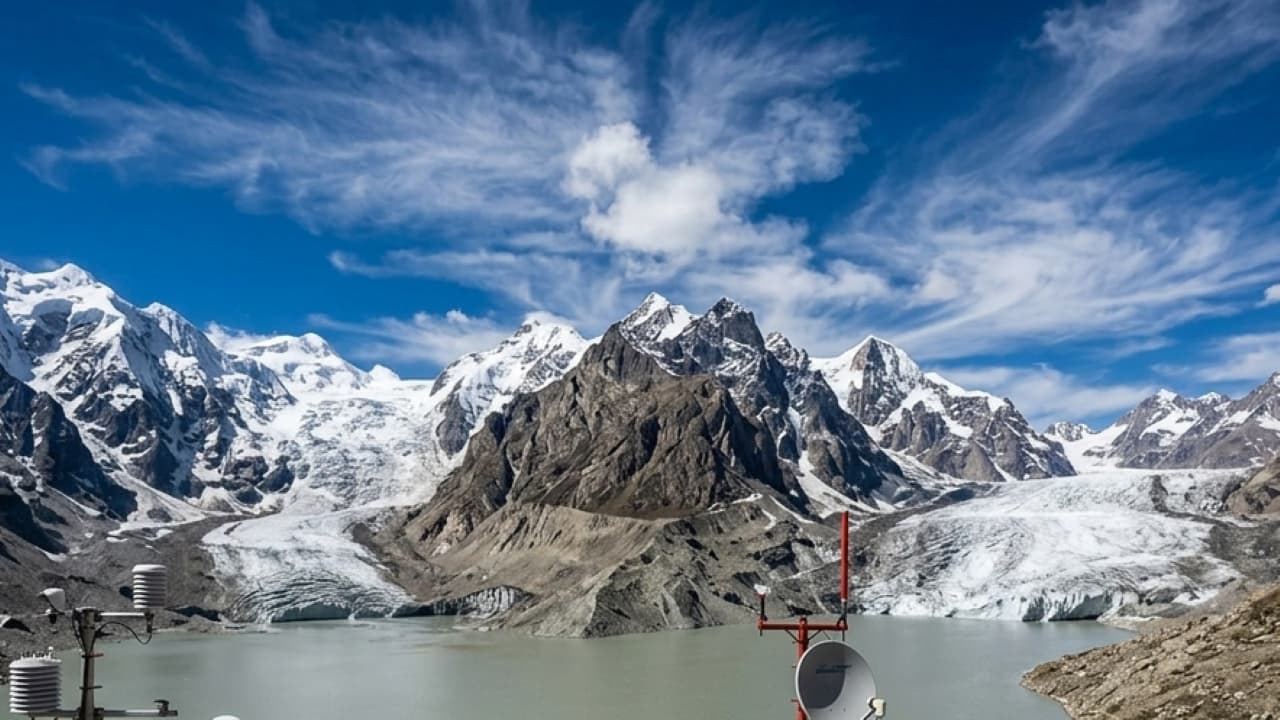
A new report warns the Himalayas are changing faster than expected, with glacier retreat, expanding glacial lakes and growing disaster risks putting water security, economies and communities under mounting pressure.
The Himalayas, often described as Asia’s water tower, are undergoing rapid environmental change that could have far-reaching consequences for millions of people across India and neighbouring countries.
A new report, Prosperous and Resilient Himalayas, warns that Himalayan glaciers are now losing mass 65 per cent faster than they were a decade ago. The accelerating melt is increasing the risk of floods, landslides, water shortages and infrastructure damage, while raising concerns about long-term economic and ecological stability.
Produced by Systemiq in partnership with the Integrated Mountain Initiative, with technical inputs from the International Centre for Integrated Mountain Development and the G.B. Pant National Institute of Himalayan Environment, the report highlights how climate change and pollution are reshaping one of the world’s most important mountain systems.
The findings show that the Himalayas are no longer facing a future threat. The changes are already underway and affecting communities, ecosystems and economic sectors that depend heavily on snow, ice and mountain water resources.
One of the major drivers identified in the report is black carbon, a soot-like pollutant released from several human activities across South Asia. Researchers estimate that black carbon contributes to roughly one-third of glacier melt in the Himalayan region.
Industries in South Asia, particularly brick kilns, account for 32 to 42 per cent of human-generated black carbon emissions affecting the Himalayas. When soot settles on snow and ice, it darkens the surface and reduces its ability to reflect sunlight. As more heat is absorbed, melting accelerates.
The report argues that while global climate change requires international cooperation, reducing black carbon emissions is an area where regional action can produce faster results.
Growing Lakes, Rising Danger
As glaciers retreat, they leave behind expanding glacial lakes in high-altitude regions. Many of these lakes are restrained by fragile natural barriers made of ice, loose sediment and rocky debris.
When such barriers fail, enormous volumes of water can rush downstream without warning, creating destructive floods capable of damaging settlements, roads, bridges and farmland.
The report points to a recent flood disaster in Nepal that occurred in August 2026, where sudden flooding destroyed homes, damaged infrastructure and affected rural livelihoods.
India faces a similar challenge. Researchers assessed 189 potentially dangerous glacial lakes across the country. Of these, 56 were classified as very high risk.
Communities and infrastructure located downstream remain vulnerable to glacial lake outburst floods, which can occur rapidly and with little warning. The threat extends beyond lakes alone.
The report notes that melting permafrost and increasingly unstable mountain slopes are raising the likelihood of landslides and other mountain hazards. Together, these processes are creating a more unpredictable and dangerous environment across the Himalayan region.
Another concern raised by researchers is the lack of adequate monitoring.
The broader Hindu Kush-Himalayan region contains an estimated 40,000 glaciers. However, only about 0.1 per cent of them are monitored regularly.
This significant monitoring gap limits the ability of scientists and policymakers to accurately assess risks, forecast future changes and provide timely warnings to vulnerable populations.
Without stronger scientific observation, risk mapping and early-warning systems, predicting disasters before they occur will remain difficult.
Water Security And Economic Risks
The consequences of glacier decline are expected to extend far beyond mountain communities.
Glacier-fed river systems support water supplies across South Asia and play a critical role in agriculture, drinking water availability, hydropower generation and industrial activity.
According to the report, many Himalayan river basins are expected to reach what scientists describe as “peak water” around the middle of this century. During this phase, glacier melt temporarily increases river flow. However, as ice reserves continue shrinking, water availability is expected to decline over time.
Researchers warn that up to 80 per cent of the current glacier volume could be at risk by the end of the century if existing trends continue.
Such losses would have implications for food production, urban water systems, energy generation and economic activity across large parts of South Asia.
The Himalayan region itself carries enormous economic importance. Although it represents only around 18 per cent of India’s land area, approximately 35 per cent of the country’s natural disasters are linked to the region.
The report estimates that the Himalayan ecosystem directly and indirectly supports more than 20 per cent of India’s GDP through agriculture, tourism, hydropower and other ecosystem services.
At the same time, mountain states retain only a small portion of the economic value generated from these resources, even as they shoulder much of the responsibility for environmental protection and disaster management.
The report calls for a new development approach centred on glacier protection, sustainable tourism, forest conservation, spring rejuvenation, stronger monitoring systems and disaster resilience.
Researchers argue that the Himalayan challenge cannot be tackled by one country alone. Since glaciers, rivers and climate impacts cross national boundaries, they stress the importance of cross-border monitoring, data sharing, coordinated early-warning systems and joint investments to reduce future risks.