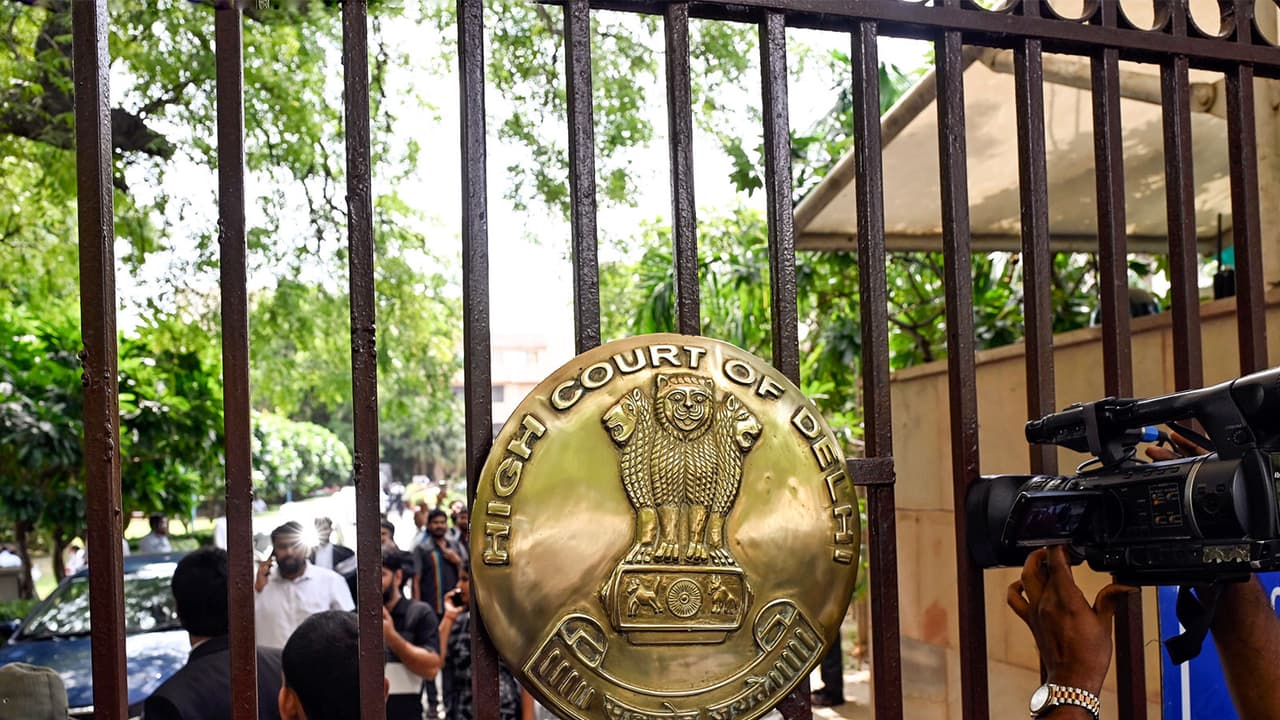
Delhi HC cancels the tender process of visa outsourcing of Ministry of External Affairs in 4 countries. Terming the evaluation as arbitrary, irrational and opaque, the court has directed to issue a fresh tender within a month and complete it soon.
New Delhi [भारत]July 15 (ANI): The Delhi High Court has quashed the technical evaluation process adopted by the Ministry of External Affairs (MEA) for outsourcing of consular, passport and visa (CPV) services at Indian missions in Abu Dhabi (UAE), Kuwait, Singapore and Canberra (Australia). The Court held that this assessment was arbitrary, irrational and opaque.
The Court has directed the Central Government to issue a fresh Request for Proposal (RFP) for all the four missions within a month and make serious efforts to complete the tender process as soon as possible.
Petitioners’ appeal accepted
A division bench of Justices Anil Kshetrapal and Shail Jain allowed the petitions filed by E Travel Tech Limited and Verasys Limited challenging their technical ineligibility in the tender process. The court has also canceled the tender awarded in favor of the successful private bidders. However, to ensure continuity of public services, it has allowed existing service providers to continue operating until the new tender process is completed and new L-1 bidders are selected as per law.
Flaws found in the evaluation process
Holding that the petitioners have made out a case for interference, the bench said that the parameter-wise marks awarded during the technical evaluation were tainted with arbitrariness, irrationality and lack of transparency, making the evaluation untenable under Article 14 of the Constitution.
The Court further said that the Ministry of External Affairs and the respective Indian Missions have violated Rules 173(iv) and 189 of the General Financial Rules, 2017 as well as the provisions of the RFP by failing to record and inform the technical evaluation of the bidders and the reasons for disqualification. The Court said that merely disclosing parameter-wise marks without explaining the basis of deduction or comparative assessment made the decision-making process opaque, arbitrary and contrary to the principles of natural justice and fair administrative action.
The bench said that although the respondents subsequently submitted parameter-wise details of the marks as per the directions of the Supreme Court, they failed to disclose the reasons for awarding such marks or the comparative criteria adopted during the evaluation. As a result, petitioners were left with no means of understanding why their otherwise compliant proposals were deemed deficient.
The Court found discrepancies in the evaluation of similar proposals in different missions. It observed that the same documentary material submitted by the petitioners received significantly different marks under the same criteria without any explanation. It also pointed to instances where bidders received zero marks despite proposing appointment windows and turnaround times that met the standards set under the RFP.
Centre’s objection rejected
Rejecting the Centre’s preliminary objection that the petitions were barred by principles of res judicata, the bench said the present challenge arose out of a new cause of action following the disclosure of the parameter-wise assessment in May 2026. She said that the validity of the assessment could not be challenged earlier because relevant material had not been disclosed at that stage.
Transparency is necessary in tender matters
The Court also held that judicial review in tender cases extends to examining whether the decision-making process is fair, transparent and non-arbitrary, even though courts do not normally sit in appeals on the merits of technical evaluations. It held that the lack of objective standards, comparative benchmarks and recorded reasons undermined the constitutional guarantee of a level playing field in public procurement.
Highlighting the element of public interest, the bench said that E Travel had placed on record a comparative statement showing that it had quoted significantly lower financial bids than the successful bidders in all the four missions. Since this position was not disputed by the defendants, the Court held that arbitrary exclusion of a low bidder directly impacts the public exchequer, making transparency in the technical evaluation all the more necessary. (ANI)
(Except for the headline, this story has not been edited by Asianet News editorial staff and is published from a syndicated feed.)