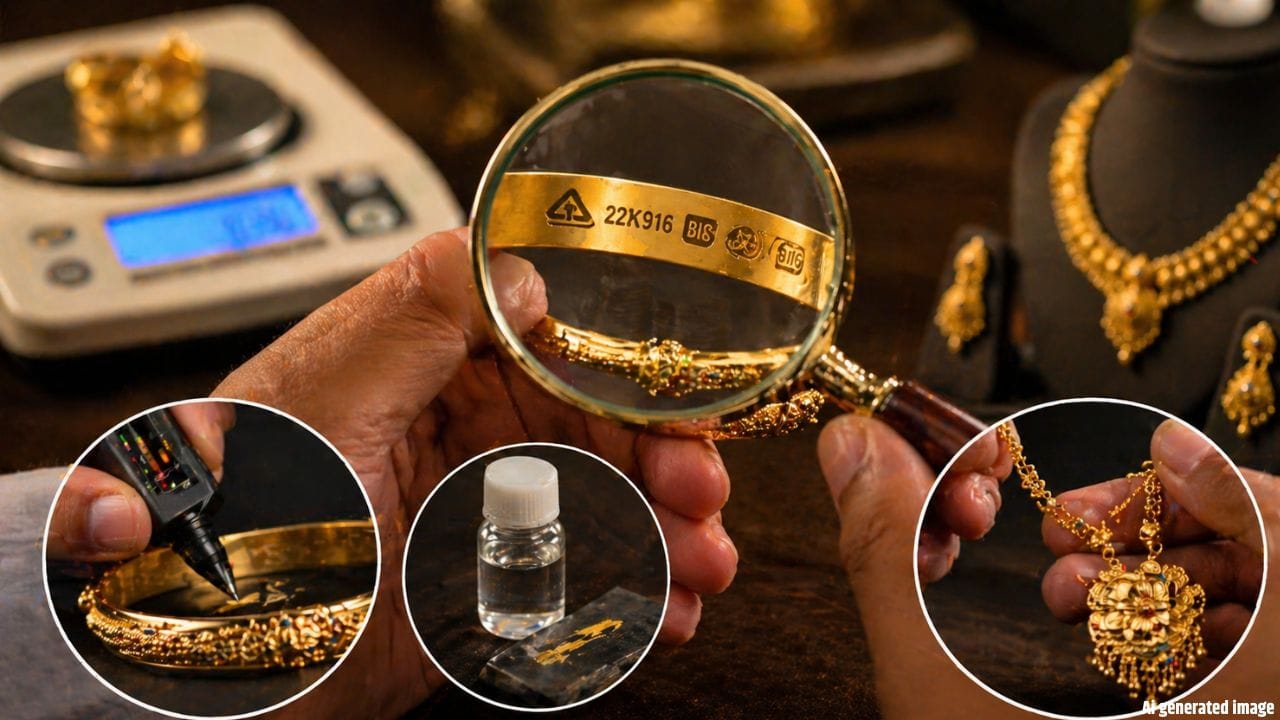
How to recognize fake hallmarks
Buying gold is no less than a big financial investment. When we buy a piece of jewelery after saving every penny for years, the biggest fear that haunts us is its purity. There was a time when another name for trust was the goldsmith’s tongue. After this, the rule of hallmarking came, which gave some legal and mental relief to the customers. But now vicious fraudsters have breached this security cordon as well.
Now fake hallmarked gold is being sold indiscriminately in the market. It is almost impossible for a customer to understand the subtle difference between a genuine and a fake stamp. This big fraud is realized when the time comes to sell or exchange the same jewelery and the gold purchased at the price of 22 carats is tested to be 18 or only 14 carats.
What is the game of fake seal?
In today’s digital age, fraudsters are making full use of technology. Many unauthorized dealers and small traders put such stamps on jewelery through laser printing, which look exactly like the original hallmark. It is very difficult to detect with the naked eye whether the mark engraved on the jewelery meets the government standards or is just an illusion. To save your hard-earned money from this fraud, it is important to know how you can test it yourself.
HUID code is the real ‘horoscope’ of your jewelry
For customer safety and transparency, the government has made it mandatory to register HUID (Hallmark Unique Identification) number on every new jewellery. It is a six-digit alphanumeric code (for example- AZ1234). This only code is the real identity of your gold. To check this, first download ‘BIS Care App’ in your smartphone. As soon as you open the app, you will see an option of ‘Verify HUID’. Enter the six-digit code recorded on your jewelry there. By doing this, complete information about that jewelery will appear on the screen. If no data related to jewelery is visible on the app, then it is a clear sign that you have been handed fake gold.
test with magnet
Although accurate scientific tests like laboratory tests are not possible at home, still some basic and easy methods can save you from major losses. According to metallurgy, gold is a ‘non-magnetic’ metal. This simply means that it is not attracted towards the magnet. If your jewelery is sticking to a magnet when taken close to it, then it is heavily adulterated with cheap metals like iron or nickel.
Identification will also be done by density
Apart from this, density test is an old but quite authentic method. The density of gold is much higher than that of many other metals. This can be estimated at home with a glass of water and an accurate weighing machine. The weight of pure gold exactly fits a specific calculation in proportion to the water it displaces. If you feel that the jewel is lighter than usual in water, then there is room for doubt.
Work will be easier with ceramic plate
Another very easy solution is ceramic plate. Try rubbing the jewelery lightly on a ceramic plate. If a golden line is formed, then the gold is real. At the same time, if this line appears black or dark in color, then it is a sure proof of adulteration.
Also read- Jewelery Insurance: Jewelery is also insured, your gold will be safe at nominal expense!