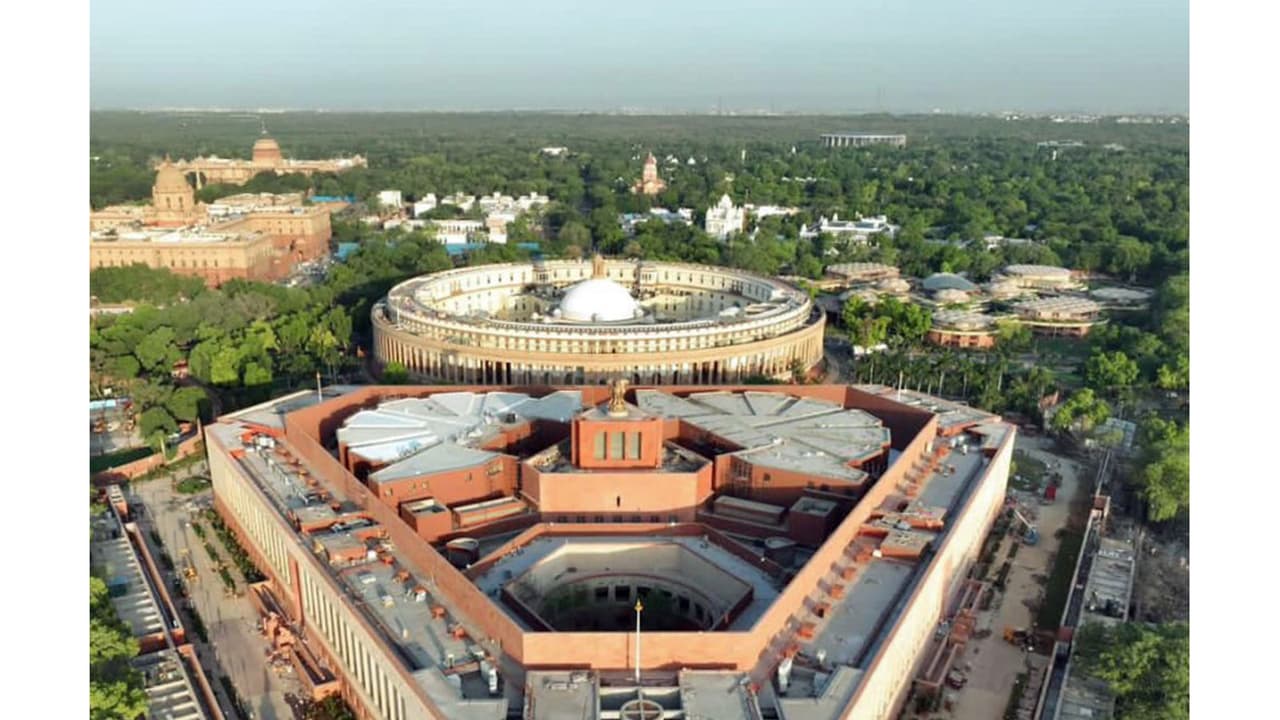
The government passed several bills in Parliament amid an opposition-led stalemate over protests. The Rajya Sabha passed the Tribunals Reforms Bill, 2026, while the controversial FCRA Amendment Bill is expected to be sent to a committee for review.
Govt Pushes Legislative Agenda Amid Stalemate
The government continues to push its legislative agenda even as a stalemate continues in Parliament over the opposition’s demand for a statement from Home Minister Amit Shah on the police action on July 20 against protestors in the national capital.
The Rajya Sabha passed the Tribunals Reforms Bill, 2026 after a brief debate while bills in Lok Sabha continued to be passed without discussion amid opposition sloganeering. Lok Sabha passed the National Co-operative Development Corporation (Amendment) Bill, 2026, which seeks to amend the National Co-operative Development Corporation Act, 1962. It also passed the Kerala (Alteration of Name) Bill, 2026, which alters the name of the state to Keralam.
FCRA Amendment Bill Under Scrutiny
Amid opposition concerns over the FCRA Amendment Bill, it is expected to be sent to a joint parliamentary committee for detailed examination, government sources said on Tuesday. While the opposition parties have expressed their opposition to the bill, Christian groups have also conveyed their concerns about its provisions. The FCRA Amendment Bill seeks to amend the Foreign Contribution (Regulation) Act, 2010, which governs the acceptance and utilisation of foreign contributions by individuals, associations and companies in India. The Bill was introduced in the Lok Sabha on March 25, 2026.
Key Provisions of the Bill
A key provision of the FCRA Amendment Bill is the creation of a Designated Authority to oversee foreign contributions and assets of organisations whose FCRA registration is cancelled, surrendered or ceases to be valid. Under the proposed framework, when an organisation loses its FCRA registration, its foreign contributions and assets would initially vest provisionally with the Designated Authority.
If the organisation restores or renews its registration within the prescribed period, the assets and unused foreign funds would be returned. If the registration is not restored within the stipulated period, the assets could vest permanently with the Designated Authority.
The Bill also introduces a provision for cessation of an FCRA certificate upon expiry, non-renewal or refusal of renewal. This seeks to address the treatment of assets and foreign contributions in cases where an organisation becomes defunct or its registration ceases.
For assets such as places of worship, the proposed framework provides that the Designated Authority must ensure that their religious character is maintained. The Bill also provides for a right of revision and judicial appeal against orders of the Designated Authority.
The proposed legislation further seeks to rationalise penalties, including reducing the maximum imprisonment for violations of the Act from five years to one year. It also proposes that state agencies obtain prior approval from the Central Government before initiating investigations under the FCRA.
Concerns and Assurances
A delegation of Christian and minority organisations had met Union Home Minister Amit Shah to express their concerns and seek changes in the Bill.
Mizoram Chief Minister Lalduhoma also met Shah to present regional concerns and recommendations regarding the legislation. Lalduhoma later said he had raised six issues with Shah and was assured that the proposed amendments would not have retrospective effect.
“The only thing that is very clearly mentioned to us is that it’s not going to be retrospective. That assurance was given to us, and the rest of the points will be given a paragraph-wise comment by him… the discussion on the 12th of this month in Parliament,” Lalduhoma had said.
A delegation led by DMK leader P Wilson had also met Amit Shah and submitted a memorandum, which talked about how the proposed legislation “impacts religious minorities and civil society”.
Govt, Opposition Trade Barbs Over Parliament Deadlock
Parliamentary Affairs Minister Kiren Rijiju on Tuesday said that the government was ready for a debate on students’ protests and the reply will be given by Amit Shah. He accused the opposition parties of stalling proceedings.
“Yesterday, we made an offer that the government is ready for a complete and detailed discussion over everything which happened around the students’ protest. We had the reply ready, and Home Minister Amit Shah was ready too. But they (the opposition) are not letting a discussion happen,” the Union Minister told reporters.
BJP MP PP Chaudhary criticised the opposition. “The Union Home Minister is ready to address the very issue, his statement on which they are disrupting House proceedings, yet the opposition walked out… The entire Monsoon Session has gone to waste… This is a burden on the public, who elect representatives to raise issues and pass bills… It is clear that the Congress has no other agenda than playing politics over our Gen Z…”
NDA leaders accused the opposition parties of “double standards” on students’ protests amid an agitation in Jharkhand. Union Minister Sanjay Seth said that Rahul Gandhi “does not want to hold a discussion in the House”.
“He does not even want to speak about the police brutality that occurred yesterday. Does Rahul Gandhi have no empathy for children? Will he speak on this? He will not speak on it because he is a partner in that system (the Jharkhand government). The public is watching your every move,” the Union Minister said. Congress leader Priyanka Gandhi Vadra said that Rahul Gandhi, who is LoP in Lok Sabha, has already met the protesting students in Jharkhand. (ANI)
(Except for the headline, this story has not been edited by Asianet Newsable English staff and is published from a syndicated feed.)