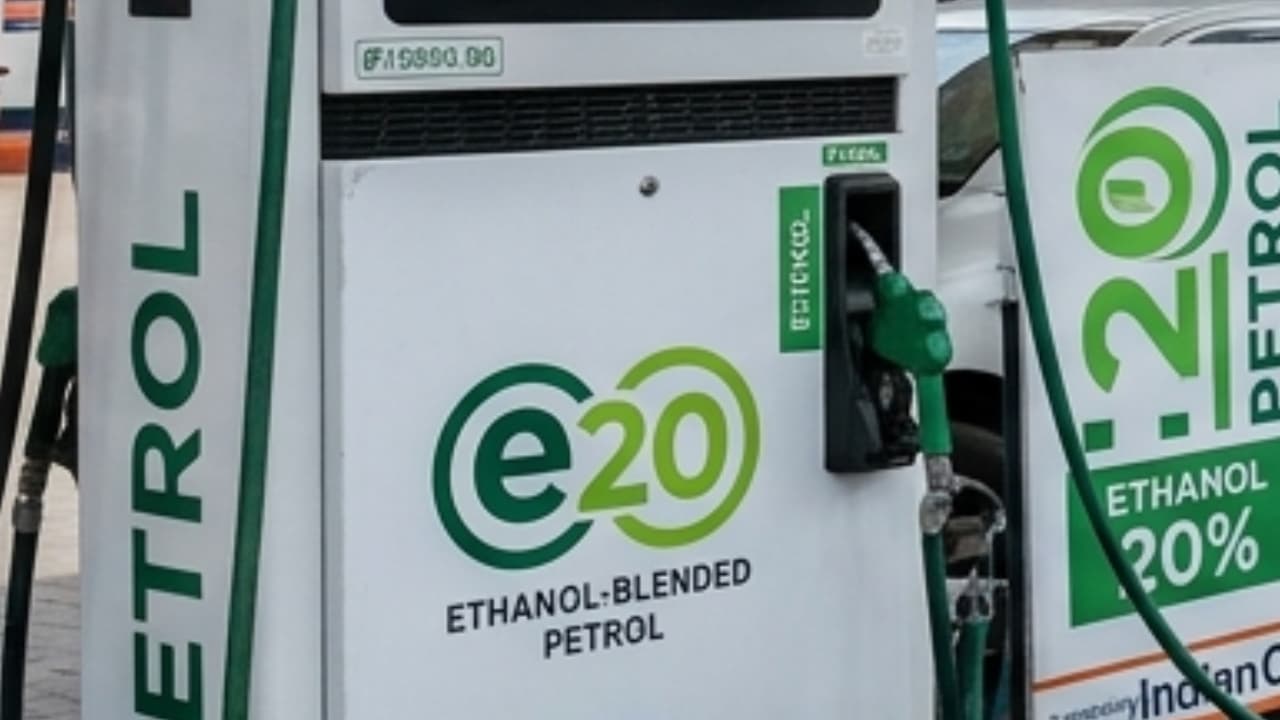
The government said in Parliament that E20 petrol is safe and based on scientific research. No damage to the engine was found in the study of 23 crore vehicles. The premium petrol is ethanol-free and there are no plans for E25/E27.
GiveThe Central Government has presented its stand in the Parliament amid the ongoing controversies regarding E20 petrol. The Ministry of Petroleum and Natural Gas says that large-scale scientific and technical investigations were conducted before introducing E20 fuel. In the assessment conducted on about 23 crore vehicles, no engine failure or unusual damage was found due to E20. This clarification has come after complaints that E20 petrol was damaging the engine, reducing mileage and affecting the performance of the vehicle. In this environment, the government has once again officially expressed its views.
Premium petrol still ethanol-free
The government said that up to 20% ethanol is mixed in the normal petrol sold in the country, which is called E20. But this rule does not apply to premium petrol. Ethanol is not mixed in premium fuels like Indian Oil’s XP 100, Hindustan Petroleum’s Power 100 and Bharat Petroleum’s Speed 100. The government clarified that these completely fall in E0 category. However, the ministry also pointed out that the sale of such premium fuel is only 0.5% of the total petrol sales in the country.
No idea at the moment on E25 or E27
The government also put an end to rumors that E25 or E27 petrol with more than 20% ethanol would soon be introduced. It was told in the Lok Sabha that at present no decision has been taken to implement ethanol blending more than E20. The government assured that if any such decision has to be taken in future, then any step will be taken only after scientific study, technical investigation and consultation with vehicle manufacturing companies, oil companies and research institutes.
No evidence of engine damage from E20
The government also rejected allegations that E20 harms petrol engines. The ministry said that before implementing E20, a large-scale study was conducted in collaboration with automobile companies, Automotive Research Association of India (ARAI), Society of Indian Automobile Manufacturers (SIAM) and oil companies. In this, all aspects like material compatibility, long-term performance of the engine, functioning of the fuel system, driving performance and pollution control were checked.
A major car manufacturing company said that out of 2.84 crore vehicles serviced in the financial year 2025-26, there were 1.5 crore vehicles which did not initially get E20 certification, but no ethanol-related defects were found in them either. Similar results were found in long-term data of 14 million E20 vehicles from another major automobile company.
Why is it not necessary to label pumps as E20?
The government also answered the question of why E20 is not labeled separately at petrol pumps. The government said that the normal petrol available at the pumps of government oil companies is completely E20. There E0 or E10 petrol is not sold separately. At the same time, the government also said that it is clearly written at the pumps where E85 fuel with 85% ethanol is available. This is because E85 fuel is only suitable for flex-fuel vehicles and cannot be used in normal petrol vehicles.
The Central Government repeatedly clarified in the Parliament that all decisions related to E20 petrol are based on scientific study and extensive technical investigation. At present, the government does not have any solid evidence to prove that E20 is causing any malfunction in the engine.