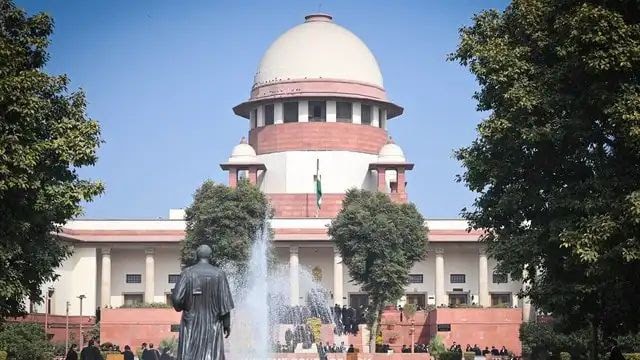
The Supreme Court said that government employees have no inherent right to ask for promotion under the old service rules. The top court said the government is capable of making changes in the method and procedure of selection and promotion by bringing in new service rules at any stage, provided they are not arbitrary.
The bench of Justices Dipankar Dutta and Augustine George Masih gave this decision while accepting the appeal of the Odisha government against the High Court’s decision.
The Supreme Court bench said that an employee neither has any inherent right to get promotion nor does he have any legitimate expectation of promotion. The bench clarified that the employee has only a limited right to have his candidature considered. However, the bench said that if the government, which is the appointing authority, decides in its discretion that the vacancies will not be filled by promotion (especially when there has been a change in cadre and reorganization of posts), it cannot be compelled to make appointments.
The Supreme Court said that as far as the present case is concerned, the post of Assistant Regional Transport Officer was a selection post and not a promotional one. Also said that the method of selection is a policy matter, which completely falls under the jurisdiction of the government. The bench said that if the government felt it was right to change the method of selection, it was within the scope of its authority, power and competence. Unless this changed policy is proved to be arbitrary, the employee cannot claim that position. This case was related to promotion of employees in Odisha Transport Department.
Asked for report on commercial use of residential area
The Supreme Court has directed civic authorities in all state and union territory capitals to investigate and submit reports on misuse of residential spaces for commercial use. These directions have been given following concerns raised over a case of unauthorized construction and violation of land use rules. The bench issued these directions in the case ‘Loganathan vs. State of Tamil Nadu’. The Supreme Court also referred to cases of alleged violations of building rules and land use norms in various cities. Said the alleged move to convert residential areas into commercial zones could have civic and environmental implications.