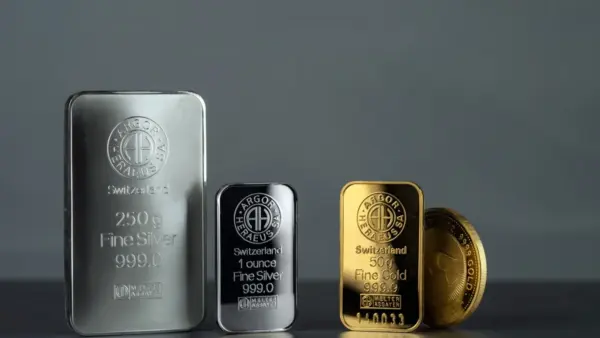
Precious metals gold and silver prices declined to around a 12-week low level during the trading session on Wednesday, June 24, as investors focused on the stronger greenback demand in the global market, amid an overall liquidation impact and the stabilising tensions in the West Asia conflict.
Multi-Commodity Exchange (MCX) data showed that the gold prices lost 1.6% or ₹2,415 per 10 grams to their intraday low of ₹1,44,114 per 10 grams as of Wednesday’s trading session, compared to ₹146,529 per 10 grams at the previous market close.
While the silver prices on the MCX dropped by 1.8% or ₹4,176 per kilogram (kg) to their intraday low of ₹2,21,658 per kg on June 24, compared with ₹2,25,834 per kg at the previous commodity market close, as per the exchange data.
The exchange data also showed that both the precious metals have hit their lowest level since March 26, 2026, marking a 12-week low, based on the active trading sessions on the Indian commodity market.
The key focus of investors is now expected to remain on potential rate hikes from the US Federal Reserve and the easing risk sentiment during the final leg of the US-Iran peace agreement, which in turn lowers the demand for safe-haven bets like gold.
Factors behind the gold & silver price fall
After the commodity market selloff at the end of January 2026, post-Fed Governor Kevin Warsh’s appointment update, gold and silver prices remained highly volatile due to geopolitical developments.
At the end of February, when the US attacked Iran, the investors, instead of buying due to heightened uncertainty, started selling the precious metals on the backdrop of a rising US dollar rate to fill in their liquidity needs to fund imports amid a supply chain disruption and higher costs.
US dollar hits 1-year high
The US dollar spot index (DYX) strengthened 0.19% to its 52-week or 1-year high level of 101.57 during Wednesday’s trading session, compared to 101.38 at the previous currency market close, according to Investing.com data.
The US dollar was witnessing heightened demand on Wednesday’s market due to a massive selloff in tech stocks on Wall Street, which in turn boosted the price of the currency.
A stronger US dollar rate impacts the demand for precious metals in the market as traders are likely to buy reduced quantities of gold and silver if the price of the benchmark currency, the US dollar, remains elevated in the market.
Data also showed that in the last three months, the US dollar has gained 2.2% and around 3.8% in the last six months, weighing down the gold and silver prices in the market.
This inverse relation between the commodity and the currency price further impacts the demand for the commodities, resulting in volatile prices set by the demand and risk equation.
Easing geopolitical sentiment
Global market investors were also focused on the easing geopolitical sentiment in the market, which reduces the demand for safe-haven bets like gold and silver.
Hence, along with the pressure from the rising US dollar, the gold prices have been on a downward trend, with the United States and Iran signing an interim peace deal in Switzerland.
As both sides have 60 days to negotiate the final peace agreement, the investors are now looking towards a near-term end to the West Asia conflict.
In case of an extension, the impact of the same can likely be felt on gold & silver prices and energy prices, which increases inflation in an economy.
US Fed’s stance impact
The US Federal Reserve has kept its key benchmark interest rates on hold this year as concerns loom over US inflation due to the impact of the Iran conflict, while the central bank aims to balance its dual mandate of controlling prices while boosting job growth.
With the interest rates on hold and the markets pricing in an upcoming interest rate hike this year, this gives investors higher return potential in government treasuries compared to other non-yielding assets like gold.
Due to this capital flow from the asset classes amid the reduced demand in the market, the prices fall as investors shift their bets to other guaranteed return investments with higher yields than gold.
CME Group’s FedWatch estimates suggest that there is a 36.3% chance of the US Federal Reserve increasing its key interest rates to the range of 3.75-4.00% in the July policy meeting, a move which can further impact gold prices in the market.
While there is a 63.7% chance that the central bank holds its key interest rate at the current level of 3.50-3.75% in the upcoming policy meeting in July 2026, according to the data.
Market experts predict that the key focus of global market investors will now remain on a September rate hike in the US economy, in an effort to control prices and bring stability to the impact of the West Asia crisis.