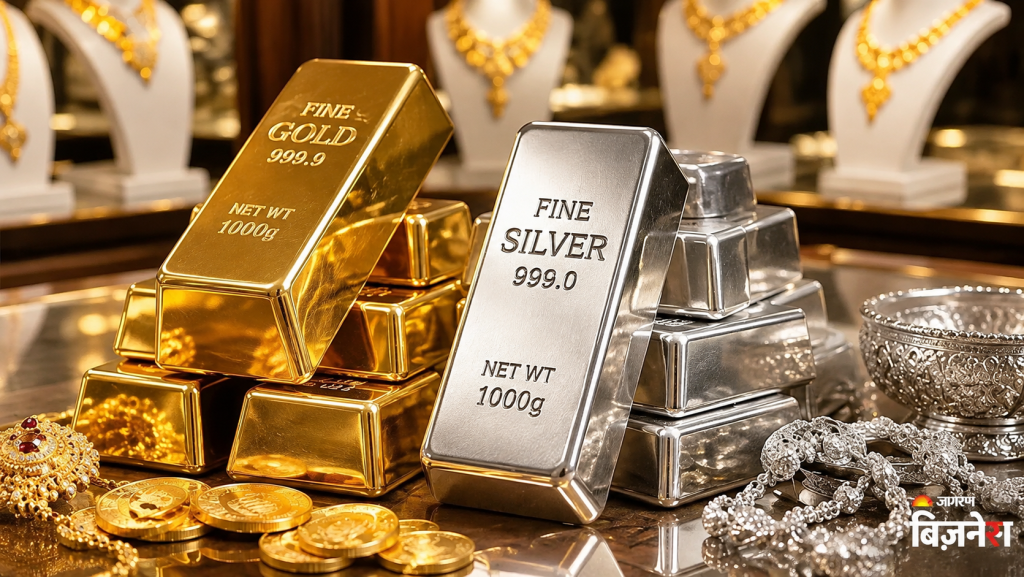
Gold Market: Gold and silver prices witnessed a sharp reversal after recording strong gains in the previous session. Gold, which had climbed 2.7% on Monday, fell around 2% on Tuesday to $3,562.60 per ounce. Silver faced an even steeper decline, losing nearly 5% to trade at $40.91 per ounce. The sudden change in direction came amid concerns over possible US import tariffs, weakness in equity markets and uncertainty surrounding the Federal Reserve’s interest rate policy.
The fall in international prices also kept domestic bullion traders focused on movements in the Multi Commodity Exchange (MCX). Both precious metals were trading lower on Wednesday morning compared with their previous closing levels.
MCX Gold and Silver Rates Move Lower
On Tuesday night, gold futures on MCX settled at Rs 1,22,250 per 10 grams, registering a decline of 0.06%. Silver futures ended the session at Rs 1,45,150 per kilogram, down 0.20%.
The downward movement continued during Wednesday’s morning trade. At around 11 am, gold was trading at approximately Rs 1,21,688 per 10 grams. This represented a fall of Rs 562 compared with Tuesday’s closing price.
Silver was quoted at around Rs 1,44,267 per kilogram, declining Rs 886 from its previous close. The domestic market’s movement reflected the weakness seen in international bullion prices, although local futures rates can also be influenced by currency movements and other market factors.
US Tariff Concerns Add to Market Uncertainty
One of the factors weighing on precious metals was renewed concern about the US administration’s plans to increase tariffs on imported goods. Reports about possible tariff changes triggered selling across global equity markets, adding to uncertainty among investors.
Gold is often viewed as a safe-haven asset during periods of market instability. However, its price does not necessarily rise every time stock markets decline. When investors face losses in other parts of their portfolios, they may sell gold and other assets to raise cash or manage their exposure.
Such selling pressure can affect bullion prices even when broader economic uncertainty remains high. This appears to have been one of the factors behind the reversal following Monday’s strong rally.
Federal Reserve Rate Outlook Puts Pressure on Gold
Expectations about US monetary policy have also influenced the movement in gold prices. Comments from John Williams, president of the Federal Reserve Bank of New York, added to discussions about the possibility of interest rates remaining high.
Williams said on Monday that more work was needed to bring inflation under control. His remarks contributed to market concerns that the Federal Reserve could consider another rate increase at its December policy meeting.
Higher interest rates are generally considered negative for gold because the metal does not offer regular interest payments. When returns on interest-bearing investments become more attractive, some investors may reduce their exposure to bullion.
The direction of US inflation and the Federal Reserve’s response will therefore remain important factors for gold traders.
Volatility Indicator Signals Possible Price Swings
The CBOE Volatility Index, which is used to assess market expectations of volatility, has also remained elevated. The index tracking volatility in gold prices reportedly reached a seven-month high last week.
This suggests that traders are anticipating significant price movements in the near term. However, volatility indicators do not establish whether prices will move higher or lower. They mainly reflect expectations of larger fluctuations.
US Inflation Data in Focus
Investors are now closely watching the Personal Consumption Expenditures (PCE) Price Index in the United States. The Federal Reserve gives considerable importance to this inflation measure while assessing the economy and deciding its monetary policy.
If inflation comes in above expectations, concerns about further interest rate increases could strengthen. That may support the US dollar and create additional pressure on gold. Softer inflation figures, on the other hand, could influence expectations about the future path of interest rates.
JPMorgan Sees Long-Term Potential for Gold
Despite the recent decline, JPMorgan has maintained a positive longer-term outlook for gold. According to the view cited in the report, softer crude oil prices and greater stability in Federal Reserve interest rates from the first quarter of 2027 could support a recovery.
The bank also sees the possibility of interest rate cuts in the first half of 2028. Its projection suggests that gold could reach $4,500 per ounce by the end of 2027.
This remains a forecast rather than a guaranteed price level. In the near term, gold and silver are likely to remain sensitive to US tariff developments, inflation data, currency movements and expectations surrounding interest rates.