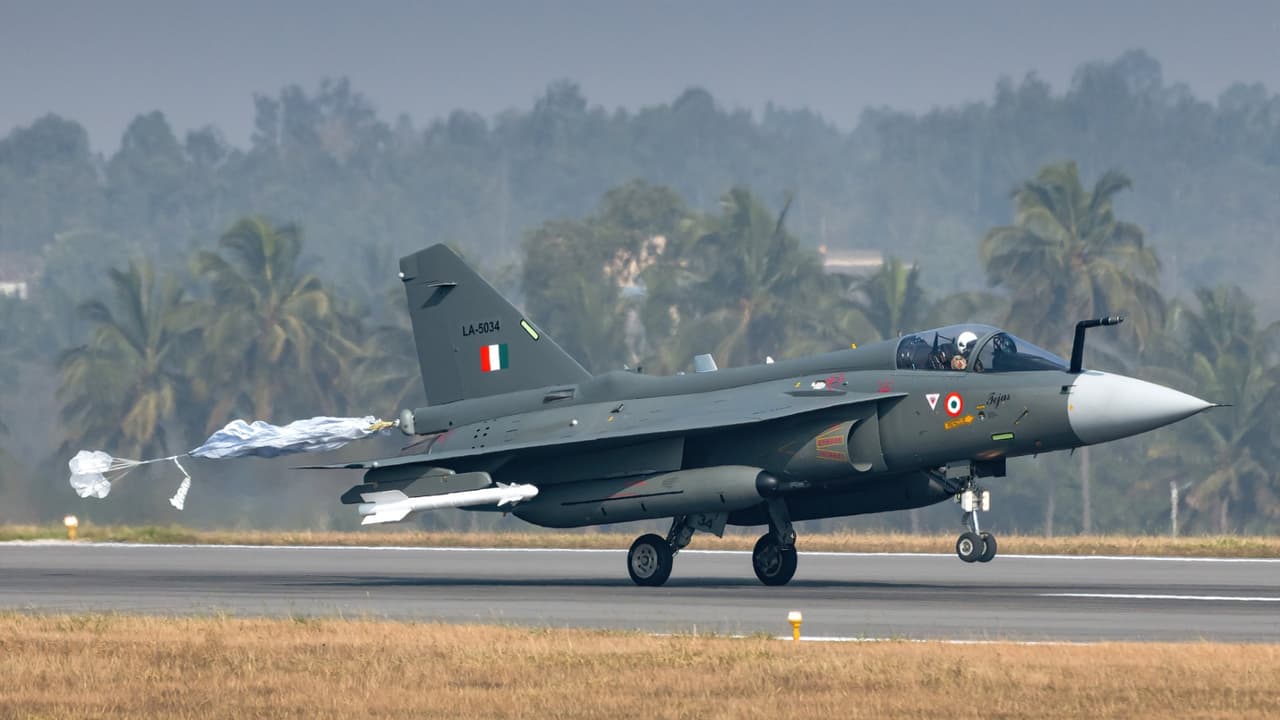
Defence Ministry has directed HAL to meet delivery deadlines for the Tejas LCA Mk1A fighter jets and recover more than two years of delays. The warning follows continued engine supply issues and certification bottlenecks. With IAF operating well below sanctioned squadron strength, faster deliveries have become a critical national defence priority.
New Delhi: The Ministry of Defence has issued a strict directive to state-owned aircraft manufacturer Hindustan Aeronautics Limited (HAL), warning the company to adhere to contractual delivery deadlines for the light combat aircraft (LCA) Mk1A and to make up for time lost, delays that have now stretched beyond two years.
The development follows mounting concerns over persistent delivery delays, further compounded by a technical snag in one of the recently delivered GE Aerospace F404-IN20 engines.
At a high-level review meeting earlier this month the HAL was also informed about the formal penalty clause. A follow-up meeting, to be chaired by Defence Minister Rajnath Singh, with the participation of Indian Air Force (IAF) Chief Air Chief Marshal AP Singh and HAL’s Chairman and Managing Director Ravi Kota, has been scheduled for September 2026.
Engine Snag and Supply Chain Hiccups
A significant setback emerged with the sixth GE Aerospace F404-IN20 engine delivered to HAL. The engine arrived with a technical snag, which a senior HAL official confirmed has since been rectified.
“Following standard operating procedure, we detect any issue upon the engine’s arrival and immediately inform GE Aerospace,” the official told Asianet Newsable, adding that the fault likely stemmed from a transshipment issue and described it as routine.
Since April 2025, HAL has received a total of six F404-IN20 engines from GE Aerospace, with the most recent delivery arriving in May 2025. The engines are part of a ₹5,375-crore contract signed in 2021 for the supply of 99 F404-IN20 engines to power the Mk1A fleet.
HAL is currently engaged in integration of Israeli AESA radar, systems certification, and other pre-delivery processes that must be completed before the jets can formally be handed over to the IAF.
The Strategic Urgency: A Force in Deficit
The IAF currently operates 30 fighter squadrons against a sanctioned strength of 42 squadrons, the minimum considered necessary to fight a credible two-front war against both China and Pakistan simultaneously. Each lost year means the gap widens.
IAF chief ACM AP Singh has, on multiple occasions, publicly expressed displeasure over the pace of LCA Mk1A deliveries. The induction of new Tejas jets was conceived as the most immediate remedy to the IAF’s depleting combat strength, as ageing MiG-21s and other legacy platforms are retired.
The LCA Mk1A Programme: Scale and Stakes
The Tejas Mk1A is a 4.5-generation delta-wing multi-role combat aircraft, indigenously designed by DRDO’s Aeronautical Development Agency (ADA) and manufactured by HAL. The first-generation LCA Mk1 entered service in 2016; of the 40 jets ordered in that initial tranche, 38 have been inducted to date.
In 2021, the IAF placed a follow-on order for 83 LCA Mk1A jets at a total cost of ₹46,000 crore, with deliveries originally expected to commence in February 2024 at an average rate of eight aircraft per year. Those timelines have slipped, with HAL now committing to 12 deliveries annually once the programme reaches full tempo, a target that requires resolving both engine supply delays and certification bottlenecks.
A second, larger order for 97 additional Mk1As, was signed in September 2025 at a cost of ₹62,370 crore. Combined, the two orders account for a fleet of 180 Tejas Mk1A aircraft.