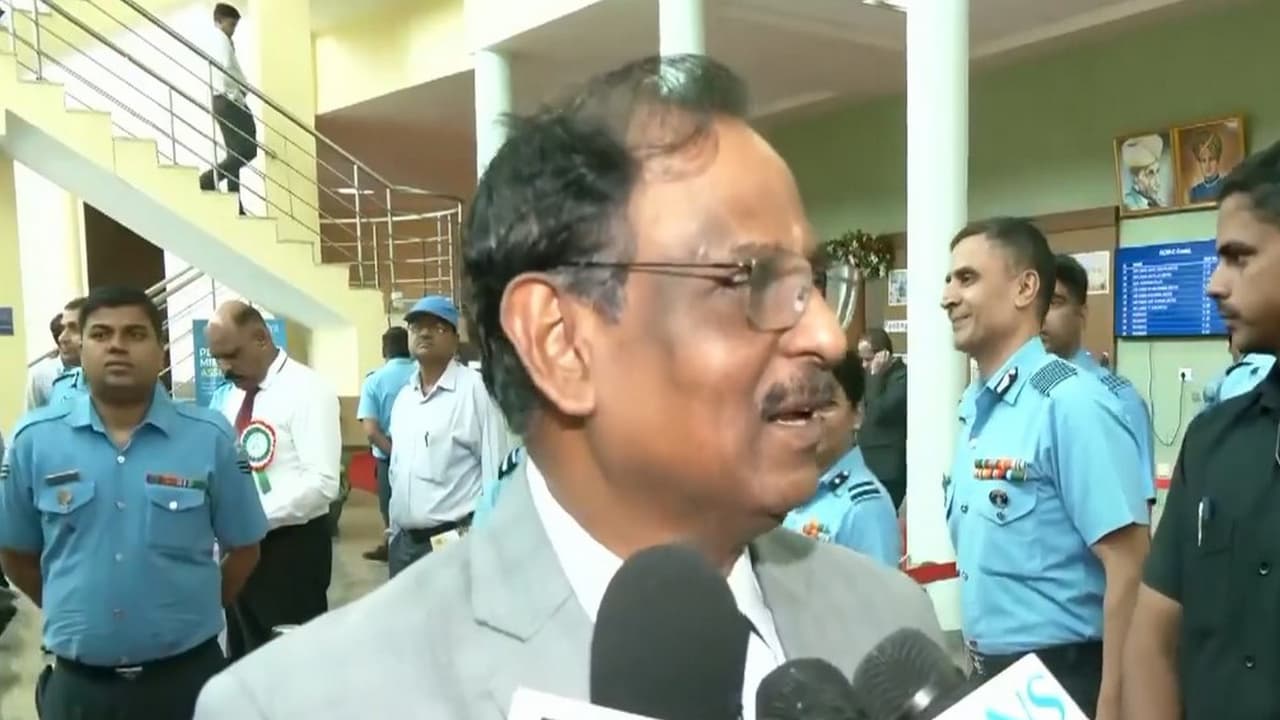
ISRO Chairman V Narayanan announced a recent propulsion test as a ‘major milestone’ for the Gaganyaan mission. He confirmed the program requires strict validation and will see three uncrewed flights before the actual human spaceflight mission.
Gaganyaan Propulsion Test a ‘Major Milestone’
Indian Space Research Organisation (ISRO) Chairman V Narayanan on Saturday said that recent propulsion-related testing marked a “major achievement and milestone,” while stressing that the Gaganyaan mission remains highly technology-intensive and will involve multiple uncrewed missions before human flight.
Referring to recent successful hot test of the Semi-Cryogenic Engine Power Head Test Article (PHTA) at a thrust level of 175 Tonne, Narayanan said, “a test that was conducted, excluding the thrust chamber…we have taken close to 90% of the thrust load…it was a major achievement and milestone, and now we are getting ready for the engine test…satellites are ready, and we are working on that, an exact date will be provided soon…” He further added that the human spaceflight programme involves strict validation protocols. “Gaganyaan is a technology-intensive mission. We have to do the human-rating of the vehicle…before sending actual human beings, we have to do 3 uncrewed missions, and we are working towards the first uncrewed mission. You will come to know about the dates very shortly…”
Details of the Semi-Cryogenic Engine Test
His remarks come after the Indian Space Research Organisation successfully carried out a hot test of the Semi-Cryogenic Engine Power Head Test Article (PHTA) at a thrust level of 175 tonnes at the ISRO Propulsion Complex (IPRC) in Tamil Nadu on June 24.
According to the ISRO release, the Power Head Test Article (PHTA) includes all engine systems except the thrust chamber. The test marked the eighth in a series of hot tests and aimed at studying build-up after pre-burner ignition and demonstrating steady-state operation at higher thrust levels. Earlier tests were conducted at 47 per cent (94 tonne) and 60 per cent (120 tonne) thrust levels. In the latest test, the system was successfully operated at 175 tonne thrust level (88 per cent) for the first time and also demonstrated the successful functioning of the main turbopumps delivering 400 and 500 bar outlet pressures.
India’s Space Achievements and Collaborations
Highlighting India’s achievements in space exploration, Narayanan said, “Aditya L1 – India is the fourth country to have a satellite to study the sun.” He added, “I have to thank the honourable Prime Minister that we have been given a direction. We have conceived and built a South Asian satellite, successfully launched and donated it to other countries. Today, we are developing the G20 satellite for the G20 countries, and India is taking the lead role.”
On international collaboration, he said, “Japan and India are working together for Chandrayaan 5. For Chandrayaan 3, we had a rover of 25 KG, but here we are building a 350kg rover. This is again a joint mission.”
The ISRO Chairman further added, “Axiom 4 mission. Shubhanshu Shukla was sent to the International Space Station under PM guidance.” (ANI)
(Except for the headline, this story has not been edited by Asianet Newsable English staff and is published from a syndicated feed.)