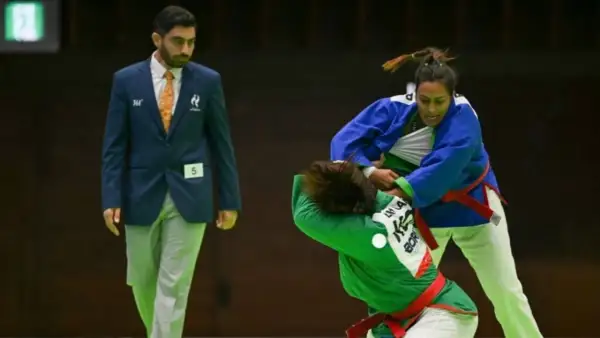
Pincky Balhara’s brave effort ended in the semifinal of the women’s -78kg Kurash event at the Asian Games 2026, but by then, the Delhi athlete had already secured something far more significant – her second Asian Games medal.
Eight years after winning silver at the 2018 Asian Games, Balhara was back on the podium, this time with a bronze.
For Balhara, however, the medal means much more than another entry on her resume. It is a reminder of a journey that has demanded sacrifice, resilience and, at times, the determination to continue even when the sport she chose offered little recognition.
“It took me eight years to reach this podium. Finally, in 2026, I am on the podium,” Balhara told MyKhel after her semifinal defeat.
Her campaign in 2026 had already demanded everything from her.
Balhara defeated South Korea’s Lim Garam 3-0 in the quarterfinal, but suffered a blow to her right knee during the bout. She still finished the contest and advanced to the semifinal.
Against South Korea’s Sumin Mo, she went down 0-5. The injury, she said, had become a significant factor.
“I had a knee injury in the quarterfinal. I won the fight. In the semifinal, I had a knee injury too. My opponent knew that and repeatedly hit my right knee. Today, my injury pulled me back,” she said.
But even as the disappointment of the semifinal remained fresh, Balhara could look back at how far she had travelled.
From a nine-year-old judoka to an Asian Games medallist
Balhara stepped onto the judo mat when she was just nine years old, training at the Baba Ganga Nath Judo & Kurash Academy in Munirka, Delhi, under her maternal uncle and coach Samundar Tokas.
Her first major setback came when she missed selection for the 2018 Asian Games judo team.
Instead of allowing that disappointment to define her journey, she switched to Kurash.
The decision changed her sporting career.
At the 2018 Asian Games, Balhara won silver in the 52kg category. But the achievement came against a backdrop of enormous personal loss.
She lost her cousin, her father and her grandfather around the period of the Games. Her father died of a heart attack at just 42, shortly after her selection.
The medal therefore carried an emotional weight that went well beyond sport.
She had lost her father before making her Asian Games debut, yet she continued towards the dream that she and her parents had shared.
Even Prime Minister Narendra Modi appreciated her performance at the time.
But the recognition did not necessarily translate into an easier life as an athlete.
Kurash remained a relatively unfamiliar sport in India, and Balhara found herself having to explain not only her sporting ambitions but sometimes even her reasons for continuing.
She was mocked by some for allegedly seeking publicity around her father’s death.
She chose not to answer those jibes.
She kept training.
When the medal did not change everything
Winning an Asian Games silver at 19 could have been expected to open doors. For Balhara, the journey remained complicated.
Kurash’s limited popularity meant limited resources. There were also financial challenges associated with competing and training internationally.
Balhara recalled having to buy her own kit in 2018 and travelling to Uzbekistan for training, where she received assistance from the Uzbek team, one of the strongest sides in the sport.
Her village community also helped her raise funds for training in Uzbekistan.
The financial burden has remained part of her sporting journey.
“I had to skip competitions. I was not given Rs 1.5-2 lakh to play outside,” she said.
Her government job at CGST Customs, which she joined in 2019, has provided some stability. But Balhara made it clear that she never regarded the job as the end of her sporting ambitions.
“I did not get the position that an Asian Games silver medallist has. People ask me if I am satisfied with my government job,” she said.
“If I was satisfied, I would not have joined this team.”
That sentence perhaps explains Balhara’s journey better than any medal tally.
The 2026 Asian Games was not simply another competition. It was something she had been working towards for years.
The promise she made in 2023
After her breakthrough in 2018, Balhara’s journey suffered another setback.
At the 2023 Asian Games in Hangzhou, she represented India in the -52kg category but was eliminated before the medal bout. She also pointed to problems within the federation during that period.
But she refused to treat 2023 as the conclusion of her story.
Instead, she made herself a promise.
“In 2023, I was determined to stand on the podium in 2026,” she said.
Eight years after her first Asian Games medal, she kept that promise.
The journey to the second medal also involved a significant physical transformation. Balhara began her career in the 52kg category and eventually moved up to -78kg, winning bronze at the South Asian Championships in 2025 in the category.
Now, at 27, she has another Asian Games medal.
And she does not want it to be her last.
‘I don’t want to give up’
There is a tendency to look at a third Asian Games appearance as a natural point to reflect on retirement. Balhara does not see it that way.
“People say that this is my last Games. I don’t know why the Indian mentality is like this,” she said.
“It is a big deal to play three Asian Games. I don’t want to give up.”
There is plenty of evidence behind that determination.
Balhara won gold at the 2024 World Nomad Games, becoming the first Indian athlete to win gold in the event, according to her account.
She also has a growing collection of international medals and believes her achievements deserve greater recognition.
Recognition she continues to seek
Balhara’s ambitions extend beyond winning medals. After years of representing India and building an international record, she now hopes her contribution to Indian sport receives greater recognition.
One such recognition is the Arjuna Award, one of India’s prominent national sporting honours, conferred by the Government of India for outstanding achievement and contribution to sport.
Balhara had applied for the award once in 2018, after her silver medal at the Asian Games, but was not selected.
Eight years later, with another Asian Games medal and a gold at the 2024 World Nomad Games among her international achievements, she remains hopeful that her body of work will now receive due recognition.
“I am very eager to win the Arjuna Award,” she said.
Asked whether she had applied before, Balhara recalled: “I applied once in 2018. I did not win the award then. I might win the Arjuna Award now.”
For an athlete who has spent years competing in a sport that remains relatively unfamiliar in India, the recognition would mean more than a personal honour. Balhara sees it as an acknowledgement of the journey she has undertaken – and, perhaps, another way of bringing Kurash into the national sporting conversation.
A medal for Kurash, too
Perhaps Balhara’s biggest frustration is not simply the lack of recognition for herself, but the lack of awareness surrounding Kurash.
Kurash is a combat sport that originated in Central Asia, particularly Uzbekistan. Athletes compete wearing jackets and attempt to throw their opponents onto the mat or their side to score points.
For Balhara, every medal is therefore also an opportunity to introduce the sport to a wider Indian audience.
“People in our country don’t know much about Kurash,” she said.
“I want everyone to know about Kurash.”
She believes international exposure is crucial for Indian athletes in the sport.
“Until we fight or practise with foreign players, we cannot improve while staying in India,” she said, urging greater opportunities for Indian athletes to compete and train overseas.
Her own experience is proof of how important those opportunities can be.
She trained in Uzbekistan, competed against athletes from some of the sport’s strongest nations and eventually stood on the Asian Games podium again.
This time, she did it in a completely different weight category.
The story continues for Pincky
There is a symmetry to Balhara’s Asian Games journey.
In 2018, she arrived as a 19-year-old who had already experienced the devastating loss of her father and grandfather. She left with a silver medal and the hope that life as an athlete would finally change.
Eight years later, she has returned with another medal.
The circumstances are different, but some of the challenges remain familiar.
The sport still needs greater visibility. International exposure remains important. Financial support continues to matter. And Balhara is still fighting to ensure that her achievements are recognised beyond the medal ceremony.
Yet the athlete who once had to turn a judo selection disappointment into a new beginning has done it again.
She changed weight categories. She endured setbacks. She competed through injury. She kept training despite limited resources.
And when asked what comes next, her answer was not about stopping.
“I will continue to win medals for my country,” she said.
For Pincky Balhara, the bronze in 2026 is not the end of an eight-year wait.
It is another chapter in a journey that began with a nine-year-old girl stepping onto a judo mat in Delhi, and still has no intention of ending there.