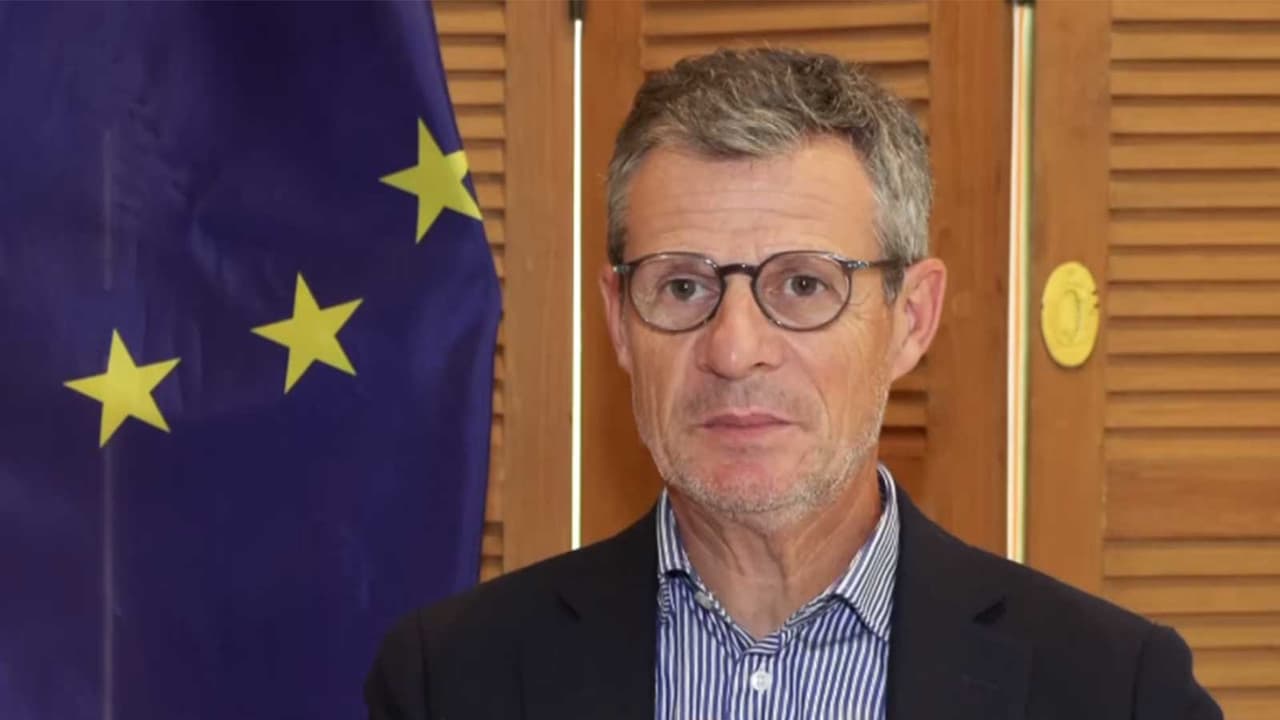
EU Ambassador Herve Delphin denied any divide among NATO members over defence spending, asserting that increased investment has strengthened the alliance. He noted a ‘wake-up call’ in Europe, with collective spending now at 400 billion euros.
European Union Ambassador to India Herve Delphin said there is no divide among NATO members over defence spending, asserting that increased investment in defence has instead strengthened the European pillar of the alliance.
Speaking to ANI on Wednesday, Delphin said there has been a continued “defence and deterrence consensus” among NATO members, while Europe’s changing security environment has prompted a “wake-up call” on the need to reinvest in defence. “I don’t think there is a divide. I would rather say there is a defence and deterrence consensus between all the members of NATO that has been there and has continued. I think what has been the sort of changing nature of relations is that the new reality, and in a way there was a wake-up call in Europe about the need to reinvest, rearm and reinvest in our defence,” Delphin said.
EU Defence Spending Reaches 400 Billion Euros
Delphin said the collective defence spending of EU member states has now reached 400 billion euros, marking an increase of close to 70 per cent. “Now the collective budget of EU member states in defence spending is 400 billion euros. It’s an increase of close to 70%, which is massive. Who would have thought that five years ago we would be here,” he said.
He further said NATO members had agreed to raise the defence spending target from 2 per cent to 3.5 per cent of GDP, calling the friction surrounding the issue “positive friction.” “So in a way, it’s not only that we agreed not to have 2% of GDP as a target but 3.5. So in a way it may have sounded frictional to the outside, but in a way it’s positive friction in the sense that we maintain the idea of a single set of forces. We are agreeing on the fact that we will strengthen the European pillar of NATO and we are certainly committed to increasing defence and deterrence applying to all NATO members,” he added.
Delphin maintained that the developments should not be viewed as evidence of a transatlantic divide. “So in a way you know sometimes people like to make headlines about divides, but I don’t think there is here,” he said.
Context of Trump’s Criticism
His remarks came amid US President Donald Trump’s repeated criticism of NATO allies over defence spending and the burden-sharing within the alliance. Earlier in July, Trump said the United States was paying “billions of dollars too much” for Europe’s security and said he would raise his concerns with NATO allies during the alliance’s summit.
Speaking alongside NATO Secretary General Mark Rutte, Trump said, “I’m going to relay my problems.” “We’ve been treated unfairly. We pay disproportionately,” Trump said, adding that the US was paying “billions of dollars too much” to ensure Europe’s security.
NATO Announces Major Defence Upgrades
Rutte had welcomed increased defence expenditure by European allies and Canada, saying the additional USD 258 billion in defence spending committed for 2025 and 2026 was “staggering.”
NATO Secretary General Mark Rutte on Tuesday said member countries were signing defence agreements worth “literally billions of dollars” during the NATO summit in Ankara, CNN reported. Speaking at the summit’s defence industry forum, Rutte said allies were announcing “new major projects” to strengthen NATO’s military capabilities.
Focus on Drone and Counter-Drone Capabilities
“These are billions that are invested in our security, boosting our economies and supporting hundreds of thousands of new jobs. It’s money well spent,” Rutte said, according to CNN.
NATO also announced plans to procure five “high-end, high-altitude and long-endurance uncrewed aircraft” from Northrop Grumman and invest USD 40 billion in counter-drone capabilities over the next five years. The alliance also plans to “train five times as many drone operators by the end of 2027.”
“Drones have fundamentally altered the character of modern warfare and become a decisive factor on the battlefield,” NATO said in a statement, as cited by CNN. “These initiatives will be essential to increase both Alliance readiness and resilience,” it added.
Replacing Ageing Surveillance Fleet
CNN also reported that NATO announced plans to replace its ageing fleet of E3 surveillance aircraft with up to 10 GlobalEye aircraft manufactured by Swedish defence company SAAB, with some components and production involving the United States and Canada.
According to CNN, Rutte also highlighted NATO’s “remarkable progress” in increasing defence spending by member countries, an issue that has been a key point of discussion with Trump, who has frequently criticised the alliance. (ANI)
(Except for the headline, this story has not been edited by Asianetnews Editorial staff and is published from a syndicated feed.)