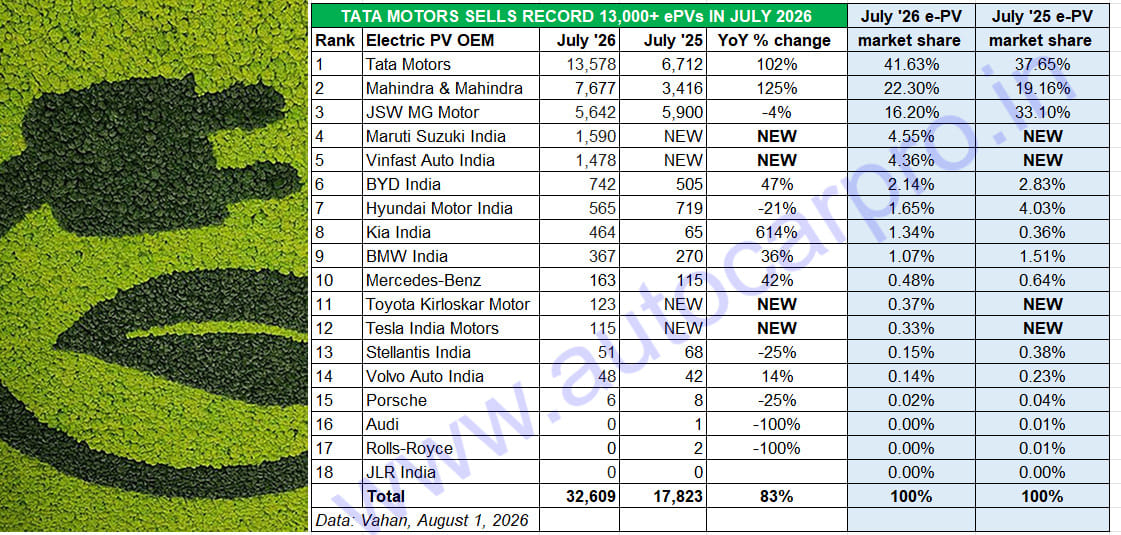
Retail sales of electric passenger vehicles (hatchbacks, sedans, SUVs and MPVs) crossed the 30,000-units mark for the second month running in July 2026. After the record 33,307 units sold in June, last month saw e-PV buyers drive home 32,609 zero-emission vehicles, marking an 83% YoY increase (July 2025: 17,823 units). This is as per the latest data available on the Vahan portal (August 2, 6.30am).
In the first half of the month (July 1-15), as per Vahan, a total of 14,309 units were sold, followed by 18,000 units in the second half which indicates 26% higher traction in the July 16-31 period. While Tata Motors registered its highest monthly sales (13,578 units), Mahindra & Mahindra and Maruti Suzuki logged their second highest. The eight luxury carmakers sold 699 units, up 60% YoY but down 17% on their best monthly sales yet in June 2026 (847 units). Let’s take a closer look at the top movers and shakers and their performance in July 2026.

Following the hike in petrol, diesel and CNG prices in mid-May, sales of electric cars and SUVs have seen a marked rise. July (32,609 units) is the second highest monthly total after June (33,307 e-PVs).
Tata Motors
July 2026: 13,578 units, up 102% YoY / up 6% MoM
e-PV market share: 42%
Tata Motors, which has expanded its e-PV portfolio with the launch of the Sierra EV, witnessed record retails of 13,578 units in July 2026. This constitutes 102% YoY growth (July 2025: 6,712 units) and 6% month-on-month (June 2026: 12,756 units). Importantly, July saw the company cross the 40% e-PV market share mark after a long hiatus. The 42% share last month is a 4 percentage basis points increase over the 38% it had a year ago, despite increased competition.
July also marked the second month in a row that Tata has sold over 12,000 units, the first being June (12,756 units). Cumulative April-July sales (46,697 units) are up 108% YoY (April-July 2025: 22,457 units).
New model launches have energised sales for Tata Motors. While the Nexon EV continues to be its volume driver, the updated MY2026 Tiago EV and the new Punch EV have drawn a large percentage of first-time EV buyers. The new Tiago EV – India’s most affordable e-PV – is expected to draw new buyers transiting from ICE hatchbacks, particularly in the wake of the petrol-diesel price hikes in May. And the recently launched Sierra EV has given even more ammo to Tata’s e-PV portfolio, which also includes the Harrier EV, Curvv EV and Tigor EV.
Mahindra & Mahindra
July 2026: 7,677 units, up 125% YoY / down 6% MoM
e-PV market share: 23%
SUV manufacturer Mahindra & Mahindra, which snapped up the No. 2 e-PV rank in March 2026, has surpassed 7,000-unit sales for the second straight month. In July, M&M sold 7,677 units, up 125% YoY (July 2025: 3,416 units) which is 498 e-SUVs less than June (8,175 units). This performance gives the company a 22% market share versus 19% a year ago.
While the BE 6 and XEV 9e, which were launched 17 months ago, continue to see demand, the XEV 9S, M&M’s first three-row, born-electric SUV launched last November, has given M&M a new charge. The XEV 9S, which has battery options spanning 59 kWh, 70 kWh and 79 kWh, slots above the XEV 9e and BE 6, both of which are two-row EVs.
JSW MG Motor India
June 2026: 5,642 units, down 4% YoY / down 9% MoM
e-PV market share: 16%
JSW MG Motor India sold 5,642 e-PVs last month, down 4% YoY (July 2025: 5,900 units) and down 9% MoM (June 2026: 6,180 units). This gives it a 16% market share, substantially down from the 33% it had in July 2025. The game-changing Windsor EV remains its best-selling product from a portfolio which includes the M9 MPV, Cyberster roadster, ZS EV and Comet EV.
On July 16, JSW MG unveiled MG ADAPT (Advance Drive Architecture Platform Technology), which it described as India’s first multi-New Energy Vehicle (NEV) platform. The modular architecture is designed to support Electric Vehicles (EVs), Hybrid Electric Vehicles (HEVs), Plug-in Hybrid Electric Vehicles (PHEVs) and Range Extender Electric Vehicles (REEVs) within a single framework, with the company confirming that one EV and one PHEV model will debut on the platform this fiscal.
Maruti Suzuki India
July 2026: 1,590 units
e-PV market share: 5%
Utility and passenger vehicle market leader Maruti Suzuki India sold 1,590 e-Vitaras to e-SUV buyers in July. While this marks the fifth month running of four-figure sales starting from March (1,02 units), April (1,354 units) and May (1,676 units), July sales are down 20% on June (1,999 units) which remains its best month yet. Till now, domestic market sales of the e-Vitara were restricted due to production constraints with more supplies allotted for exports. This is set to change with the company commencing production at a new fourth manufacturing line at its plant in Hansalpur, Gujarat. Additional capacity is now in place at the plant which rolls out the e-Vitara, along with the Fronx, Baleno and Swift.
Vinfast India
July 2026: 1,478 units
e-PV market share: 4.36%
Vinfast India takes fifth rank amongst the 18 e-PV manufacturers. The local arm of Vietnamese EV major Vinfast registered its highest-ever monthly sales in July – 1,478 units – bettering the previous best (June 2026: 1,448 units) by 30 units and 2 percent. This gives Vinfast India a 4% e-PV market share for July.
Of the four models in its portfolio, two (VF6 and VF7) are SUVs and two (VF MPV 7 and VF Limo Green taxi) are MPVs. As per wholesales data, the VF Limo Green fleet taxi is the best-selling Vinfast model at present. In Q1 FY2027 (April-June 2026), as per SIAM wholesales data, the seven-seater Green Limo (2,746 units) accounted for 46% of Vinfast India’s 6,001 units, substantially more than the VF7 and VF6 e-SUVs and the MPV7. Vinfast will be looking to achieve higher sales traction when it launches the VF5 hatchback, which is likely to go head-to-head against the Tata Tiago EV or Punch EV, depending upon its specifications.
BYD India
July 2026: 742 units, up 4% YoY / down 20% MoM
e-PV market share: 2%
BYD India, the local division of China’s BYD, sold 742 units last month. This is a 47% YoY increase (July 2025: 505 units) but down 20% on June 2026 (925 units) which has been its highest monthly sales yet. On July 1, BYD raised its EV prices by 1-2%, marking the second hike this year after May 1. BYD India currently sells the Atto 3 SUV, e-Max 7 MPV, Seal sedan and Sealion 7 SUV. It has confirmed plans to introduce the Seal U PHEV later this year. This strategic move will mark BYD’s entry into India’s plug-in hybrid vehicle segment.
Hyundai Motor India
July 2026: 565 units, down 21% YoY / up 51% MoM
e-PV market share: 2%
Hyundai Motor India sold 565 EVs last month, down 21% YoY (July 2025: 719 units). However, on MoM basis, this is a 51% increase over the 374 units it sold in June 2026. The company, which has only two models in its EV portfolio (Creta Electric and Ioniq 5) continues to feel the heat of the intense competition in the e-SUV market where market leaders Tata Motors, M&M and JSW MG Motor have fast expanded their portfolios at multiple price-points to draw more buyers. As a result, Hyundai’s e-PV share has halved to 2% from 4% a year ago.
Kia India
July 2026: 464 units, up 614% YoY / down 14% MoM
e-PV market share: 1%
Ranked eighth amongst the 18 e-PV players is Kia India with 464 units, up 614% YoY on a low year-ago base of just 65 units. On a month-on-month basis, the July sales are down 14% (June 2026: 539 units). Following the launch of the mass-market Carens Clavis EV MPV, which joined the far more expensive EV6 and EV9 imported as CBUs, Kia had seen its monthly numbers improve last year.
July 23 saw Kia India launch the electric avatar of the Syros compact SUV. The Syros EV, which is the company’s second mass-market made-in-India EV after the Carens Clavis EV, is priced at Rs 13.49 lakh (ex-showroom) for the 42 kWh variant and Rs 16.99 lakh (ex-showroom) for the 51.4 kWh Extended Range variant. Sales have commenced from July 30, which means Kia India’s August sales numbers should see a good uptick. Like the Clavis EV, the Syros EV benefits from the Battery-as-a-Service (BaaS) option which slashes upfront EV cost by separating battery ownership from the vehicle purchase.
Toyota Kirloskar Motor
July 2026: 123 units, up 251% MoM
e-PV market share: 0.37%
Toyota Kirloskar Motor, the latest mainstream PV manufacturer to plug into the EV industry in India, delivered 123 units of the Urban Cruiser Ebella in July to be ranked 11th amongst the e-PV OEMs. The Toyota Ebella is the badge-engineered version of the Maruti e-Vitara and also rivals the Mahindra BE 6, Vinfast VF6, MG ZS EV, Hyundai Creta Electric and Tata Curvv EV. The Ebella is currently sold in three variants (E1, E2 and E3) albeit priced at a considerable premium over its Maruti cousin.
Luxury Electric Car & SUV Sales Rise 60% YoY to 699 Units, Tesla Outsells Volvo
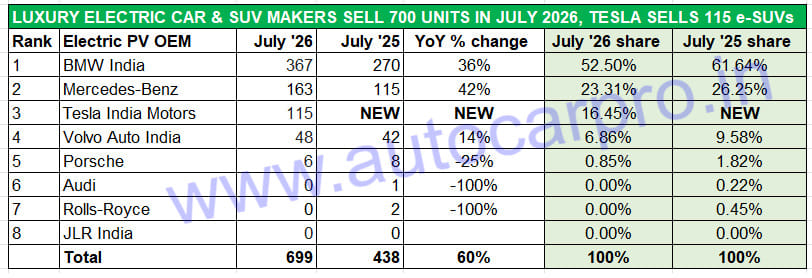
Demand for zero-emission vehicles in the luxury vehicle sub-segment continued to rise YoY in July. The eight OEMs in this category sold 699 units, up 60% YoY (July 2025: 438 units) but down 17% on their best monthly sales yet in June 2026 (847 units). While this market continues to be dominated by the top two OEMs – BMW and Mercedes-Benz – Tesla India registered its highest monthly sales and crossed the 100-unit mark for the first time.
BMW India, which is ranked No. 9 amongst the 18 e-PV OEMs in July, continued to top the luxury e-PV table with 367 units, up 36% YoY (July 2025: 270 units) for a 52% segment share. Its July sales though are down 29% MoM (June 2026: 517 units). BMW India, which topped the luxury e-PV category in FY2026 with a record 3,898 e-PVs, has sold 1,606 units in the April-July period, which is 41% of its FY2026 sales.
Mercedes-Benz India, which sold 163 EVs last month, posted 42% YoY growth (July 2025: 115 e-PVs) albeit this is down 33% MoM (June 2026: 243 units). The luxury carmaker registered strong growth on the back of the launch of the CLA electric sedan in end-April priced from Rs 55 lakh to Rs 59 lakh (ex-showroom). Based on the Mercedes-Benz Modular Architecture (MMA) EV-first platform, the CLA EV replaces the combustion-powered A Class sedan, plus the EQA and EQB electric SUVs in India.
The big news though belongs to Tesla, which has expanded its portfolio with the extended-wheelbase six-seater Model Y L. The Indian arm of the American OEM sold 115 units in July, a massive 203% jump MoM (June 2026: 38 units). As a result, its luxury e-PV market share has jumped to 16% in July from 4% in June and ensured that it has gone ahead of Volvo Auto India. This sharp spike in sales can be attributed to Tesla India slashing prices of its first product – the Model Y e-SUV – to Rs 50.89 lakh (ex-showroom), down by Rs 900,000.
Volvo Auto India, now ranked fourth in this sub-segment, sold 48 e-PVs in July, up 14% YoY (July 2025: 42 units) and up 23% MoM (June 2026: 39 units). The Swedish carmaker had hiked prices of its products by up to Rs 100,000 from May 1, citing ongoing global supply-chain challenges and fluctuations in foreign exchange rates. In July, Volvo had a 7% market share versus 10% a year ago.
While German sports car maker Porsche sold 6 units last month, Audi, Rolls-Royce and JLR India did not sell a single EV last month, as per Vahan data.
In terms of EV market penetration, these eight luxury EV OEMs had a 2.14% share of the record 32,609 e-PVs sold in July 2026 compared to 2.45% in July 2025 and 2.54% in June 2026.