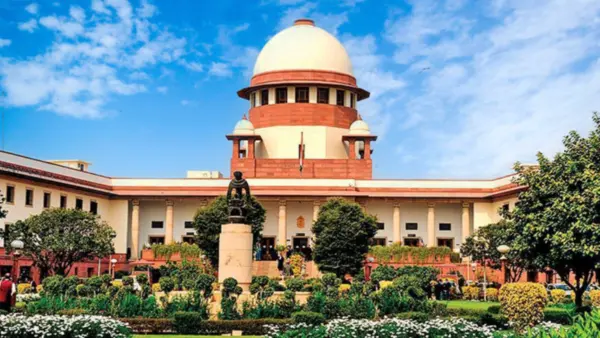
Mala Dixit, New Delhi: In a significant judgment, the Supreme Court ruled that the mere use of abusive or indecent language does not itself constitute an offence of obscenity under Section 294(b) of the Indian Penal Code (IPC).
The apex court emphasised a sharp distinction between obscenity, vulgarity, and profanity, noting that while certain words may be profane or vulgar, they do not necessarily cross the threshold into obscenity in the eyes of the law.
Abusive Language Doesn’t Constitute Offence Of Obscenity: SC
The Supreme Court has clarified that the mere use of profanity, foul language, and vulgar words, no matter how uncivilised or offensive, cannot be legally classified as obscenity. For words to constitute an offence of obscenity, they must be inherently sensual, capable of arousing lust, and possess a tendency to deprave or corrupt the minds of open or weak individuals.
The apex court emphasised that while vulgar or abusive language may trigger feelings of disgust, hatred, or shock, these emotional reactions do not make it obscene in the eyes of the law. The court noted that several previous judgements have held that use of vulgar language does not amount to an offence of obscenity.
In Which Case Was The Verdict Given?
A two-judge bench of Justices Sanjay Karol and Vipul M Pancholi ruled on an appeal filed by a 70-year-old man challenging his conviction in a land dispute case from Tamil Nadu. The court partially allowed his appeal, setting aside his convictions under Section 294(b) (uttering obscene words in a public place) and Section 506(ii) (criminal intimidation) of the Indian Penal Code (IPC).
While the top court upheld his conviction under Section 326 IPC for voluntarily causing grievous hurt with a dangerous weapon, it took a compassionate approach to the punishment. Taking into account the appellant’s age, poor health, and the fact that the incident stemmed from a land dispute, the bench commuted his prison sentence to confinement “till the rising of the court” and directed him to pay a fine of Rs 50,000.
What Is The Legal Test For Obscenity?
The bench clarified in its judgement that to establish an offence of obscenity, it is necessary to prove not only that the words in question were uttered in a public place, but also that they were inherently sensual, capable of arousing sexual desires, and possessed a tendency to corrupt or deprave the minds of open or weak individuals.
The apex court emphasised that the mere use of offensive or vulgar language does not automatically meet these criteria. While such words may be vulgar or offensive, they cannot be classified as obscene unless they are explicitly sexual or morally depraved.