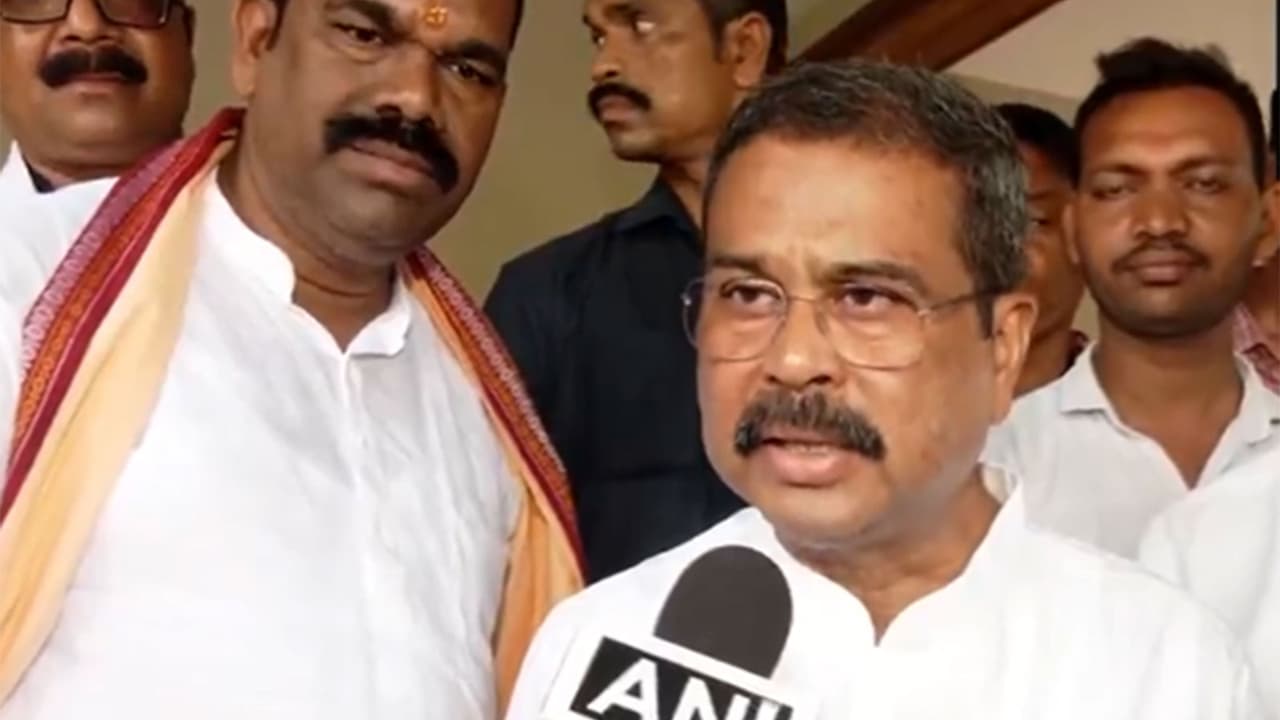
Dharmendra Pradhan slammed Rahul Gandhi’s ‘System vs Students’ narrative in Indore, accusing him of political theatre. Pradhan defended the government’s record on education, citing increased access, new loan schemes, and anti-cheating legislation.
Former Union Education Minister Dharmendra Pradhan on Saturday accused Lok Sabha Leader of Opposition Rahul Gandhi of coming to Indore “with a microphone and a manufactured ‘System vs Students’ narrative” after Gandhi’s ‘Chhatron Ki Goonj’ programme in the city.
Pradhan Hits Back at ‘Political Theatre’
In an X post, Pradhan cited government initiatives in response to Gandhi’s criticism of the education sector, stating that the reality is “more consequential than mere rhetoric”. “At Indore’s ‘Chhatron Ki Goonj’, Rahul Gandhi chose to portray every challenge faced by students as proof of a ‘captured system’ and reduce a complex education ecosystem to political slogans,” Pradhan said, adding, “Students deserve answers, not political theatre.”
‘Reality More Consequential Than Rhetoric’
Pradhan, who recently resigned as the Education Minister following massive youth-led protests over NEET paper leak, said that while Gandhi is “busy peddling his agenda”, the country has expanded higher-education access, citing Gross Enrolment Ratio rise from 23.7% in 2014–15 to 30% in 2023–24. “PM-Vidyalaxmi now provides collateral-free education loans and interest support for eligible students, while PM-USHA is strengthening infrastructure and quality across state institutions. Our QS World rankings have improved significantly in the last decade and so has our institutional capacity,” he said.
Centre’s Action on Exam Malpractices
On examination reforms, Pradhan said the government had moved towards computer-based testing “precisely to reduce vulnerabilities associated with paper-based examinations, while acknowledging that examination integrity requires continuous strengthening.” He said the Centre has enacted a dedicated law against exam malpractices in 2024 and has now strengthened it with tougher penalties and fast-track courts, referring to the passage of the Public Examinations (Prevention of Unfair Means) Amendment Bill, 2026 during the Parliament Monsoon Session.
“The concerns raised by students must be taken seriously. But so must the work being done to expand opportunity, affordability, infrastructure and transparency. Will Rahul Gandhi speak about solutions, or will he keep turning every student’s anxiety into a political prop?” he asked.
“India’s students do not need a politician to tell them to be angry. They need institutions that act, opportunities that expand and a government that stands with them. That is the difference between politics over students and politics for students,” Pradhan added.
Rahul Gandhi’s ‘System vs Students’ Programme
The Indore event, part of Gandhi’s student outreach initiative previously held in Kota, Dehradun, Prayagraj and Pune, was themed “System vs Students.” Students and aspirants spoke of delayed examinations, alleged recruitment irregularities, lack of infrastructure and rising education costs.
‘The System Has Captured Every Institution’
In a presentation titled “Desh par system ka kabza,” Gandhi alleged that India’s major institutions had been captured by a network of political, administrative, ideological and corporate interests. “The struggle is against the system. What is this system? The system has various layers. At the top level sit six individuals who run it. Narendra Modi ji—he handles the intimidation, the acts of beating students, the use of nail-studded batons, and the firing of pellet guns; Amit Shah ji runs it; he is the enforcer. This is Ajit Doval ji, the National Security Advisor. In informal conversations, he says that to control India, one only needs to control 500 people. He has taken control of India’s telephones, WhatsApp, and Facebook communications; he orchestrates phone tapping and passes the information to Amit Shah ji and Narendra Modi ji. In the middle is Mohan Bhagwat ji, who deals with ideology; his organisation receives thousands of crores of rupees to run schools, colleges, and institutions. Then, on one side, there is Adani ji, and on the other, Ambani ji…The system has placed its own people in every single institution,” he said.
The programme also brought back the long-running issue of examination integrity in Madhya Pradesh. A video montage shown at the programme featured aspirants questioning the transparency of competitive examinations and alleging that paper leaks had destroyed their faith in the system. One aspirant said, “How can anyone trust any competitive exam nowadays? Where is the transparency? How do we know selections are fair?” Another said that along with students who died in incidents connected to examination-related distress, “our faith in the system has died.”
Allegations of Privatisation, Declining Investment
Gandhi also used the programme to attack what he described as the unchecked privatisation of education. He also cited figures which he presented as showing a decline in the share of government spending devoted to education, claiming it had fallen from 4.6 per cent in 2014 to 2.6 per cent currently. He further claimed that around Rs 7.7 lakh crore that could have gone towards public education had instead been diverted towards corporate concessions.
Gandhi also claimed that students had received 1.5 crore fewer scholarships and that more than 10 lakh teaching posts remained vacant in government schools. The remarks formed part of Gandhi’s larger argument that privatisation, rising costs and declining public investment were pushing education beyond the reach of poorer families.
(Except for the headline, this story has not been edited by Asianetnews Editorial staff and is published from a syndicated feed.)