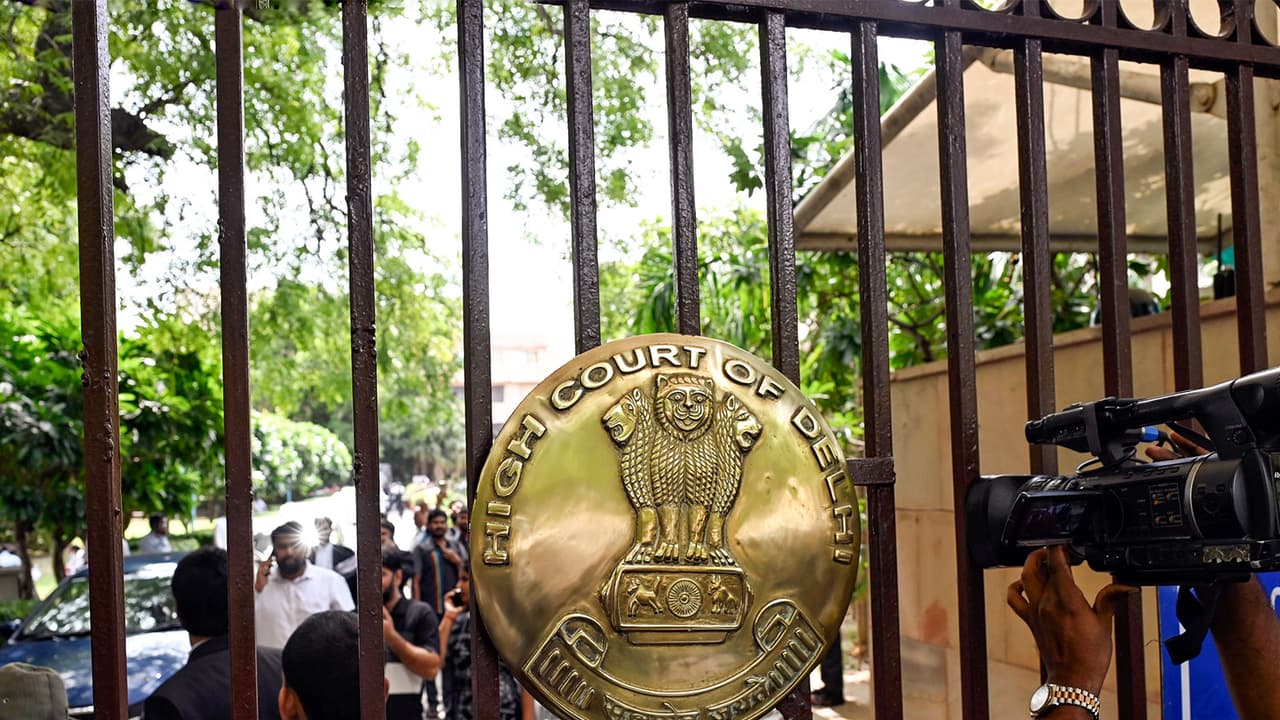
The Delhi High Court has questioned the ECI over deploying school teachers for electoral roll revision, asking it to explain the legal authority for such actions. The court was hearing a PIL challenging the move, which petitioners say disrupts education.
The Delhi High Court on Friday questioned the Election Commission of India (ECI) over its decision to deploy school teachers for Booth Level Officer (BLO) duties during the ongoing Special Intensive Revision (SIR) of electoral rolls in the national capital, asking under what authority teachers were being compelled to perform election work.
Court Questions ECI’s Legal Authority
A Division Bench of Chief Justice Devendra Kumar Upadhyaya and Justice Tejas Karia was hearing a Public Interest Litigation (PIL) filed by Advocates Rajesh Kumar Gogna and Ashok Agarwal, challenging the large-scale deployment of government, municipal and government-aided school teachers for BLO and SIR duties.
During the hearing, the Bench questioned whether the ECI could invoke Article 324 of the Constitution to justify any action it chooses. “Taking shade of Article 324, you do whatever you like?” the Chief Justice remarked, asking the Commission to explain the legal authority under which school teachers were being directed to perform SIR duties.
ECI Defends Deployment
Appearing for the ECI, Advocate Sanjay Vashishtha submitted that the Special Intensive Revision exercise in Delhi is almost complete and that only about 10 to 14 per cent of school teachers are eventually required for electoral roll revision work. He argued that the Commission’s power to requisition staff flows from Section 13B(2) of the Representation of the People Act and that the power is exercised sparingly to minimise inconvenience.
Court Rejects Holiday Work Justification
Vashishtha further submitted that teachers are required to perform BLO duties only during holidays and non-teaching hours, in accordance with the Election Commission’s instructions. The Bench, however, questioned why teachers should be required to sacrifice their holidays for election work. “Somebody is not interested in your honorarium or compensation. Can these instructions issued by you be said to be mandatory? Can you say no, no, no, we are compensating, please come. Destroy their holidays? Don’t they need rest?” the Court asked.
Petition Highlights Disruption to Education
The Court also noted that teachers who refuse to perform such duties can face disciplinary consequences, observing that although the ECI describes the personnel as “volunteers,” they effectively have no option but to comply. “Make a statement that this is voluntary, and we will dispose of the petition,” the Bench told the Commission.
The hearing assumes significance in light of a July 23, 2026 circular issued by the Office of the Chief Electoral Officer (CEO), Delhi, directing all District Election Officers to strictly follow the Election Commission’s instructions so that teachers’ academic responsibilities are not disrupted during the SIR exercise. The circular acknowledged concerns raised by the Directorate of Education and other representations that deployment orders issued by Electoral Registration Officers (EROs) and Assistant Electoral Registration Officers (AEROs) had resulted in the prolonged absence of teachers from schools. It directed that teachers should, as far as possible, perform SIR/BLO duties after school hours or in a manner that does not require their complete disengagement from teaching. It also reiterated that BLO work should ordinarily be assigned during holidays, non-teaching hours, after office hours and on non-teaching days so as to avoid any loss of academic work.
The petition seeks quashing of orders requisitioning more than 10 per cent of the regular teachers of any school for BLO and SIR duties or requiring teachers to perform election-related work during school hours. It also seeks directions to ensure that election work is assigned without disrupting classroom teaching and that the available pool of non-teaching staff is exhausted before teachers are deployed.
According to the petitioners, the large-scale requisition of teachers has severely disrupted education in government and municipal schools, with some schools allegedly losing their entire teaching staff to election work while private unaided schools continue functioning normally. They contend that this violates the fundamental rights of children studying in government schools under Articles 14, 21 and 21A of the Constitution. The petition further argues that the deployment is contrary to the Supreme Court’s judgment in Election Commission of India v. St. Mary’s School and violates the provisions of the Right of Children to Free and Compulsory Education Act, 2009, which protect instructional hours and mandate the prescribed pupil-teacher ratio. (ANI)
(Except for the headline, this story has not been edited by Asianet Newsable English staff and is published from a syndicated feed.)