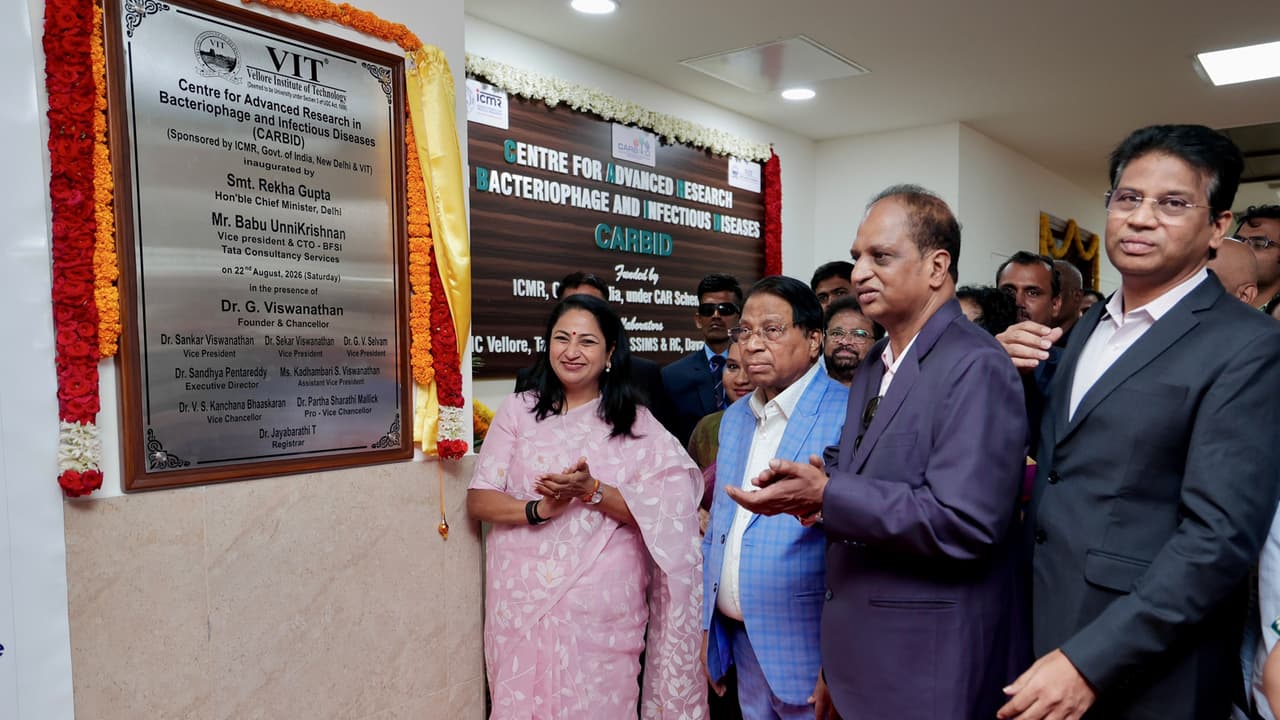
Delhi CM Rekha Gupta inaugurates CARBID at VIT Vellore, a research centre focused on bacteriophages, antimicrobial resistance and infectious diseases, with ICMR-backed projects exploring future treatment strategies.
India takes yet another stride in scientific research regarding infectious diseases and AMR. The Delhi Chief Minister, Rekha Gupta, has opened the Center for Advanced Research in Bacteriophage and Infectious Diseases (CARBID) at Vellore Institute of Technology (VIT) in Tamil Nadu on Saturday.
Founded under the aegis of the Indian Council of Medical Research (ICMR), the center will conduct studies relating to bacteriophages, drug-resistant bacteria, and research in advanced infectious diseases. It will strive to ensure that laboratory-based scientific studies are used to develop solutions for health problems in reality.
CARBID at VIT
CARBID has been founded under the ICMR Center for Advanced Research initiative. Among other things, it will undertake the study of bacteriophages and use them for the treatment of bacterial infections.
The virus called bacteriophages destroys bacteria. In this way, they can be potentially used in treatment because the development of antibiotic resistance has diminished the efficiency of many antibiotics.
Research on Antimicrobial Resistance
Antimicrobial resistance creates a threat because antibiotic-resistant bacteria become more difficult to cure. The research topics at CARBID cover MDR bacteria, ESKAPE pathogens, biofilms and combined therapy with bacteriophages and antibiotics.
The idea of CARBID is to conduct research that may have potential to help with the development of new infection control and treatment measures in the future.
From Laboratory Research to Public Health
CARBID will also carry out translational research, which involves moving the results of scientific studies from laboratories to healthcare practice.
Collaboration between scientists, physicians and institutions in India and overseas will be part of the activities of CARBID. The idea is not to limit ourselves to research alone but consider various technologies and methods of treatment that can be used in the future.
ICMR Research Projects Include Phage Research
According to VIT, CARBID has received funding for several ICMR research projects. These projects include the development of phage cocktails to cure acute respiratory infections caused by MDR ESKAPE pathogens.
A further ICMR-supported CAR project aims at developing bacteriophages for use against bacterial infections of the skin and musculoskeletal system. According to VIT, the duration of this project is 2024-2029, with the total cost being approximately ₹9.84 crore, with ₹4.82 crore allocated to VIT.
Why CARBID is Important
This center has been established in view of the increasing threat of antimicrobial resistance all over the world. The study of bacteriophages can be considered an alternative or complement to antibiotic therapy, but the clinical efficacy of this method requires additional research.
The creation of CARBID combines the research in the fields of infectious diseases and phages, as well as drug resistance, and thus becomes a foundation for finding ways to solve the problems of the future.