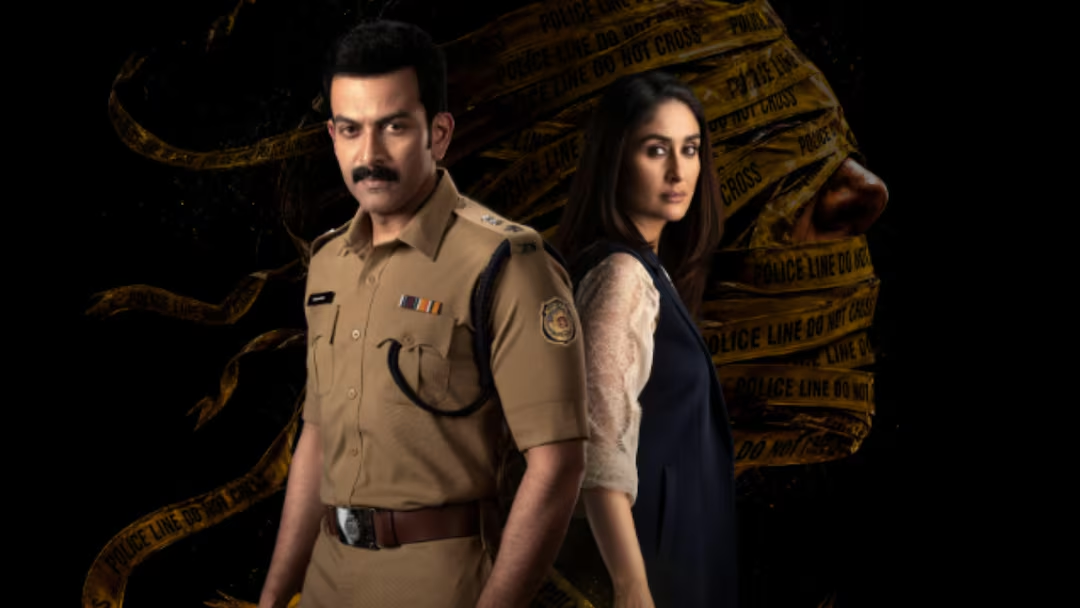
Daayra opens on an unsettling note, with a crowd celebrating an encounter killing, before cutting to the disappearance of a 24-year-old woman and the police investigation that follows. The opening stretch keeps you guessing, unsure where exactly the film is headed. Then Kareena Kapoor Khan makes her entry, and it’s an unexpected one that briefly injects fresh intrigue into the plot.
But that spark doesn’t last. For all its dark, socially charged premise, Daayra never quite manages to pull you into its world. The characters stay at arm’s length, and the narrative frequently slips into confusion rather than tension.
How Is The Story?
The film centres on the disappearance of a young woman who calls her family in panic, telling them her scooter has been stolen, her phone battery is dying, and that a truck driver has offered to help her track it down, though she admits she’s scared. Her mother rushes to the location but is met with indifference. At the police station, she’s turned away and told to go home. No FIR is filed because the case, she’s told, doesn’t fall under their jurisdiction.
What follows is a frustrating trail through CCTV footage. One camera is conveniently switched off, while another catches the woman parking her scooter near a toll plaza before she gets into an auto or a shared cab. Police stations keep bouncing the case between each other, each claiming it isn’t theirs to solve, and the investigation stalls further with every passing hour.
This is the case that draws DCP Ajooni Kohli, played by Kareena Kapoor Khan, and DCP Raman Kumar, played by Prithviraj, into direct conflict. As the investigation unravels into a brutal rape case, the two officers emerge as, in director Meghna Gulzar’s own words, yin and yang, clashing over justice, accountability, and just how far institutional authority should be allowed to stretch.
Whether the woman is found, and what the opening encounter was actually about, is left for the film to reveal. That’s where Daayra tries to build its central drama.
There are flashes where Daayra hits its mark, particularly in depicting police apathy and the bureaucratic loopholes that let cases slip through the cracks. Kareena gets one especially sharp line, describing the “daayra,” or circle, that law and order operates within, one with its own rigid limits. It lands as the thematic core of the film.
But the storytelling struggles to hold together. The first half is genuinely confusing, the kind that leaves you leaning over to whisper, “Wait, what just happened?” to the person sitting next to you. What feels like it should be layered instead comes across as disjointed. The second half swings in the opposite direction, packing in one development after another without giving any of them enough room to land.
The rape scene, which should have been the film’s emotional gut punch, ends up feeling surprisingly flat rather than devastating. Kareena Kapoor Khan, despite being one of the film’s biggest draws, is given surprisingly little to work with. By the end, Raman and Ajooni’s paths diverge in a symbolic, open-ended finale that feels more conceptual than earned.
Verdict
Daayra has all the raw material for a gripping, unsettling crime drama, but it never manages to fuse those pieces into a story that actually stays with you once the lights come up.
For a director like Meghna Gulzar, who has given us films like Raazi, taut, assured, and emotionally precise, this one feels like a rare miss. Daayra knows exactly what it wants to say, but never quite figures out how to say it effectively.