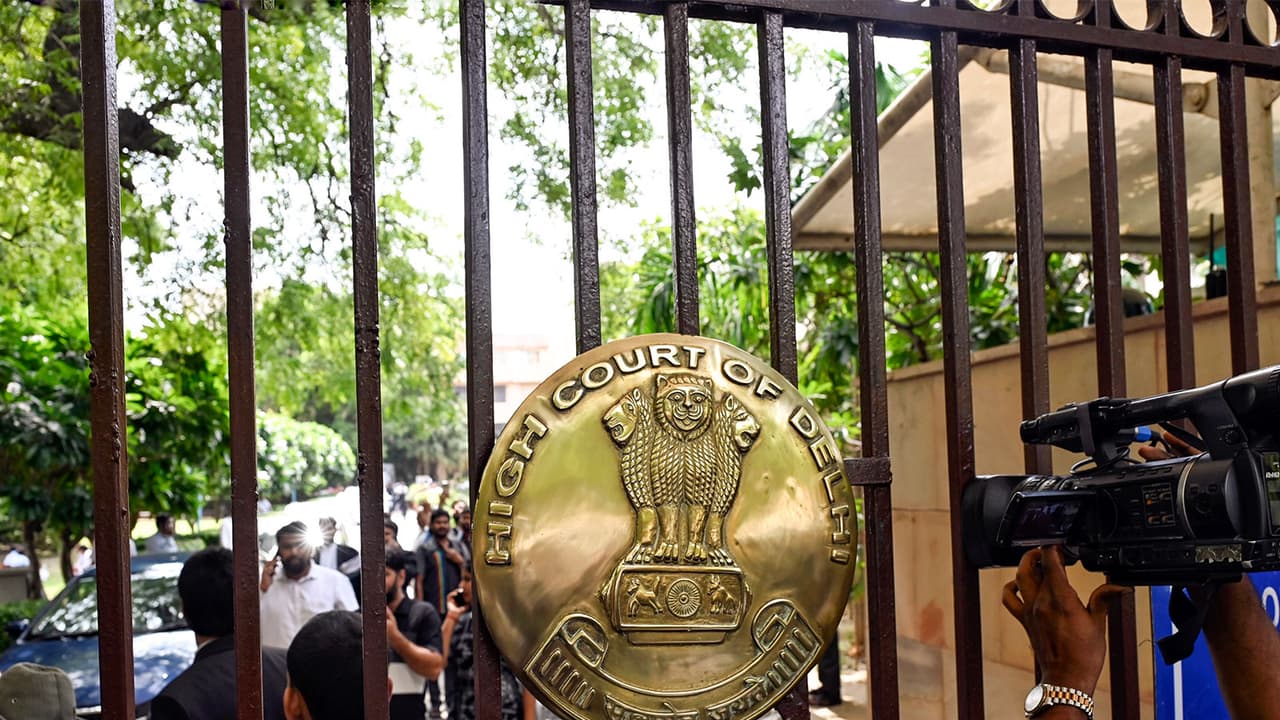
The Delhi High Court quashed an FIR against Hemkunt Foundation over alleged misuse of Covid-19 funds. The court ruled that allegations of cheating and criminal breach of trust were not disclosed by the material collected during the investigation.
The Delhi High Court on Tuesday quashed the FIR lodged against Hemkunt Foundation over alleged misuse of funds collected to help Covid 19 patients. It was alleged that the foundation had created a fixed deposit and transferred Rs. 38 crore to a health firm to purchase land. An FIR was lodged by the Special Cell of Delhi Police in 2022.
The High Court said that the allegations in the FIR and the material collected during investigation do not disclose cheating and criminal breach of trust. Justice Saurabh Banerjee quashed that FIR and the proceedings connected with it.
“Once the allegations contained in the FIR and the materials collected during investigation thereafter, do not disclose the essential ingredients of Section 406 IPC and/ or Section 420 of the IPC, no offence under Section 120B IPC can independently be maintainable or tried, and thus the FIR involved cannot itself survive,” Justice Banerjee said “Resultantly, in view of the afore-going discussions, the present FIR dated 22.01.2022 registered at Police Station: Special Cell, Delhi, and all the consequential proceedings arising therefrom, is hereby quashed,” he added.
Details of the Allegations
The petitioner filed a petition seeking quashing of FIR registered at Special Cell, Delhi under Sections 406, 420, 120B of IPC and all the consequential proceedings.
As per the FIR, secret information was received regarding suspicious financial activities by Hemkunt Foundation. The FIR alleged that the Foundation, on the pretext of providing relief to people suffering from the COVID-19 pandemic, particularly by posting emotional photos and videos, collected huge amounts of donations from the general public as well as from corporate entities in its bank accounts, amounting to an approximate sum of Rs.74.55 crores.
It was stated that out of the amount so collected, the petitioner created fixed deposits, as well as transferred Rs.38.31 crores to a firm called M/s. Dhruva Healthcare LLP for purchase of land. It also surfaced during the police inquiry that the said M/s. Dhruva Healthcare LLP was formed in the year 2006 as Dhruva Healthcare Private Limited, and had no business activity till July, 2021; however, subsequently, in August, 2021, the said company was converted to a Limited Liability Partnership (LLP) firm.
High Court’s Observations
The court said the charges about fraudulent collection of money are not borne by material(s) collected during investigation.
“In fact, contrary to that, it is the own case of the prosecution in the PMLA proceedings arising out of the present FIR that the petitioner has spent a substantial amount of Rs.5.18 crores on Covid-19 relief activities,” Justice Banerjee noted. The High Court said that as such, merely because the petitioner solicited donations on emotional appeal, it does not make out a case for deception.
“Moreover, the utilisation of the funds in a manner which, arguendo, is assumed to be inconsistent with the purpose for which the donations were solicited, cannot, by itself, constitute the offence of ‘cheating’, much less in the absence of material demonstrating deception and dishonest intention at the inception,” the judge said. “Accordingly, under such circumstances, the present FIR under Section 420 IPC is also not sustainable against the petitioner,” the High Court ordered.
Foundation’s Defense
The counsel for the Foundation had argued that the petitioner is a public charitable trust constituted on 17.02.2010 with various objects of charity and has always been engaged in various large-scale humanitarian and charitable works across India, including disaster relief operations in flood-affected States for support of farmers since its inception. In fact, during the Covid-19 pandemic, the petitioner undertook relief operations, including supply of Oxygen cylinders, medical kits and ration and food, which were recognized/ reported and acclaimed nationally and internationally, the counsel submitted.
It was argued that the present FIR is only a retaliation of the petitioner for rendering sewa during the farmers’ agitation, and in order to harass the petitioner. The counsel for Foundation said that initially, the Income Tax Department conducted search proceedings, where no incriminating materials were found against the petitioner and, thereafter, the petitioner and its trustees were implicated in a false case under the Prevention of Money Laundering Act, 20025, for which a scheduled offence was contrived by getting the present FIR registered.
It was submitted that there is no victim in the present proceedings as nobody has come forward or made any complaint with the police regarding cheating or entrustment against the petitioner so as to trigger the present FIR. Similarly, there is no injured person herein as well. The present FIR has been registered “pursuant to secret information” and on the complaint of the SI, who, admittedly, is not the victim and thus had no locus standi to put the criminal law in motion, the counsel submitted.
Prosecution’s Arguments
The prosecution opposed the petition and said that the investigation prima facie disclosed commission of the offences under Sections 406, 420, 120B IPC. Additional Public Prosecutor (APP) submitted that the donations were solicited through social media campaigns, crowdfunding platforms and public appeals, with specific representations that the funds would be utilised exclusively towards Covid-19 relief activities, including procurement of oxygen cylinders, oxygen concentrators, medicines and other emergency medical supplies.
He said acting on such representations, thousands of individual donors and various corporate entities had parted with substantial amounts in favour of the petitioner, which can also be seen from the transaction narrations accompanying several donations wherein it has been mentioned “Covid”, “Corona” and “Oxygen”. Thus, delivery of property was therefore a direct consequence of the representation made by the petitioner, the APP had argued.
The Police said that the petitioner (Foundation) was exclusively managed and controlled by members of a single family and that there was no independent trustee or governing member outside the said family. They exercised exclusive control over the petitioner, its bank accounts and the donated funds facilitated the subsequent movement and utilisation thereof. The aforesaid, prima facie, show their common control and concerted action, the APP said in his arguments. (ANI)
(Except for the headline, this story has not been edited by Asianet Newsable English staff and is published from a syndicated feed.)