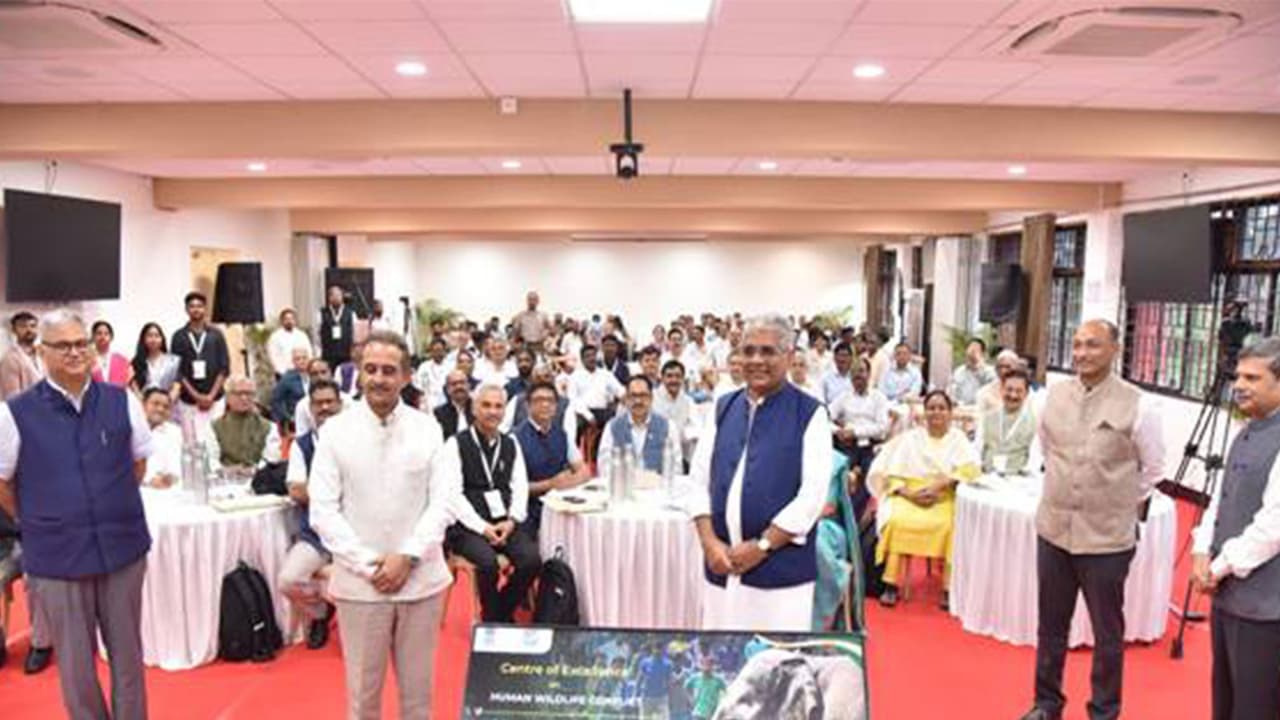
Union Minister Bhupender Yadav inaugurated the Centre of Excellence on Human-Wildlife Conflict in Coimbatore. The centre will serve as a national hub for research, innovation, and policy support to scientifically manage rising human-wildlife interactions.
Union Minister for Environment, Forest and Climate Change Bhupender Yadav on Friday inaugurated the Centre of Excellence (CoE) on Human-Wildlife Conflict at Coimbatore, established to strengthen research, innovation, policy support and capacity building for managing human-wildlife interactions across the country.
According to an official release, the inauguration was followed by a National Workshop on Human-Wildlife Conflict, which brought together senior policymakers, forest managers, scientists, researchers, technology experts and conservation practitioners from across India to deliberate on effective strategies for mitigating human-wildlife conflict. The event was attended by Union Minister of State for Environment, Forest and Climate Change Kirti Vardhan Singh.
A Solution-Oriented Approach
Delivering the keynote address on the occasion, Bhupender Yadav said increasing interactions between humans and wildlife due to habitat fragmentation, changing land-use patterns and expanding human activities have made human-wildlife conflict one of India’s major conservation and development challenges. “Our approach should be solution-oriented, instead of being problem-oriented, utilising modern technological advances,” Yadav said.
Role of the Centre of Excellence
The Minister said that the newly established Centre of Excellence, announced by Prime Minister Narendra Modi during the 7th Meeting of the National Board for Wildlife, will act as a national hub for research, innovation, policy support, capacity building and dissemination of best practices to promote scientific and evidence-based management of human-wildlife conflict.
The Minister also desired that the institute must focus on a strategy to form a policy to manage conflicts of tigers outside tiger reserves, leopards and elephants with humans. He stated that awareness generation needs to be carried out in mission mode, in urban as well as rural areas, on how to deal with human-wildlife encounters. The approach needs to involve area-specific as well as species-specific measures to address human-wildlife conflict. This would go a long way in addressing panic in society, he stated.
Yadav also urged the forest departments across the country to take proactive preventive measures in managing the conflicts and damage caused to human establishments and crops. This, he said, must be done by addressing the issues in a coordinated manner with the respective communities, through multi-stakeholder consultations. Innovative best practices must be evolved and implemented widely on the ground, by using the latest technologies in wildlife conservation. “Coexistence and harmony, instead of conflict, should be the mantra of ecological sustainability”, the Minister said while concluding his address.
Balancing Conservation with Progress
Addressing the gathering, Union Minister of State for Environment, Forest and Climate Change Kirti Vardhan Singh said the success of wildlife conservation efforts has led to increased human-wildlife interactions, creating a larger socio-economic challenge apart from being a conservation concern. He said there is a need to find long-term solutions by balancing wildlife conservation with the socio-economic progress of the country. Singh expressed hope that the Centre of Excellence would play a significant role in capacity building of officials and communities while promoting the use of advanced technologies for data documentation and conservation efforts.
Digital Tools and Publications Launched
During the inaugural session, the Minister also launched the National Human-Wildlife Conflict Portal, a digital platform designed to facilitate data management, knowledge sharing and decision support for conflict mitigation across the country.
The first edition of a series of publications titled ‘Current Status of Human-Wildlife Conflict in India: An Overview’ was also released, providing a comprehensive assessment of the current status, trends and emerging challenges related to human-wildlife conflict in India.
Workshop Sessions and Discussions
The technical sessions of the workshop included a live demonstration of the Human-Wildlife Conflict Portal, followed by expert presentations and panel discussions on ‘Human-Elephant Conflict’, ‘Human-Big Cat Conflict’, and ‘Technology and Innovation for Human-Wildlife Conflict Mitigation’. The discussions are expected to help formulate actionable recommendations for strengthening national strategies on human-wildlife conflict management, encouraging technological innovation, improving coordination among stakeholders and promoting peaceful coexistence between people and wildlife.
Government’s Commitment to Coexistence
As per the release, the establishment of the Centre of Excellence reflects the Government of India’s continued commitment to balancing biodiversity conservation with the protection of human lives and livelihoods through science-based, technology-enabled and community-oriented approaches.
Senior officials present on the occasion included the Secretary, Ministry of Environment, Forest and Climate Change; Director General of Forests and Special Secretary; Additional Director General (Wildlife); Director of the Wildlife Institute of India; senior officials from the ministry, state forest departments, academic institutions and partner organisations. (ANI)
(Except for the headline, this story has not been edited by Asianet Newsable English staff and is published from a syndicated feed.)