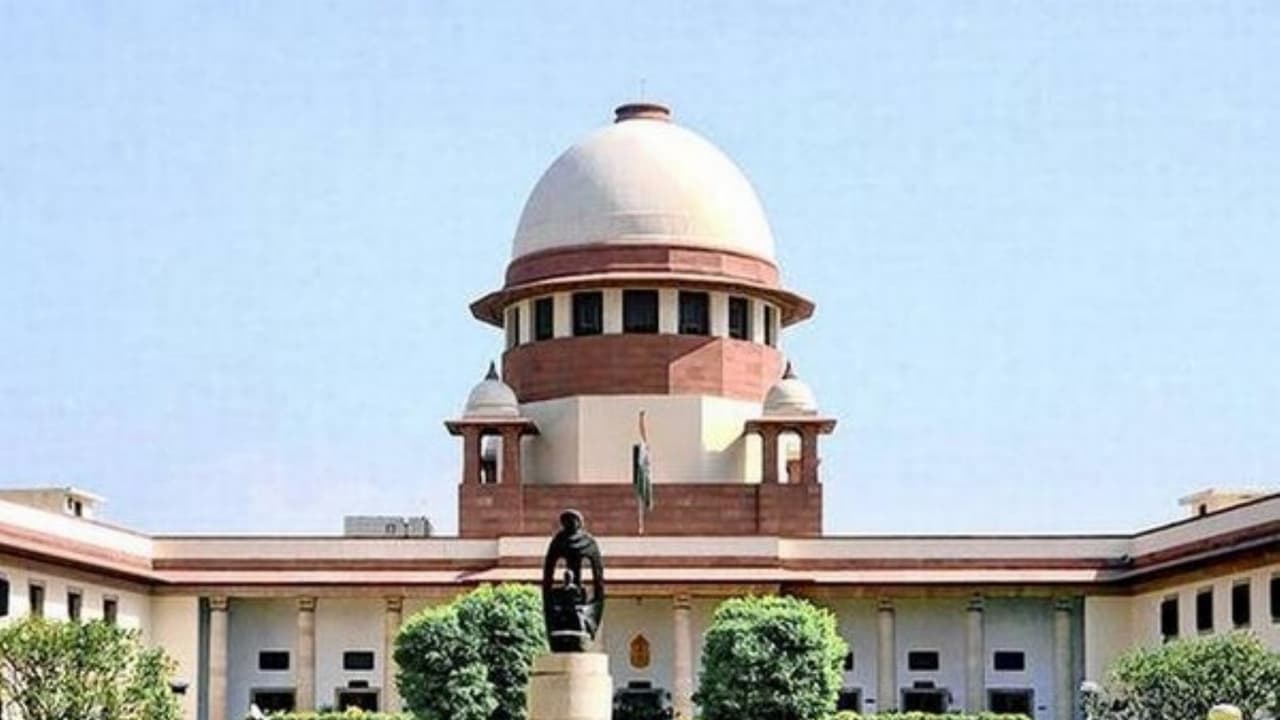
The Supreme Court delivered a split verdict on referring pleas against the 2023 CEC appointment law to a larger bench. Despite the differing opinions, the bench unanimously directed the matter to be placed before the CJI for this consideration.
The Supreme Court on Wednesday delivered a split verdict on whether pleas challenging the validity of the 2023 law relating to the appointment of the Chief Election Commissioner (CEC) and Election Commissioners, which dropped the CJI from the selection panel for Election Commissioners, should be referred to a larger five-judge bench.
A division bench of Justices Dipankar Datta and Satish Chandra Sharma differed on the question. While Justice Datta rejected the plea for reference to a larger bench, Justice Sharma held that the issue warranted consideration by a Constitution bench. The bench, however, unanimously directed that the matter be placed before the Chief Justice of India for considering the constitution of a Constitution bench of appropriate strength, observing that referring the question first to a three-judge bench would unnecessarily delay the proceedings.
Challenge Against New Appointment Law
The petitions challenged the 2023 law, which replaced the selection mechanism prescribed by the Supreme Court in its 2023 judgment in Anoop Baranwal and excluded the CJI from the selection committee. Under the new law, the committee comprises the Prime Minister, a Union Cabinet Minister nominated by the Prime Minister and the Leader of Opposition in the Lok Sabha.
Split Verdict Explained
Justice Datta Questions Executive’s Role
Justice Datta prima facie questioned whether the mechanism under the 2023 Act ensures an independent selection process and observed that the composition of the committee appeared to give the Executive a veto and raised concerns over whether the process would inspire public confidence in the independence of the Election Commission.
“Free and fair elections depend on a truly independent ECI. It is not enough for the ECI to be independent; it must appear to be independent,” Justice Datta observed. He questioned whether a nominee of the Prime Minister could reasonably be expected to vote against the Prime Minister and said the inclusion of Cabinet Ministers did not provide an independent counterweight to the Executive.
Justice Sharma for Constitution Bench Review
Justice Sharma, on the other hand, held that the constitutional validity of the 2023 law raised an issue that required authoritative determination by a Constitution bench under Article 145(3) of the Constitution.
Debate Over Referral to Larger Bench
The Central government sought reference of petitions to a larger bench. The petitioners had opposed the Centre’s request, arguing that referring the matter to a larger bench could further delay its adjudication.
The bench acknowledged concerns over the prolonged pendency of cases referred to larger benches, observing that constitutional matters often remain pending for years. “The petitioners seem to be justified in saying references remain pending for years. Undisputedly, this is an area of great concern. Self-introspection indeed is required,” the bench observed.
The bench further requested the Chief Justice of India to consider constituting a permanent five-judge bench to hear and decide constitutional matters, with a view to addressing delays in the adjudication of cases requiring consideration by larger benches.
Details of the Legal Challenge
The apex court had reserved its judgment in July on the question of whether the challenges to the 2023 law should be placed before a Constitution bench. In 2024, the apex court had declined to put on hold the two Election Commissioners’ appointments under the Chief Election Commissioner and Other Election Commissioners Act, 2023.
The pleas were filed in the apex court seeking a stay on the Act by the Association for Democratic Reforms (ADR) and Jaya Thakur (General Secretary of the Madhya Pradesh Mahila Congress Committee), Sanjay Narayanrao Meshram, Dharmendra Singh Kushwaha, and advocate Gopal Singh.
The petitions stated that the provisions of the enactment are violative of the principle of free and fair elections since it does not provide an “independent mechanism” for appointment of the members of the Election Commission of India (ECI).
The petitions said the Act excludes the Chief Justice of India from the process of appointment of the members of the ECI and it’s in violation of the March 2, 2023 verdict of the top court, which had ordered that the appointment of members of the ECI be done on the advice of a committee comprising the Prime Minister, the CJI and the Leader of Opposition in Lok Sabha till a law is made by the Parliament. By excluding the CJI from the process, the judgement of the Supreme Court stands diluted as the Prime Minister and his nominee will always be “the deciding factor” in the appointments, said the petitioners.
The petitions in particular challenged Sections 7 and 8 of the Chief Election Commissioner and Other Election Commissioners (Appointment, Conditions of Service and Term of Office) Act, 2023. The provisions lay down the procedure for the appointment of ECI members. They sought direction to the Centre to include the Chief Justice of India in the selection committee for the appointment of the CEC and ECs, which currently comprises of the Prime Minister, the Leader of the Opposition in Lok Sabha and a Union Cabinet Minister nominated by the Prime Minister. The Act replaced the Election Commission (Conditions of Service of Election Commissioners and Transaction of Business) Act, 1991. (ANI)
(Except for the headline, this story has not been edited by Asianet Newsable English staff and is published from a syndicated feed.)