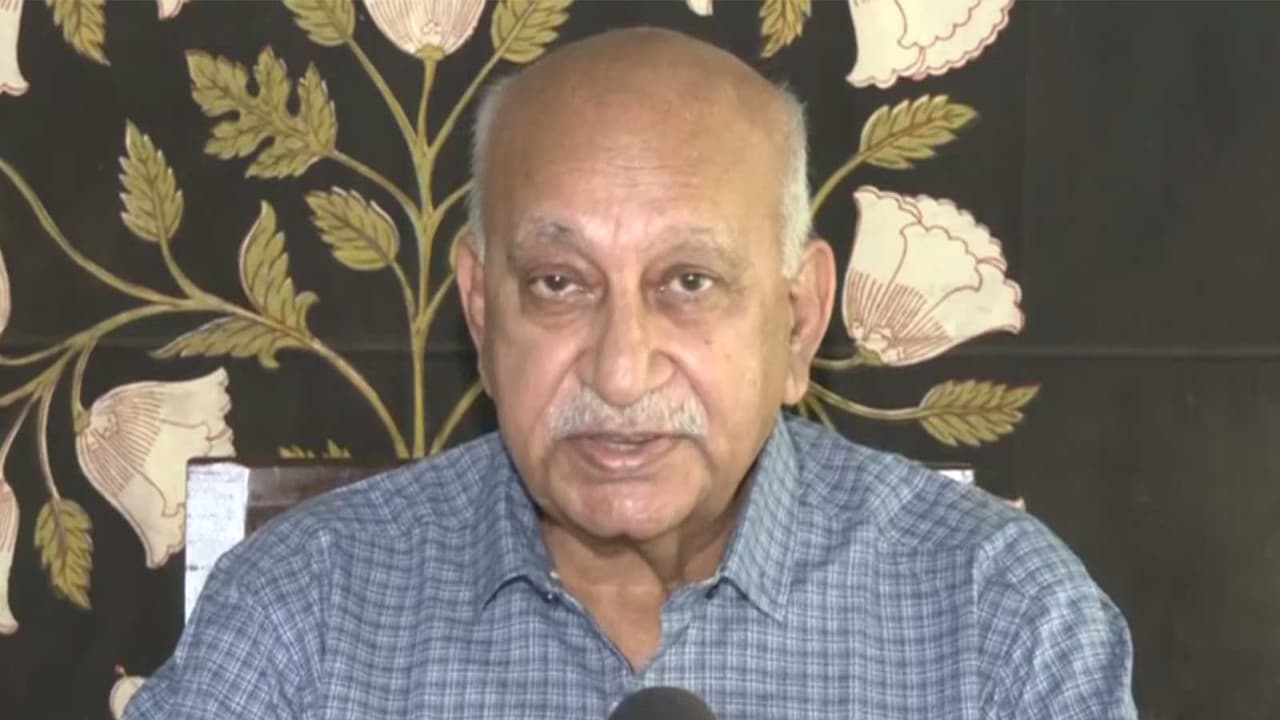
Former Union Minister MJ Akbar slammed Pak PM Shehbaz Sharif’s Indus Waters Treaty remarks, stating ‘blood and water will not flow together’ and that Islamabad must first answer for every drop of Indian blood lost to terrorism.
Former Union Minister MJ Akbar on Friday hit back at Pakistan Prime Minister Shehbaz Sharif’s remarks on the Indus Waters Treaty (IWT), saying Islamabad must first answer for every drop of Indian blood lost in terror attacks before raising concerns over water.
Akbar’s remarks came after Sharif, speaking on the eve of Pakistan’s Independence Day, indulged in hollow and empty rhetoric against Indian stating that every drop of Pakistan’s water is a “red line” and calling for a “direct response” if New Delhi did not “come to the right path” over the IWT.
“Pakistan’s Prime Minister Shehbaz Sharif is worried about every single drop of water on the Indus, saying it is a red line. The message from India is different. Every single drop of Indian blood lost to terrorists, lost to terrorism sponsored by Pakistan, needs accountability. Pakistan has to give an answer. That is the answer that India is searching for. Blood and water will not flow together,” Akbar said.
Sharif had accused India of being an “enemy of peace” over New Delhi’s decision to keep the Indus Waters Treaty in abeyance. Following the April 22, 2025 terror attack in Jammu and Kashmir’s Pahalgam, India kept the Indus Waters Treaty in abeyance after a Cabinet Committee on Security (CCS) meeting on April 23, 2025 and asserted that the conditions under which the treaty was negotiated have fundamentally changed. India has stated that the treaty can no longer function in its present form and will remain in abeyance until Pakistan “credibly and irrevocably” ends its support for cross-border terrorism.
Akbar on Pakistan’s Internal Instability
Akbar also invoked remarks by Pakistani political leader Maulana Fazlur Rehman while questioning Islamabad’s ability to exercise control over parts of its own territory. “The full truth about Pakistan has been exposed by a very major Pakistani leader, Maulana Fazlur Rehman, head of their Jamiat. He has told the Pakistani government, the Prime Minister as well as the real chief of Pakistan, their Field Marshal Asim Munir, who is the head of their armed forces. He has told them to first gargle before they say anything, because he hints that their voices have become unclean with the untruth,” he said.
Akbar went on to slam the security situation in Balochistan. “The truth about Pakistan, which he has exposed himself, is that more than 80 per cent of Balochistan today is outside the control and governance of Islamabad. 80 per cent of Balochistan is virtually independent; it is free. It is certainly outside the control. Pakistan is the only government which bombs its own country. In the last 24 hours, Pakistan has bombed Pakistan in Balochistan,” he said.
According to Human Rights Defender and Baloch Activist Zara Baloch, more than 20 civilians, including innocent children, were killed in a strike by Pakistani forces. He described Pakistan as being in a state of deepening instability, arguing that the country’s internal challenges have increasingly overshadowed its rhetoric against India.
“The fact of the matter is that Pakistan on its Independence Day is crumbling. It has become what I have described in my book as a jelly state, which will neither be stable nor will it disappear,” Akbar said.
“The truth about Pakistan is known to those who have suffered the brutality of the Pakistan army in Pak-occupied Kashmir, in Khyber Pakhtunkhwa, and in Sindh. And this truth is known to the Pakistani people. Pakistan is on the edge,” he added.
India Links IWT Future to End of Terrorism
Sharif’s latest remark has come as Pakistan continues to face a range of security and political challenges. Militant violence remains a major concern in Khyber Pakhtunkhwa, while Balochistan has witnessed continuing unrest and allegations of human rights violations. Pakistan-occupied Jammu and Kashmir has also faced protests, political tensions and allegations of excessive use of force. At the same time, former Pakistan Prime Minister Imran Khan remains imprisoned, with his family and supporters continuing to raise concerns over his access to family members, lawyers and medical professionals.
Against this backdrop, Sharif’s decision to make India’s water policy a central focus of his Independence Day remarks has drawn criticism from Akbar, who argued that Islamabad should first address the consequences of terrorism and instability within Pakistan. For India, the central issue remains clear: New Delhi has repeatedly linked the future of the IWT to Pakistan taking credible and irreversible action against cross-border terrorism. Akbar’s “blood and water” formulation therefore puts the dispute in the broader context of India’s long-standing argument that normal bilateral arrangements cannot be insulated from continued security concerns and terror attacks.
(Except for the headline, this story has not been edited by Asianetnews Editorial staff and is published from a syndicated feed.)