England secured a series-clinching victory over Sri Lanka in the third ODI at The Oval, but the match will be remembered as much for a highly unusual umpiring sequence as for the result itself.
Pavan Rathnayake was given out, then not out, and then out again, with the entire process taking approximately four minutes to resolve.
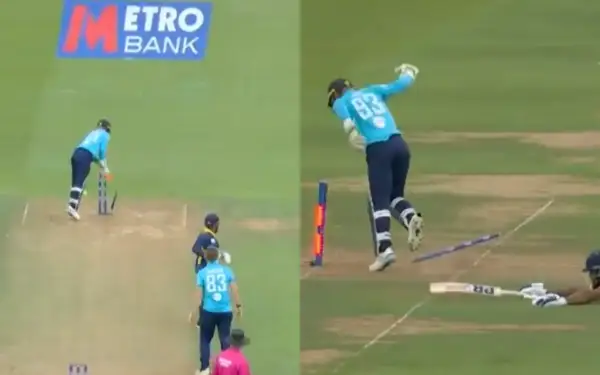
The passage of play occurred in the 15th over of Sri Lanka’s run-chase. Charith Asalanka steered Liam Dawson to short third, and Jofra Archer‘s throw at the keeper’s end found Rathnayake well short of his ground. The LED lights on the stumps and bails flashed, and square-leg umpire Rob White initially gave Rathnayake out on-field without referring to TV umpire Adrian Holdstock. After consultation with standing umpire Wayne Knights, White did refer the decision.
Replays showed that wicketkeeper Jordan Cox‘s gloves had dislodged the bails just before the ball struck the stumps. Holdstock appeared to overturn the decision after around two minutes of deliberation, with ‘not out’ flashing on the big screen at The Oval. However, Holdstock continued to review the matter during the drinks break and, after a further 90 seconds, gave Rathnayake out for 18. The decision was ultimately correct: while Cox’s gloves had removed the bails, Archer’s throw had uprooted the stump entirely, which under MCC Law constitutes a fairly broken wicket.
Which MCC Laws made this dismissal stand?
The decision rested on two specific sub-clauses within MCC Law 29.2, which governs how a wicket is fairly broken. Both clauses were relevant to the sequence of events at The Oval, and together they explain why Rathnayake’s dismissal was upheld despite the bails having already been dislodged before the ball reached the stumps.
“The wicket is broken fairly if a bail is completely removed from the top of the stumps, or a stump is struck out of the ground by the ball,” MCC Law 29.2.1.1 reads, as quoted by Cricinfo.
“The wicket is also broken fairly if a fielder strikes or pulls a stump out of the ground (as in 29.2.1.5),” MCC Law 29.2.1.6 reads, via the aforementioned source.
Former England batter Mark Butcher described the circumstances as highly unusual, stating that he had never seen such circumstances take place before.
“What I find hard to believe is that in all the years I’ve either played or commentated on the game, I’ve never seen this before or heard that Law before. Everybody knows that if you break the stumps and the bails come off, then you need to get the ball in your hand and take the stump out in order to affect the run-out. I’ve never heard the sub-Law about the throw knocking the stump out of the ground, and that counting as a dismissal,” Butcher said on Sky Sports.
What happens next after the Oval decision?
The dismissal drew widespread attention beyond the match itself, with players and commentators alike admitting they had not previously encountered this particular application of the Laws. MCC, who write and interpret the Laws of Cricket, are expected to clarify the decision in the coming days.
Tom Banton, who was named Player of the Match after scoring his maiden international hundred during England’s innings, admitted he was equally surprised by the sequence. Rathnayake’s dismissal had clearly puzzled those in the England dressing room as well.
“I’ll be honest, I have never seen that before, so I actually don’t know. But we take the mick out of Jamie Overton because he seems to know everything, and he said it was out straight away,” Banton said, as quoted by Cricinfo.