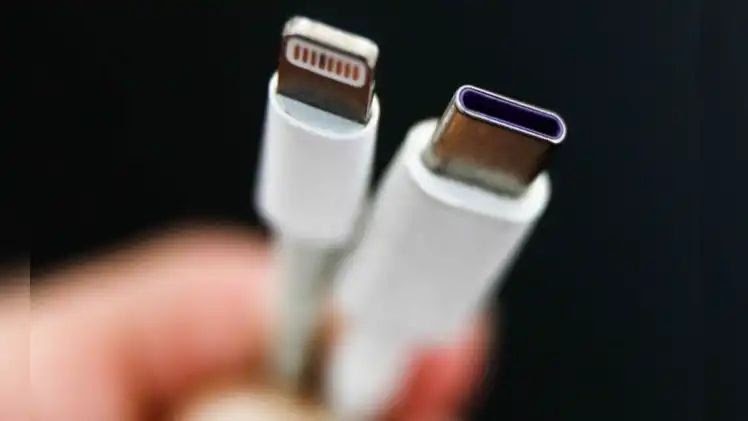
Today, the use of Type-C charging port has become common in smartphones, laptops, tablets, smartwatches and even small electronic gadgets. In the last few years, Type-C technology has revolutionized the world of charging and data transfer.
Almost every new smartphone and electronic device is now coming in the market with this port. However, most of the millions of people who use it daily do not know what the real meaning of ‘C’ present in Type-C is. Many types of notions and claims keep coming up regarding this on social media and internet, but according to technical experts, most of the people have wrong information about it.
There are many types of USB (Universal Serial Bus) connectors in the technological world. In the initial phase, USB Type-A and Type-B were most popular. The biggest problem with these connectors was that they could only be installed in a certain direction. If the user tried to insert it in the wrong direction, there was a risk of damage to the port or cable. To overcome this problem, engineers developed a new and more convenient connector, which was named USB Type-C.
According to experts, there is no official full form of ‘C’ present in Type-C. This is just a name indicating the design and category of the connector. Just as USB Type-A and USB Type-B existed earlier, the new design was named Type-C. Many people believe that ‘C’ means any special technology, charging capability or is related to third generation, but according to technical standards it is not so. This name was kept only to identify the new format of USB connector.
The biggest feature of Type-C technology is its reversible design. This means that the user can insert the cable into the port from any direction. This not only increases convenience but also reduces the possibility of damage to ports and cables. This is the reason why big tech companies around the world gradually started adopting it and today it has become a global standard.
Type-C is known not only for charging but also for high-speed data transfer. Modern Type-C ports and cables are capable of transferring data at speeds of several Gbps. Apart from this, this technology also supports video and audio transmission. Many laptops and smart devices can connect monitors, projectors, and TVs directly through the Type-C port. This is why it is seen as a multipurpose connector.
However, technical experts also clarify that not all Type-C cables and ports are the same. Two Type-C cables that appear similar may have different capabilities. Some cables are designed only for normal charging, while some support advanced features like high-speed data transfer, fast charging, and video output. So just having a Type-C port does not mean that every device will provide the same speed or features.
Over the past few years, many countries, including the European Union, have taken steps towards adopting Type-C as a standard charging port with the aim of reducing electronic waste and providing convenience to consumers. Following EU rules, many big companies had to include Type-C ports in their products. Its biggest advantage is that now the need for consumers to keep separate chargers for different devices has reduced.
Experts associated with the technology industry say that the future of Type-C is going to get stronger. Its charging capacity, data transfer speed and other technical features are being continuously improved over time. With the help of technologies like USB Power Delivery, smartphones to high-performance laptops can now be charged rapidly through Type-C port. This is the reason why this port can remain the main standard of the technical world in the coming years.
Experts believe that common consumers should also understand the technical specifications of the port instead of relying only on its name. If a person wants to use features like fast charging, high-speed data transfer or video output, he should ensure that both his cable and device support the respective standards. Otherwise, despite having a Type-C port, the expected performance will not be achieved.
In the rapidly changing era of technology, Type-C has become a common term today, but many misconceptions still exist about it. The most important fact is that there is no official full form of ‘C’ present in Type-C. It is simply the name of a modern and advanced form of USB connector, which has made the world of charging and data transfer easier, faster and convenient than ever before.