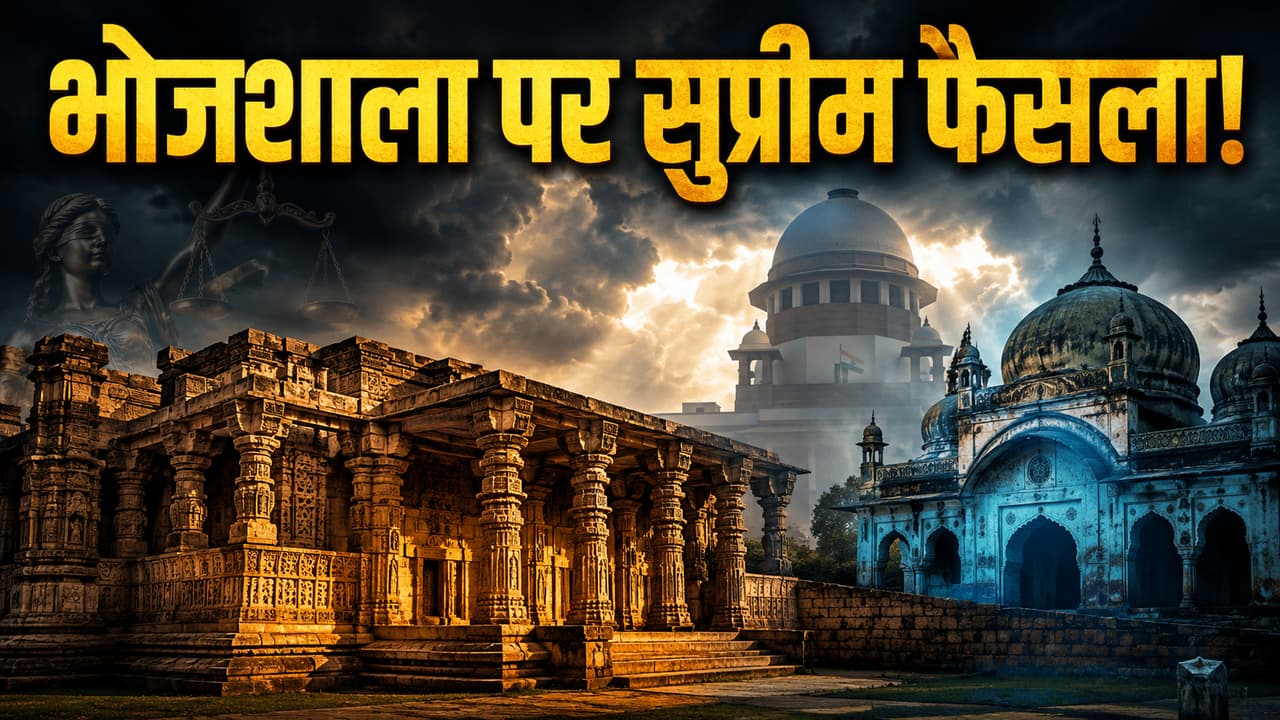
Big decision of Supreme Court in Bhojshala dispute! Denial of interim relief on Friday prayers, order to MP government to provide alternative place. Now what will change from daily hearing?
New Delhi: The Bhojshala-Kamal Maula Masjid dispute located in Dhar, Madhya Pradesh has once again reached the Supreme Court of the country. On Tuesday, the Supreme Court described the matter as “extremely sensitive” and made it clear that no order will be given in haste that could deepen the controversy. The court refused to grant interim relief on the demand of the Muslim side seeking permission for Friday prayers inside the Bhojshala premises. However, the court directed the Madhya Pradesh government to provide a suitable open space near the disputed site for Muslims to offer prayers between 1 pm and 3 pm on Friday. The court also restrained the Archaeological Survey of India (ASI) from making any structural changes without the court’s permission.
Now hearing will be held every day, efforts will be made to find a solution
A bench headed by Chief Justice Surya Kant, also comprising Justices Joymalya Bagchi and V. Mohana, said that every word used in this case can have far-reaching implications. Therefore, all parties will have to exercise restraint. The bench also indicated that instead of prolonging the dispute, the court is ready for daily hearing so that after hearing the arguments of all the parties, it can move towards an early resolution.
Mysterious Bhojshala: Is it a temple or a mosque?
The history of Bhojshala, which has been surrounded by controversies for centuries, is as rich as it is complicated. The Hindu community strongly believes that this complex is a sacred temple of Vagdevi (Goddess Saraswati) and a Sanskrit learning center built by King Bhoj. On the other hand, the Muslim side claims that the site has been used as the Kamal Maula Mosque for generations. In 2003, the Archaeological Survey of India (ASI) made an arbitrage arrangement, under which the Hindu side was allowed to offer prayers on Tuesday and the Muslim side was allowed to offer namaz on Friday. But now this system is buried in the pages of history.
Test of ‘patience’ at the doorstep of justice: Supreme Court bluntly
The bench of Supreme Court Chief Justice Surya Kant, Justice Joymalya Bagchi and Justice V. Mohana, sensing the sensitivity of this matter, has given a strong message to both the parties. The court said in clear words: “Bhojshala is a very sensitive matter. We have to be extremely careful about every single word used here.” The court has appealed to both the parties to maintain peace and patience and has committed to conduct daily hearings to resolve the matter at the earliest.
‘Suspense’ ends on Friday prayers: What is the interim order of the Supreme Court?
The Muslim side had challenged the Madhya Pradesh High Court’s decision declaring Bhojshala a temple and taking away their right to offer namaz inside the premises. The Muslim side expected from the Supreme Court that they would get interim relief to offer Friday prayers on the campus, but the apex court clearly refused to put a stay on it or give any interim order. However, keeping the scales of justice balanced, the Supreme Court has given an important direction to the Madhya Pradesh government. The government has been ordered to provide an ‘open space’ near the Bhojshala premises for people of the Muslim community to offer namaz between 1:00 pm and 3:00 pm on Friday.
Why did the High Court’s decision change the whole situation?
In May this year, the Madhya Pradesh High Court had quashed ASI’s 2003 arrangement, under which Hindus used to offer puja on Tuesday and Muslims on Friday. The High Court said in its decision that the available historical and archaeological evidence points towards Bhojshala being a temple and a Sanskrit teaching centre. The Muslim side has challenged this decision in the Supreme Court.
The truth of 2,000 pages, which changed the whole story!
The biggest turning point in this entire matter came when on the orders of Madhya Pradesh High Court, ASI started the scientific survey of Bhojshala complex from March 11, 2024. After this intensive research which lasted for 98 days, ASI submitted a detailed report of more than 2,000 pages to the court. This report added fuel to the fire of controversy:
- Remains of the temple: According to reports, before the construction of the present structure, a huge temple dating back to the Paramara kings existed there.
- Evidence of reconstruction: The report claimed that pillars, stones and carved parts of the pre-existing temple were reused to build the present disputed structure.
- Statues and Coins: The Hindu side claims that the ancient coins, inscriptions and sculptures found during the survey are irrefutable proof that it was originally a temple of Mother Saraswati.
Accusation of ‘bias’ and unresolved question of future
In May this year, the High Court, based on the ASI report, had canceled the 2003 order under which Muslims were allowed to offer Friday prayers there. Disagreeing with this decision, the Muslim side has approached the Supreme Court. Muslim petitioners allege that this ASI survey report is completely “biased” and has been prepared only to strengthen the claims of the Hindu side.
What has changed now and what will happen next?
After the latest order of the Supreme Court, at present Friday prayers will not be allowed inside the disputed premises. Instead the state government will have to provide alternative space. At the same time, ASI will not be able to do any kind of construction or structural change without the permission of the court. Now everyone’s eyes are on the biggest court of the country. The Supreme Court has also given strict instructions to the ASI that no change or tampering of any kind will be done in the original structure of the Bhojshala without the written permission of the court. Will the Supreme Court be able to solve this historical and religious conundrum? Will these daily hearings yield any acceptable solution that is acceptable to both parties? Only time will tell.