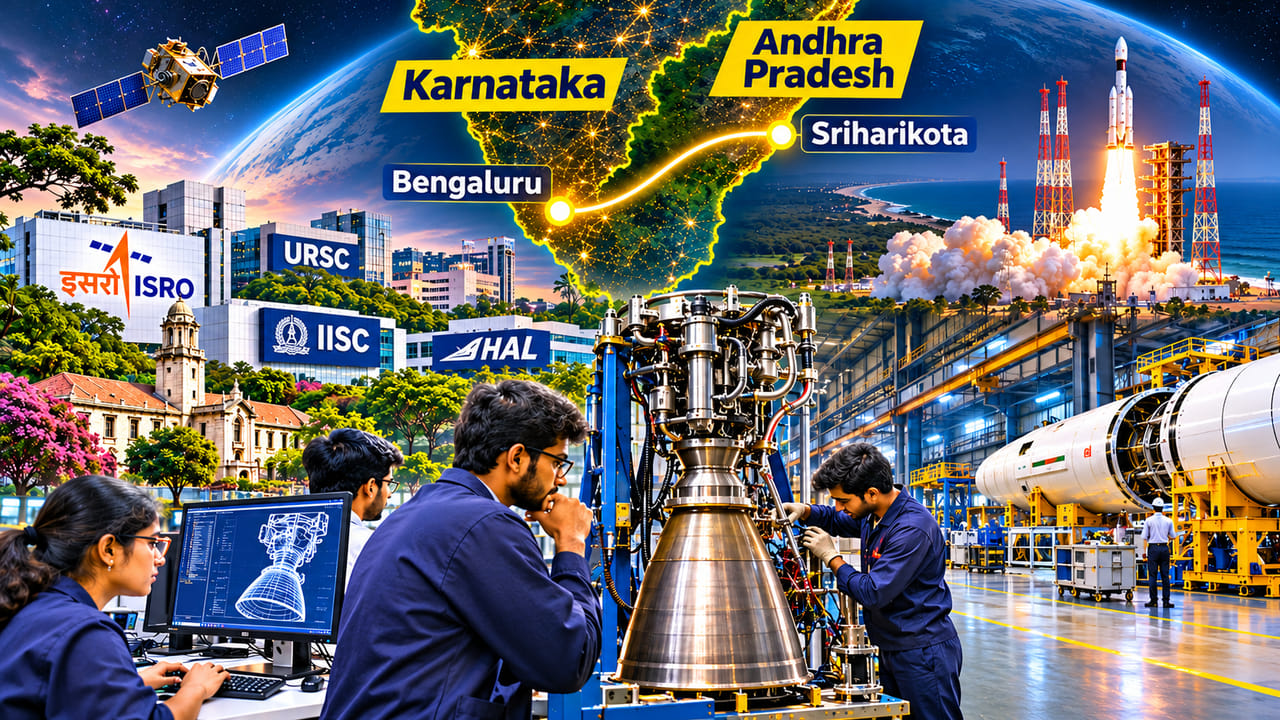
Karnataka and Andhra Pradesh are emerging as complementary rivals in India’s private space race, setting closely matched investment targets of ₹27,600 crore and ₹25,000 crore, respectively.
For decades, India’s journey into space has been planned, designed and dreamed up largely in one city. Bengaluru houses ISRO’s headquarters, the U R Rao Satellite Centre, IISc and HAL. More than 2,500 firms in Karnataka already supply ISRO, and the state’s startups have drawn about ₹1,380 crore, roughly 35 per cent of India’s NewSpace funding, as the money flowing into the country’s new private space companies is called.
Karnataka has no intention of resting on that legacy. Its Space Technology Policy, cleared by the state Cabinet in November 2025, wants half of India’s space technology market, a business worth more than ₹2 lakh crore, by 2033. It seeks ₹27,600 crore in investment and promises to train 50,000 professionals and back 500 startups and MSMEs, the micro, small and medium enterprises that form the backbone of Indian industry. Supporting it are ₹225 crore in incentives, a Space Manufacturing Park planned with the national space regulator IN-SPACe, and India’s first state-led Centre of Excellence for Space Technology, opened in Bengaluru in May 2026.
Yet a telling recent move by a Bengaluru company happened just outside the state. Bellatrix Aerospace is preparing to spend ₹550 crore at Lepakshi in Andhra Pradesh, barely two hours’ drive away. Bellatrix builds propulsion systems, the small engines that nudge a satellite into position and keep it there, much as a boatman’s oar holds a boat steady.
In mid-November, Andhra Pradesh gave its long-term space ambitions their first real muscle. Bellatrix was one of five well-known NewSpace firms to sign agreements with the state. Astrobase Space Technologies has pledged ₹800 crore for rocket engine testing at Thimmasamudram, where engines are fired while bolted to the ground, long before they ever fly. Agnikul Cosmos will invest ₹510 crore in Tirupati to manufacture orbital data-centre units, essentially computer servers that work from space. Skyroot Aerospace is committing ₹400 crore in Tirupati to develop launch vehicles, the rockets that carry satellites upward, while Hathor Rockets adds ₹250 crore for rocket engines and research. Together these promises come to ₹2,510 crore, about one-tenth of the state’s ₹25,000 crore goal: a respectable start, but only a start.
That goal comes from Andhra Pradesh Space Policy 4.0 (2025–30), notified in July 2025, which seeks ₹25,000 crore of investment over ten years and about 35,000 jobs, 5,000 of them direct. The plan is built around Sriharikota, the island on the Bay of Bengal, several hours’ drive east of Bengaluru, from which India launches its rockets. Two “space cities” carry the vision. In Tirupati district, close to the Satish Dhawan Space Centre, factories will assemble launch vehicles, build avionics (the electronic brain of a rocket that steers it and talks to the ground) and test hardware. At Lepakshi in Sri Sathya Sai district, along the Hyderabad–Bengaluru corridor, the focus will be design and research. A dedicated body, the Andhra Pradesh Space City Corporation, will run both, and companies can receive investment subsidies of 25 to 45 per cent. The aim is a private manufacturing base of MSMEs and startups beside the country’s only operational spaceport.
So the neighbours have set closely matched financial goals while reaching for different prizes. Karnataka’s advantage is people: engineers, scientists and investors gathered over decades, an ecosystem no subsidy can conjure overnight. Andhra’s advantage is land. A rocket engine under test roars with tremendous force and needs wide, empty grounds with safety buffers, and every finished rocket must reach Sriharikota. Hauling huge, delicate rocket sections across state highways is costly and risky, so building them next door to the launch pad makes sense. Tirupati and Sri Sathya Sai districts offer cheaper, more plentiful land than anywhere near Bengaluru, which is why the new pledges lean towards engines and launch vehicles.
Both carry real risk. For Karnataka, the danger is complacency. If land-hungry industries keep slipping across the border, Bengaluru may become the thinking mind of India’s space programme while others build its body. For Andhra, the test is delivery: signed commitments are not working factories, ₹2,510 crore is far from ₹25,000 crore, and roads, power, water and homes for skilled workers must arrive on time.
Perhaps that is the hopeful lesson of Lepakshi. Karnataka holds the talent; Andhra Pradesh holds the launch pad. If design and research stay rooted in Bengaluru while heavy manufacturing and testing flourish just across the border, South India could become one connected space corridor from Bengaluru to Sriharikota. In that future no state loses. The nation rises together, one launch at a time.
(Girish Linganna is an award-winning science communicator and a Defence, Aerospace & Geopolitical Analyst. He is the Managing Director of ADD Engineering Components India Pvt. Ltd., a subsidiary of ADD Engineering GmbH, Germany.)