Nepal PM Balendra Shah’s state visit to India focused on strengthening bilateral ties. Leaders exchanged cultural gifts, signed eight MoUs, flagged off the Saryu-Kamala Express, and announced a 24,000 crore Nepali rupee aid package.
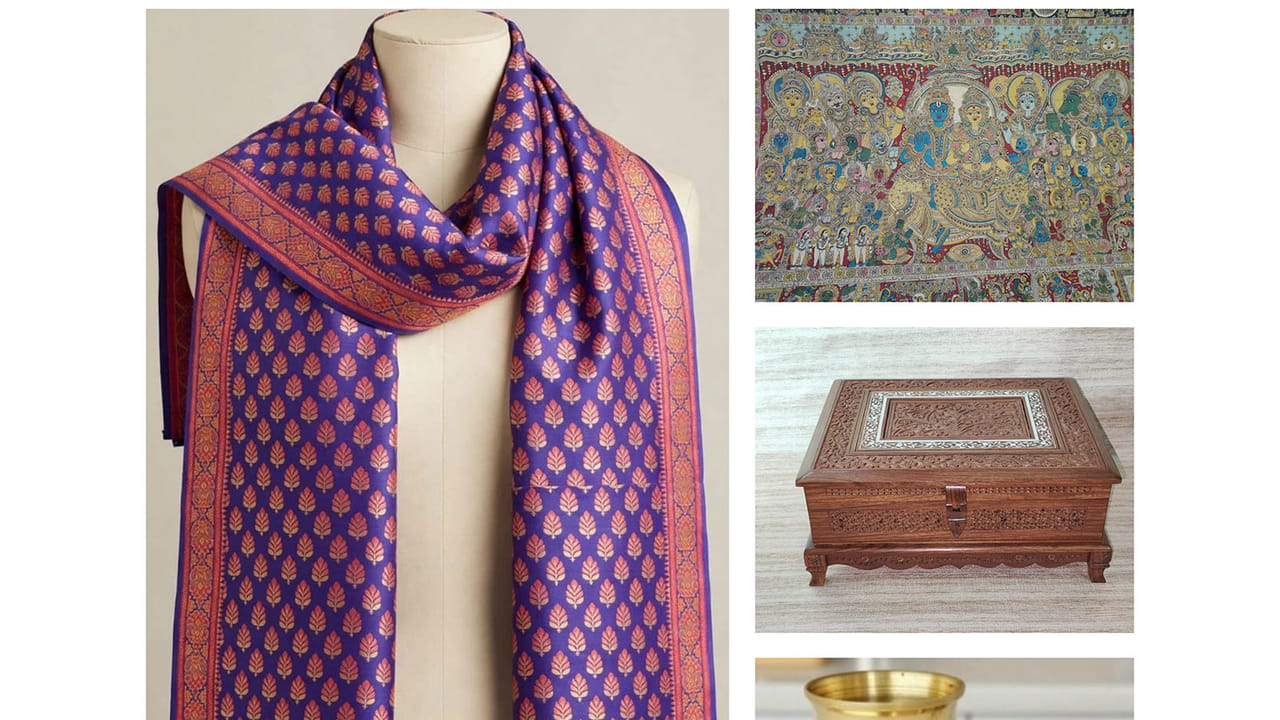
From the sacred waters of the Ganga in Kashi to an elaborate Kalamkari depiction of the Ramayana and a handwoven Banarasi silk stole, India’s gifts to Nepal Prime Minister Balendra Shah during his two-day state visit offered a glimpse into the centuries-old religious, cultural and civilisational bonds between the two neighbouring countries. The carefully curated gifts, representing the spiritual traditions and artisanal heritage of different Indian regions, carried a message of friendship, shared faith and cultural unity as the rapper-turned-Prime Minister visited India for the first time since assuming office in March 2026.
Among the offerings was sacred Ganga Jal from Kashi, presented in an intricately crafted brass urn. Originating from the holy Ganga near the revered Kashi Vishwanath Temple, the offering holds particular spiritual significance, symbolising the connection between Baba Vishwanath of Kashi and Lord Pashupatinath of Kathmandu, both revered manifestations of Lord Shiva. The gift reflects the deep-rooted religious ties between India and Nepal, with the sacred water symbolising purity, devotion and divine blessings. It also conveys wishes for peace, prosperity and spiritual unity while celebrating the enduring friendship between the two nations.
Another gift showcased India’s celebrated textile and woodworking traditions through a Banarasi brocade silk stole presented in an exquisite Sadeli box from Gujarat. The stole, originating from Varanasi, features intricate motifs and shimmering zari work crafted by skilled master weavers. Its presentation box, meanwhile, reflects Gujarat’s traditional woodworking heritage, featuring intricate geometric inlay and craftsmanship. Together, the two creations bring the artisanal traditions of Varanasi and Gujarat into a single offering, celebrating generational craftsmanship and India’s longstanding tradition of handmade excellence.
A particularly significant gift was a monumental Kalamkari Sampoorna Ramayana painting from Andhra Pradesh, depicting major episodes from the life of Lord Rama, beginning with his birth and exile, followed by his victory over Ravana and eventual return to Ayodhya. Hand-painted on cotton in the traditional Srikalahasthi style, the artwork has been created using a bamboo pen, known as a kalam, and natural dyes. The painting reflects India’s rich heritage of devotional storytelling and traditional craftsmanship. Beyond its artistic significance, the Ramayana artwork carries a special message for Nepal, connecting Ayodhya, the land associated with Lord Rama, with Janakpur, revered as the birthplace of Goddess Sita. The two destinations occupy an important place in the shared religious and cultural imagination of India and Nepal.
The gifts assumed particular significance during Shah’s visit, which saw both countries take steps to strengthen their bilateral relationship through diplomatic engagements, development cooperation and improved cross-border connectivity. During his two-day state visit, Shah held delegation-level talks with Prime Minister Narendra Modi at Hyderabad House, where the two sides exchanged eight Memorandums of Understanding (MoUs) covering space technology, security and forensic cooperation, civil service capacity building, healthcare, traditional medicine, sustainable urban development, and livestock and fisheries development.
The two leaders also jointly flagged off the Saryu-Kamala Express, a new weekly train service connecting Ayodhya Cantt in Uttar Pradesh with Janakpur Dham in Nepal, further strengthening the cultural and religious links represented by the Ramayana painting. Highlighting the shared civilisational heritage, PM Modi said, “Friends, the relations between India and Nepal are woven with threads of shared history, faith, culture, and deep people-to-people ties. Lord Ram and Mother Sita are the symbols of our shared civilisation and faith. In 2018, on the sacred land of Janakpur, I had said: without Nepal, our dhams are incomplete; without Nepal, our Ram is also incomplete.”
The new railway service is expected to facilitate travel between the two important religious destinations, with stoppages at Gorakhpur, Basti, Raxaul, Sitamarhi, Madhubani and Jaynagar, improving connectivity for pilgrims, tourists, families and business travellers. Shah, in his remarks following the bilateral talks, also invoked the shared spiritual traditions of the two countries and expressed gratitude for the hospitality extended to him. “Carrying the blessings of Lord Pashupatinath, Mata Janaki, and compassionate Matsyendranath, along with the affection, warmth, and goodwill of the people of Nepal for India and its people, I extend my heartfelt gratitude to Prime Minister Shri Narendra Modi for this gracious invitation and warm hospitality,” Shah said.
Referring to the newly inaugurated railway connectivity, the Nepalese Prime Minister said, “Nepal and India have been bound by historical, cultural, and civilizational ties since the sacred era of Lord Ram and Mata Janaki. Today, we have inaugurated rail connectivity to make this bond even more vibrant.” In another significant announcement during the visit, PM Modi unveiled a Development Cooperation Package of 24,000 crore Nepali rupees to support Nepal’s post-flood reconstruction and long-term development, following the severe floods that struck the country in August. Shah also invited PM Modi to visit Nepal and encouraged Indian citizens to explore its religious and cultural destinations, including Muktinath, Pashupatinath, Janakpur, Kumari and Lumbini. As Shah concluded his two-day state visit and departed for Kathmandu on Monday, the gifts presented during the visit stood as cultural expressions of a relationship that extends beyond diplomatic engagements, reflecting the shared faith, artistic traditions and civilisational connections that continue to link India and Nepal.