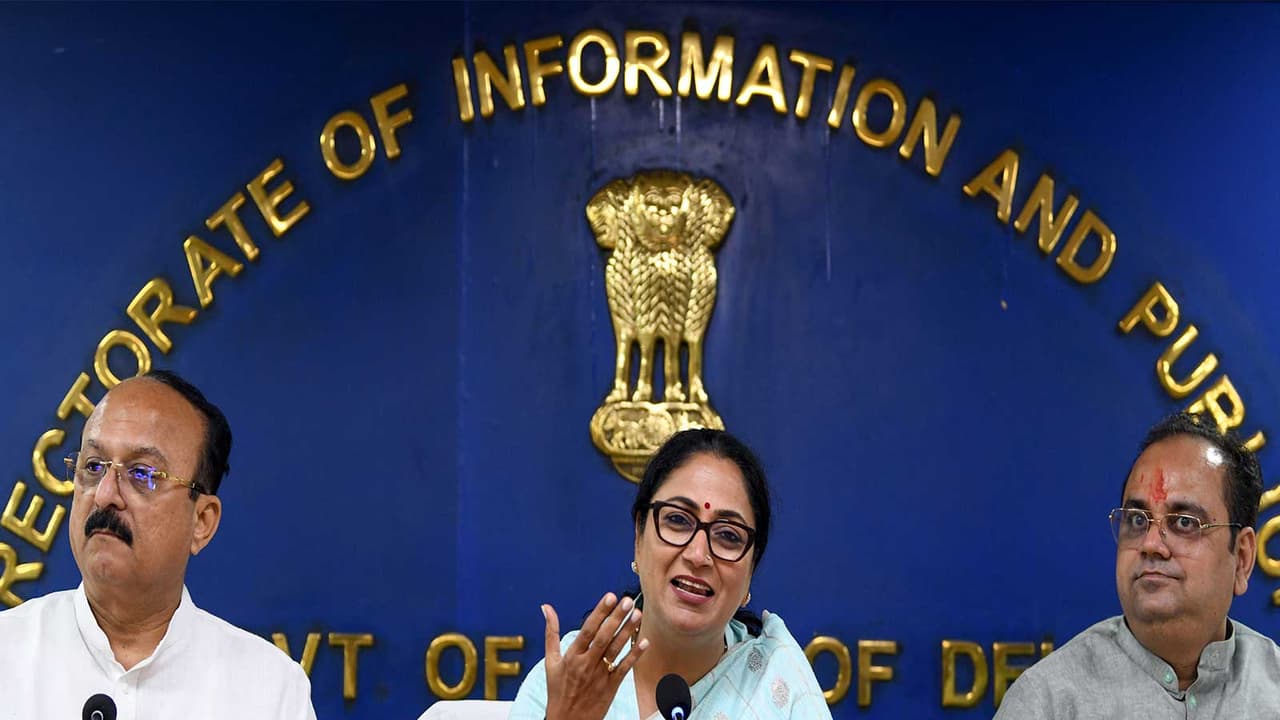
The Delhi Cabinet chaired by Chief Minister Rekha Gupta has approved the Delhi EV Policy 2026. Its objective is to promote electric vehicles and reduce pollution. The policy includes road tax exemption, purchase and scrapping incentives.
New Delhi [भारत]June 29 (ANI): In a major step towards promoting clean transportation and tackling air pollution, the Delhi Cabinet on Monday approved the Delhi EV Policy 2026. It is an ambitious roadmap that aims to accelerate the adoption of electric vehicles, expand charging infrastructure and gradually transition many vehicle categories to zero-emission vehicles.
This policy, approved under the leadership of Chief Minister Rekha Gupta, will come into effect from July 1, 2026 and will remain valid till March 31, 2030. It will now be sent to Lieutenant Governor (LG) Taranjit Singh Sandhu for final approval before being implemented.
These concessions will be available under the policy
The policy offers a range of incentives to encourage the adoption of electric vehicles across different categories. Under the new framework, EV buyers will get 100 percent rebate on road tax and registration fees, this benefit will be applicable on electric four-wheelers priced up to Rs 30 lakh (ex-showroom). The government has announced purchase incentives of up to Rs 30,000 for electric two-wheelers, up to Rs 50,000 for electric three-wheelers and up to Rs 1 lakh for N1 category goods vehicles. Additionally, scrapping incentives will be offered to owners replacing old polluting vehicles with EVs. These incentives include up to Rs 1 lakh for four-wheelers, Rs 50,000 for N1 trucks, Rs 25,000 for three-wheelers and Rs 10,000 for two-wheelers.
Charging infrastructure and phased transition
One of the biggest highlights of the policy is the proposed expansion of charging infrastructure, with plans to create over 30,000 EV charging points across Delhi. The incentive amount will be transferred directly to the beneficiaries through Direct Benefit Transfer (DBT) mechanism. The policy also introduces a phased shift towards electric mobility. Only electric three-wheelers and N1 goods carriers will be registered in Delhi from January 1, 2027. Registration of only electric two-wheelers will be allowed from April 1, 2028. The government has also set electrification targets for school buses, aiming to replace 10 per cent of the fleet within two years, 20 per cent within three years and 30 per cent of the fleet by March 2030.
Government said historic and transformative step
To support the implementation, the Delhi government has approved a financial commitment of over Rs 7,000 crore over the next four years. According to government estimates, the overall benefits of the policy, including incentives, infrastructure support and tax exemptions, could exceed Rs 15,000 crore. Chief Minister Rekha Gupta described this policy as a transformative initiative supported by the Centre. He said, “Pollution in Delhi is a challenge that requires coordinated action across the entire NCR. This policy has been finalized after extensive deliberations and will benefit every vehicle buyer in Delhi. No state in the country has provided this level of support for EV adoption. The Delhi EV Policy 2026 will be a transformative and revolutionary policy that will make Delhi eco-sustainable, affordable and future-ready.” He also emphasized that the policy lays special emphasis on replacing old BS-IV and old vehicles through scrappage incentives.
Delhi Transport Minister Pankaj Singh said the policy has been designed to ensure public benefits while reducing pollution. He said, “I am very proud to say that we have passed our EV policy in the Cabinet today. It has been sent for the approval of the Lieutenant Governor. We are bringing this policy for the benefit of the people of Delhi. I urge everyone to understand this and adopt electric vehicles so that Delhi can become a clean, serene and better city.” Highlighting the incentives for young buyers and vehicle scrappage, Singh said, “The Delhi government is committed and accountable for making Delhi a clean city. We are bringing in such incentives that I have unwavering confidence will greatly benefit the people of Delhi.”
In a separate statement, Singh described the policy as “an important initiative towards building a clean, green and modern Delhi” through expansion of charging and battery-swapping infrastructure, promotion of electric commercial fleet and clean public transport.
Delhi Minister Ashish Sood called this policy a historic step towards sustainable development. “Delhi’s EV policy is now ready. It will bring a change in the lives of the people of Delhi. The country’s capital should have modern infrastructure, and its transport system should eliminate pollution,” Sood said. In a post shared on He further said that this policy is “a huge step towards clean air, smart mobility and a sustainable future” and will help reduce the cost of ownership while creating a green transportation ecosystem.
Delhi Minister Manjinder Singh Sirsa also welcomed the decision, saying that this policy will help in phasing out old polluting vehicles. Sirsa said, “This EV policy will help in taking action against pollution by removing polluting vehicles. If EV vehicles are introduced then pollution in Delhi can be reduced.” In a separate statement, he termed the policy as “a powerful commitment to clean air, modern transport and building a developed Delhi”, and said it would boost investment, employment and green growth while encouraging citizens to adopt electric vehicles.
Political reactions to the policy
Meanwhile, Congress leader Sandeep Dikshit welcomed efforts to reduce pollution, but cautioned that electric mobility alone will not solve Delhi’s environmental challenges. Dikshit said, “The issue of Delhi’s pollution is very complex. We have talked about the constant construction, broken roads and flying dust. Even with EVs, a big question is what will happen with the disposal of batteries. This pollution also has to be solved by the government. It should not be that we spoil the future by trying to solve today’s problems.”
SP demands more subsidy
From Uttar Pradesh, Samajwadi Party MLA Ravidas Mehrotra called for more financial support to make electric vehicles affordable. He said, “If electric vehicles are introduced, the government should provide adequate subsidy so that these vehicles become very cheap. Compared to petrol and diesel vehicles, EVs are expensive. The government should make electric vehicles cheaper than conventional vehicles.”
‘Copying Kejriwal’s work’: AAP
Aam Aadmi Party (AAP) leader Priyanka Kakkar accused the BJP government of re-packaging the initiatives launched during the Arvind Kejriwal administration. “In Delhi, it is easy to take Arvind Kejriwal’s work, rename it and call it your own. When Arvind Kejriwal made this policy, Delhi became the third largest city globally in terms of EV usage,” he said. Kakkar said, “As a result, we gave many incentives so that people move towards EVs, petrol and diesel consumption reduces, and we move towards zero emissions. All this has already happened. Today, Rekha Gupta ji wants to repackage it and call it her own…” He claimed that during the tenure of the AAP government, about 3,000 charging stations and 300 battery-swapping stations were set up, along with incentives that encouraged citizens to take up electric mobility. Encouraged to move forward. He commented, “Keep copying Arvind Kejriwal’s schemes, keep changing his name, no problem. Imitation is the best form of flattery. But implement it in your other states too.” Kakkar also raised concerns over pollution from thermal power plants around Delhi-NCR, alleging that the Center has weakened mandatory requirements for flue-gas desulphurization (FGD) technology. According to him, pollution control measures beyond vehicle electrification are necessary if Delhi is to achieve meaningful improvement in air quality.
Now while the policy awaits the Lieutenant Governor’s approval, the Delhi government hopes that the combination of subsidies, scrappage incentives, charging infrastructure and a phased electrification mandate will accelerate the capital’s transition to clean mobility as well as address one of its most persistent challenges – air pollution. (ANI)
(Except for the headline, this story has not been edited by Asianet Newsable English staff and is published from a syndicated feed.)