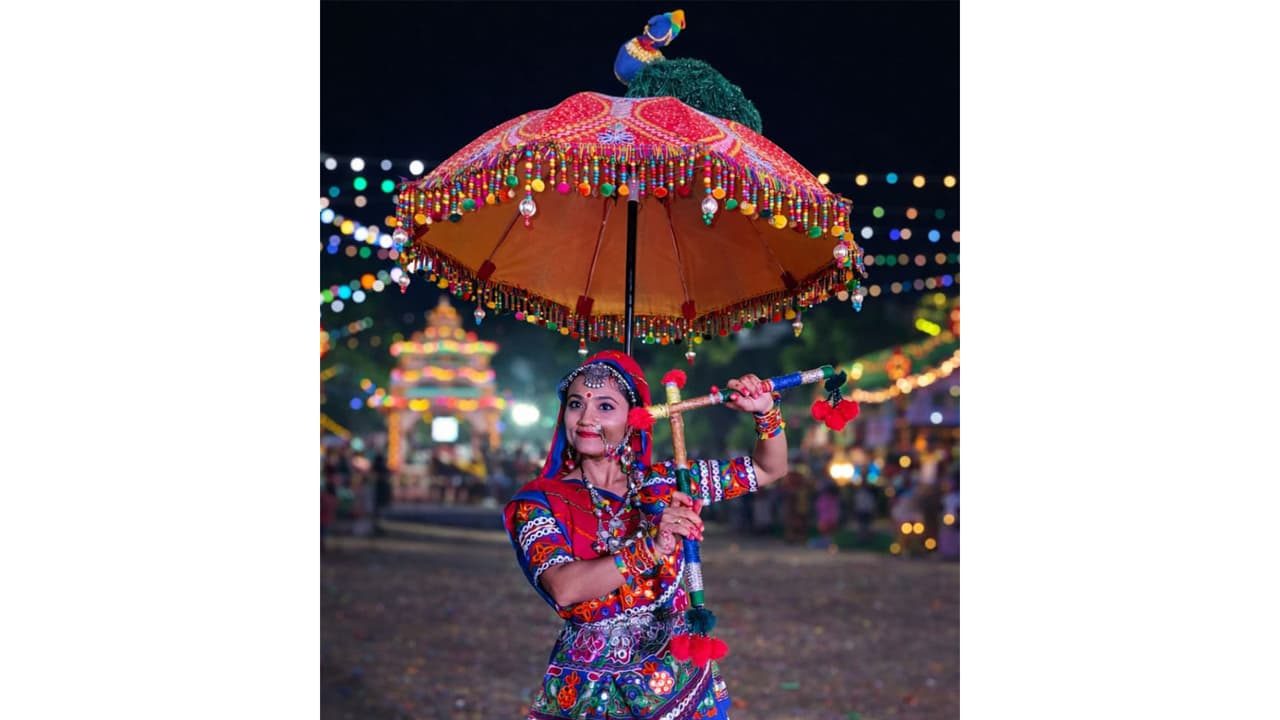
Twisha Killolkumar Vyas, a young folk artist from Bardoli, Gujarat, has won the prestigious Ustad Bismillah Khan Yuva Puraskar 2025 for her exceptional contribution to the traditional folk dance form, Garba.
Twisha Killolkumar Vyas, a young folk artist from Bardoli in South Gujarat, has been selected for the prestigious Ustad Bismillah Khan Yuva Puraskar 2025 by the Sangeet Natak Akademi, an autonomous organisation under the Union Ministry of Culture, for her outstanding contribution to the traditional folk dance form Garba.
The honour comes at a significant time, following UNESCO’s inscription of Gujarat’s traditional Garba on its Representative List of the Intangible Cultural Heritage of Humanity, further reinforcing the global recognition of the state’s rich cultural legacy.
An Artist’s Philosophy and Mission
“Garba is not merely a folk dance; it is a living expression of faith, culture and our collective identity,” says Twisha Vyas, whose artistic philosophy has been shaped by this belief. Based in Bardoli, Twisha runs the V. Killolkumar Group of Music & Dance Academy, where she trains young girls in the intricate movements, rhythm, expressions and traditional essence of Garba. While many learn Garba simply as a dance form, Twisha has dedicated herself to understanding its original traditions, spiritual significance and cultural depth.
A Multifaceted Talent
Twisha’s achievements extend well beyond folk dance. She holds a postgraduate degree in English Literature and is an accomplished violinist. She has performed before the President Droupadi Murmu, former President Ram Nath Kovind, and renowned music composer Anandji Kalyanji. She is also a Gold Medalist with a Master of Performing Arts (M.P.A.) degree and an M.A. in Bharatanatyam (‘Alankar’). Besides the violin, she is proficient in playing the mandolin, flute, harmonium and tabla. Her extensive training in both music and dance has given her a distinctive understanding of rhythm, expression and stage presentation, qualities that are reflected in every Garba performance she delivers.
Showcasing Garba Across India
Twisha Vyas has showcased her talent at several prestigious cultural events organised by the Government of Gujarat, including the International Tarnetar Fair, Chotila Festival, Modhera Festival, Dakor Faganotsav, Vasantotsav, G-20 events, Gujarat Gaurav Abhiyan and Ambaji Mahotsav. She has also served as a judge in various government-organised competitions such as Kala Mahakumbh and Yuva Utsav. Beyond Gujarat, she has represented the state’s rich folk traditions in Rajasthan, Odisha, Andhra Pradesh, Manipur, West Bengal, Jharkhand and Madhya Pradesh, promoting Garba and Gujarat’s cultural heritage across the country.
A Responsibility to Preserve Heritage
For Twisha, the national recognition is not the culmination of her journey but the beginning of a greater responsibility. She believes the younger generation should view Garba not merely as entertainment but as a living cultural heritage that deserves to be understood, respected and preserved in its purest traditional form. Her message carries added significance at a time when traditional art forms face increasing competition from modern entertainment. Artists like Twisha are serving as a bridge between tradition and contemporary society, proving that preserving cultural heritage remains both relevant and achievable.
A Testament to Dedication and Tradition
Twisha Vyas’ achievement is not just a personal milestone but also a recognition of Gujarat’s vibrant folk culture. At a time when popularity often defines success, her journey stands as a testament to years of quiet dedication, disciplined practice and unwavering commitment to preserving tradition.
From the Garba grounds of Bardoli to one of India’s highest honours for young artists, Twisha Vyas’ inspiring journey reminds us that traditions survive not merely by being inherited, but by being proudly carried forward by the next generation. It is through such dedication that India’s rich cultural heritage continues to be preserved, promoted and celebrated. (ANI)
(Except for the headline, this story has not been edited by Asianet Newsable English staff and is published from a syndicated feed.)