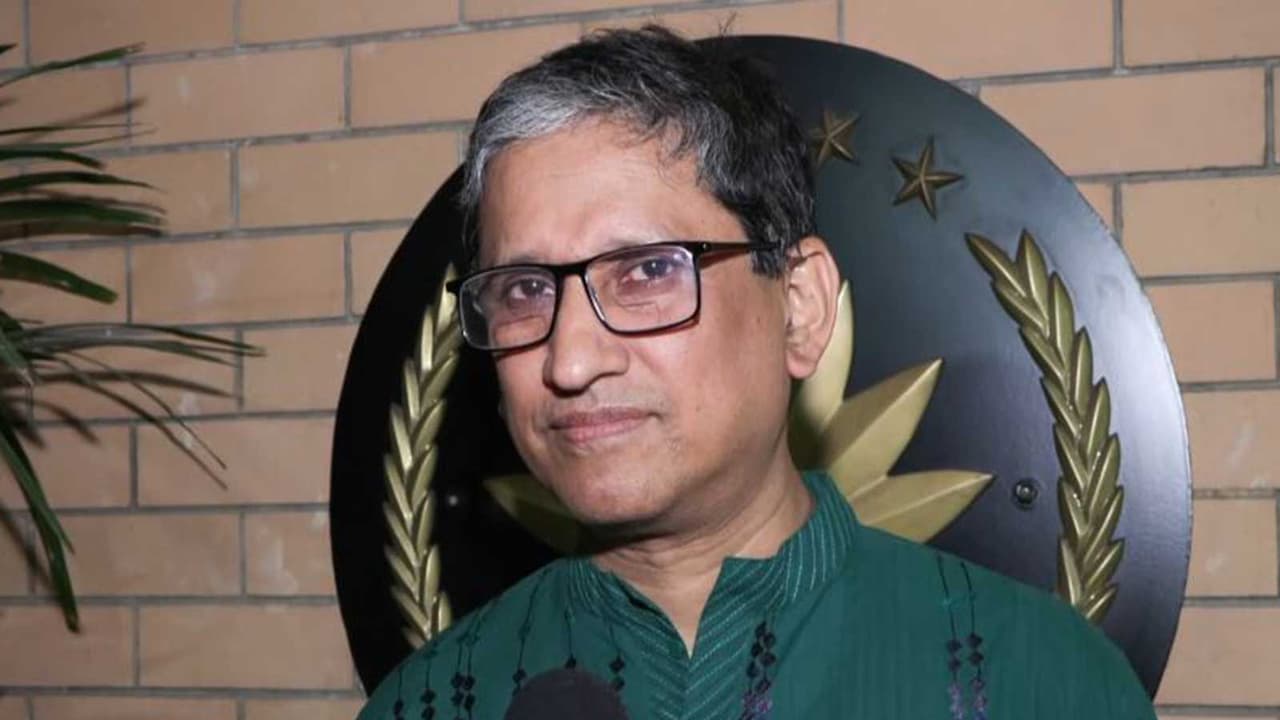
Outgoing Bangladesh High Commissioner Riaz Hamidullah reflects on his 3.5-decade association with India, recalling his time as a student at Aligarh Muslim University and stressing the importance of engaging with people beyond state-to-state relations.
As his tenure as Bangladesh High Commissioner to India draws to a close, Riaz Hamidullah has reflected on his three-and-a-half-decade association with India, recalling his first stint as a student at Aligarh Muslim University and stressing the importance of engaging with people beyond state-to-state relations.
Speaking about his journey in India, Hamidullah said his first exposure to the country came in September 1990, when he arrived as a young student and stayed at a hostel at Aligarh Muslim University. “When I came 35 years ago, in September 1990, as a young student, I stayed in a hostel at Aligarh Muslim University. That afforded me a great opportunity to understand India and to mingle with people from different states,” Hamidullah told ANI.
The Bangladesh envoy said the experience helped him appreciate India’s diverse social and cultural landscape, including its varied culinary traditions and regional identities.
People-to-People Ties: The Core Approach
Hamidullah, who later returned to New Delhi for a professional posting between 2003 and 2005, said his interest in understanding Indian society remained central to his engagement during his diplomatic career. “State-to-state relations are one thing, but if you want to go to the deeper part of India, I think we must not miss society. That is what actually drew me to engage without any inhibition with people,” he said.
He said he travelled to different parts of India and sought conversations with people from diverse backgrounds, even when the subjects discussed were not directly linked to Bangladesh. “Sometimes it was not necessarily something of immediate relevance to Bangladesh. I thought that if I don’t go, then how can I tell someone about Bangladeshi society or our point of view, or understand them here?” Hamidullah said.
He added that dialogue remained important even when conversations involved difficult or divergent viewpoints. “Everyone is sovereign in his or her viewpoint. As much as someone can speak out, I can also engage in conversation. So, getting engaged in conversation in the long haul is very important. That was my approach,” he said.
An Encounter in Kashmir
Recalling one of his most recent memories from India, Hamidullah spoke about a visit to Srinagar in the Kashmir Valley around three weeks ago, where he visited Delhi Public School Srinagar. He said the visit left a lasting impression on him, particularly an interaction with a Class 12 student who introduced herself as a radio jockey. “From the airport, I drove straight to the DPS Srinagar school. Two things struck me. There were around 5,000 students, and I think almost 40 per cent of them were girls,” he said.
The envoy said the student, Fatima, took him to the school’s digital radio studio and engaged him in a conversation. “The second question was really puzzling. I didn’t expect it from her. She asked me, ‘How do you look at borders?’ Imagine — sitting in Srinagar, a young girl asking this question,” Hamidullah recalled.
He said he responded to the question “in absolute candour” and was further struck by children singing one of his favourite compositions of poet-philosopher Allama Iqbal as he was leaving the school.
Looking Beyond Divisive Lines
Reflecting on the encounter, Hamidullah said people-to-people interactions often transcend the political and geographical boundaries that dominate conventional discourse. “What really struck me is that we always look at the lines that divide us, but we should also see how uniquely the larger part of the population keeps moving, without being mindful of the divisive lines or differences,” he said.
The Bangladesh High Commissioner’s reflections come as he prepares to conclude his tenure in India, where he has sought to engage not only with official counterparts but also with people and communities across different parts of the country. (ANI)
(Except for the headline, this story has not been edited by Asianetnews Editorial staff and is published from a syndicated feed.)