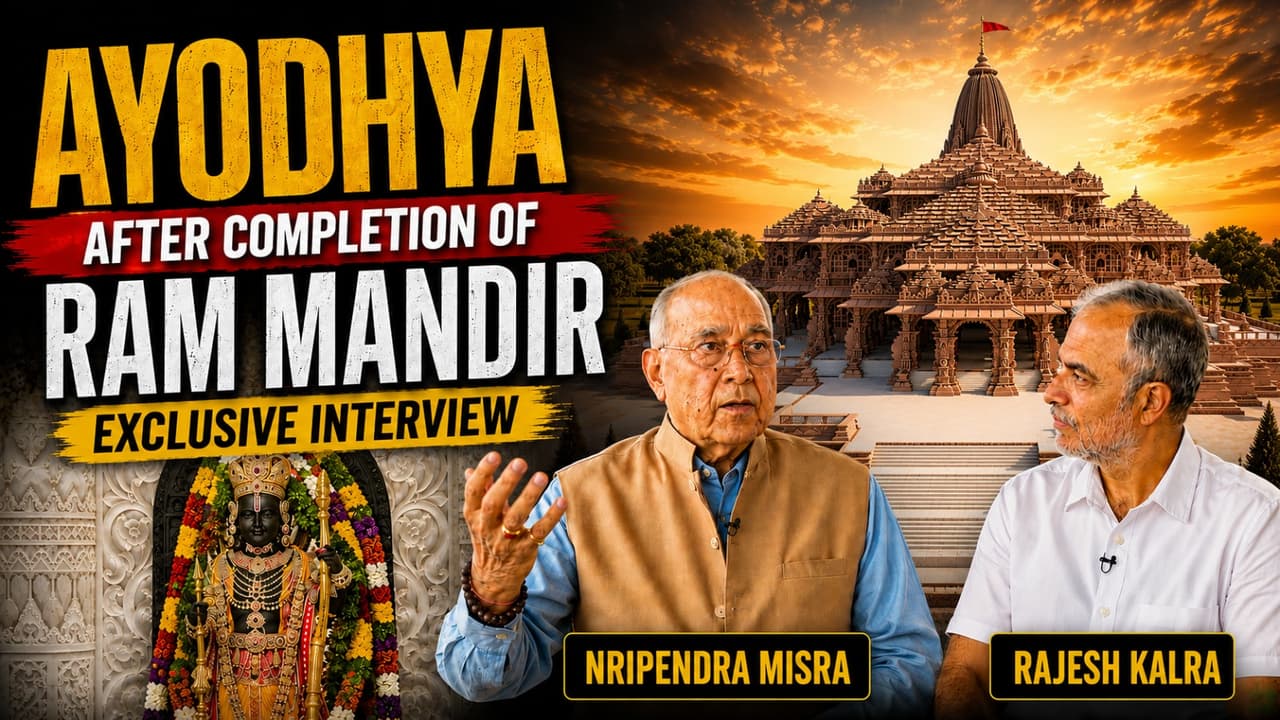
Ram Mandir Construction Committee Chairman Nripendra Mishra revealed the challenges and future plans of the project. He said that now the priority is to improve the experience of the devotees, which is currently only 60% complete and many improvements have to be made in it.
Chairman of Ram Mandir Construction Committee and former Principal Secretary to Prime Minister Narendra Modi, Nripendra Mishra has revealed many inside facts related to this project for the first time. In an exclusive conversation with Asianet Newsable, Mishra explained the huge technical, administrative and spiritual effort that went into building the Ram temple in Ayodhya. Besides, he also told what more is yet to be done to give a world-class experience to the devotees.
Biggest challenges of Ram temple
Mishra says that even though the temple looks ready today, every step of its construction was full of engineering and management challenges. One of the biggest technical difficulties came with the titanium parts. Engineers found that more than 52 percent of the material was being wasted in the process of making it. After this, the committee took opinion from many experts including private sector experts, so that a technically sound and cost-effective solution could be found.
Mishra calls this temple “a dream realized in instalments”. He gives the credit for this not to any one person, but to crores of devotees, saints and scholars who had thought about how the temple of Lord Ram should be. Every artistic decision regarding the temple, such as the installation of bronze statues of saints, was taken only after consulting experts in the Vedas, Puranas and Indian spiritual traditions. A panel of scholars selected 79 saints and great men whose lives reflect the ideals of Maryada Purushottam Shri Ram.
When asked if he was satisfied with the work of the temple, Mishra replied very honestly. He said, “My satisfaction will be from the expressions visible on the faces of the devotees.” According to him, this project should be judged not just by its design but by the ease with which devotees are able to have darshan.
Enhancing the visitor experience
He estimates that from a devotee’s perspective, the temple ecosystem is still “about 60 percent complete.” Many improvements are to be made in the future, such as sign boards in multiple languages, more drinking water points, shaded walkways, better shoe storage system, easier access routes and additional facilities for elderly devotees coming from across the country.
Mishra also revealed that Prime Minister Narendra Modi had given a clear instruction during planning—Ram Temple should never be seen as the only temple of North India. Rather, it should reflect the broader spirit of Sanatan Dharma, welcoming devotees from every region, language and tradition.
In this exclusive interview, plans for expansion of the huge 71-acre temple complex were also discussed. In future, a 3D Ram Katha Museum, a large auditorium for religious and cultural programs, better gardening, more facilities for devotees, cooling system from water sources and memorials for the kar sevaks who sacrificed their lives in the Ram Janmabhoomi movement will be built here.
Mishra said that natural cooling techniques, covered paths, drinking water stations and shady canopies are being installed to provide comfort to the devotees even in the scorching heat of Ayodhya. Continuous improvements are being made based on feedback from people, making the project a constantly evolving process rather than a finished building.
Spiritual journey of Nripendra Mishra
Talking about his personal journey, Mishra says that the Ram Mandir project completely changed him. Having spent decades in civil service, including as Principal Secretary to the Prime Minister, he admits that earlier he viewed his achievements through the lens of personal success. But working for the temple for five years taught him humility.
He recalled a message from spiritual guru Mata Amritanandamayi, who reminded him that every person is merely “a medium” chosen by God to fulfill a divine responsibility. This message changed his perspective on leadership and service.
According to Mishra, perhaps the most special thing about this project is the collective participation of the people. Engineers, contractors, artisans and technology companies came forward not just as professionals but as devotees. Many organizations did not even charge their professional fees and considered it a service to Lord Ram. Donations for the temple were collected from more than 10 crore families in more than 4 lakh villages, resulting in an accumulation of approximately Rs 3,200 crore.
The biggest responsibility for Mishra was to safeguard what he repeatedly called “God’s money”. He says that every expenditure was examined with full accountability and reverence, because this temple belongs to crores of devotees.
Now that the construction is in its final stages, the Ram Temple is emerging as not just an architectural wonder but a living symbol of faith, service and national participation. In this exclusive conversation with Asianet Newsable, Nripendra Mishra makes it clear that even though the structure of the temple is nearing completion, the mission to create an ideal pilgrimage experience for every devotee has just begun.
Click below to watch the full interview…