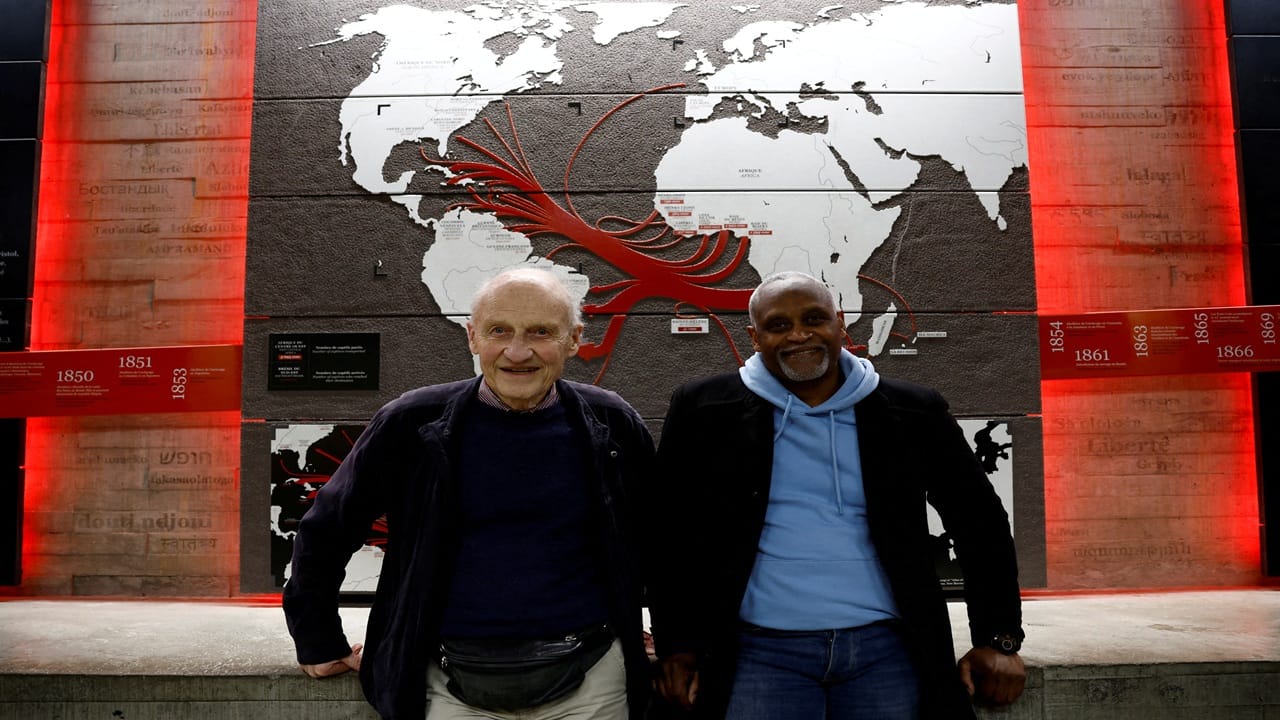
New Delhi: On Saturday a man in his 80s issued what is believed to be the first formal apology by someone in France for their family’s role in transatlantic slavery, reported Reuters.
Going by the name Pierre Guillon de Prince’, he said he hoped others, including the government, would follow after him. His ancestors, based in Nantes, France’s largest port for transatlantic slavery, were shipowners who transported around 4,500 enslaved Africans and owned plantations in the Caribbean.
A landmark apology
Guillon de Prince delivered the apology to a gathering in Nantes ahead of the inauguration of an 18-meter replica ship mast, alongside Dieudonné Boutrin, a descendant of enslaved people from the Caribbean island of Martinique. As reported by Reuters, the duo work together at Coque Nomade-Fraternité, an association dedicated to “breaking the silence” around slavery. “Many families of descendants of slave traders don’t dare speak out for fear of reopening old wounds and anger,” said Boutrin, 61. “Pierre’s apology is a courageous act.”
Guillon de Prince on the other hand said that other French families must also confront their historical ties to slavery. Taking in the responsibility of the state as well, he added that it should go beyond symbolic gestures to address the past, including through reparations. “Faced with the rise of racism in our society, I felt a responsibility not to let this past be erased,” the 86-year-old said as reported by the news publication.
France’s trade history and calls for reparations
France played a major role in the transatlantic slave trade, ranking third after Portugal and Great Britain. Ports like Nantes, Le Havre, Bordeaux, and La Rochelle prospered from the trade, fueling France’s plantation economy in sugar, coffee, and other commodities until slavery was first abolished for a brief time in 1794 and permanently ended in 1848.
France recognized the transatlantic and Indian Ocean slave trades as crimes against humanity via the 2001 Taubira Law. Since then calls for reparations have grown, particularly from Caribbean nations like Haiti and several African countries. Recent diplomatic talks, including with Ghana in 2026, have signaled France’s openness to dialogue on the issue, Pierre Guillon de Prince’ forms a part of this larger national trend which might be expected to give the movement further impetus.