Argentina’s hopes of defending their FIFA World Cup crown came to an end after a narrow 1-0 defeat to Spain in the 2026 World Cup Final.
Ferran Torres scored the solitary goal of the match as La Roja beat the 10-man Albicelestes at the MetLife Stadium.
While the scoreline suggests a closely fought contest, the match statistics paint a very different picture. Spain controlled possession, dictated the tempo, created far more chances and barely allowed Argentina to threaten their goal. Ferran Torres’ extra-time winner was ultimately the reward for a dominant Spanish display. Here are the four biggest reasons why Argentina fell short on football’s biggest stage.
Lack of Attacking Threat Cost Argentina
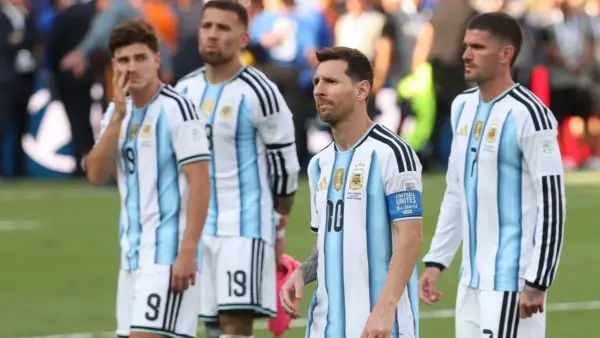
Argentina’s biggest downfall was their inability to trouble Spain’s defence throughout the match. Lionel Scaloni’s side managed just two shots during the entire contest and failed to register a single effort on target. Their expected goals (xG) stood at just 0.20, compared to Spain’s 1.94, highlighting how few meaningful opportunities they created. Lionel Messi was also incredibly underwhelming in the final.
The Albiceleste also recorded zero big chances and had only eight touches inside Spain’s penalty area, while Spain managed 31. Even when Argentina managed to win possession, they struggled to progress the ball into dangerous areas. Unai Simón finished the final without having to make a single save, a statistic that perfectly sums up Argentina’s lack of attacking intent. Against a side as dominant as Spain, creating almost no chances meant they were always one defensive lapse away from defeat.
Spain Completely Dominated Midfield and Possession
The battle in midfield was overwhelmingly won by Spain, who imposed their trademark possession-based football from the opening whistle. They enjoyed 65% possession, completed 852 passes with an impressive 89% accuracy, while Argentina completed only 358 accurate passes at 77% accuracy.
Spain constantly pushed Argentina deeper into their own half, completing 417 passes in the opposition half compared to Argentina’s 120. Their midfield controlled the rhythm of the game, forcing Argentina to spend long periods defending instead of building attacks. With so little of the ball, Argentina struggled to establish any sustained possession or momentum, allowing Spain to dictate where and how the game was played.
Emiliano MartÍnez Could Only Delay the Inevitable
Despite the defeat, Emiliano MartÍnez produced another outstanding performance between the posts. The Argentine goalkeeper made 11 saves, while his defenders contributed 24 clearances, 18 tackles and 16 interceptions to keep Spain at bay for much of the match.
However, the relentless pressure eventually became too much to withstand. Spain fired 20 shots, with 12 hitting the target, and generated an Expected Goals on Target (xGOT) of 2.76, illustrating the quality of chances they created. MartÍnez repeatedly denied Spain, but Argentina’s defence was forced into emergency action throughout the contest because their attack failed to relieve the pressure. Eventually, Spain’s persistence paid off in extra time when Ferran Torres found the decisive breakthrough.
The Enzo Fernández Red Card
Enzo’s Red Card didn’t help things for the Argentines, who went down to 10 men and could only hope for relentless defending and taking the match to penalties. Spain, who were already dominating the match, upped the ante with the advantage and found the crucial goal from Torres, thus eventually winning the title.