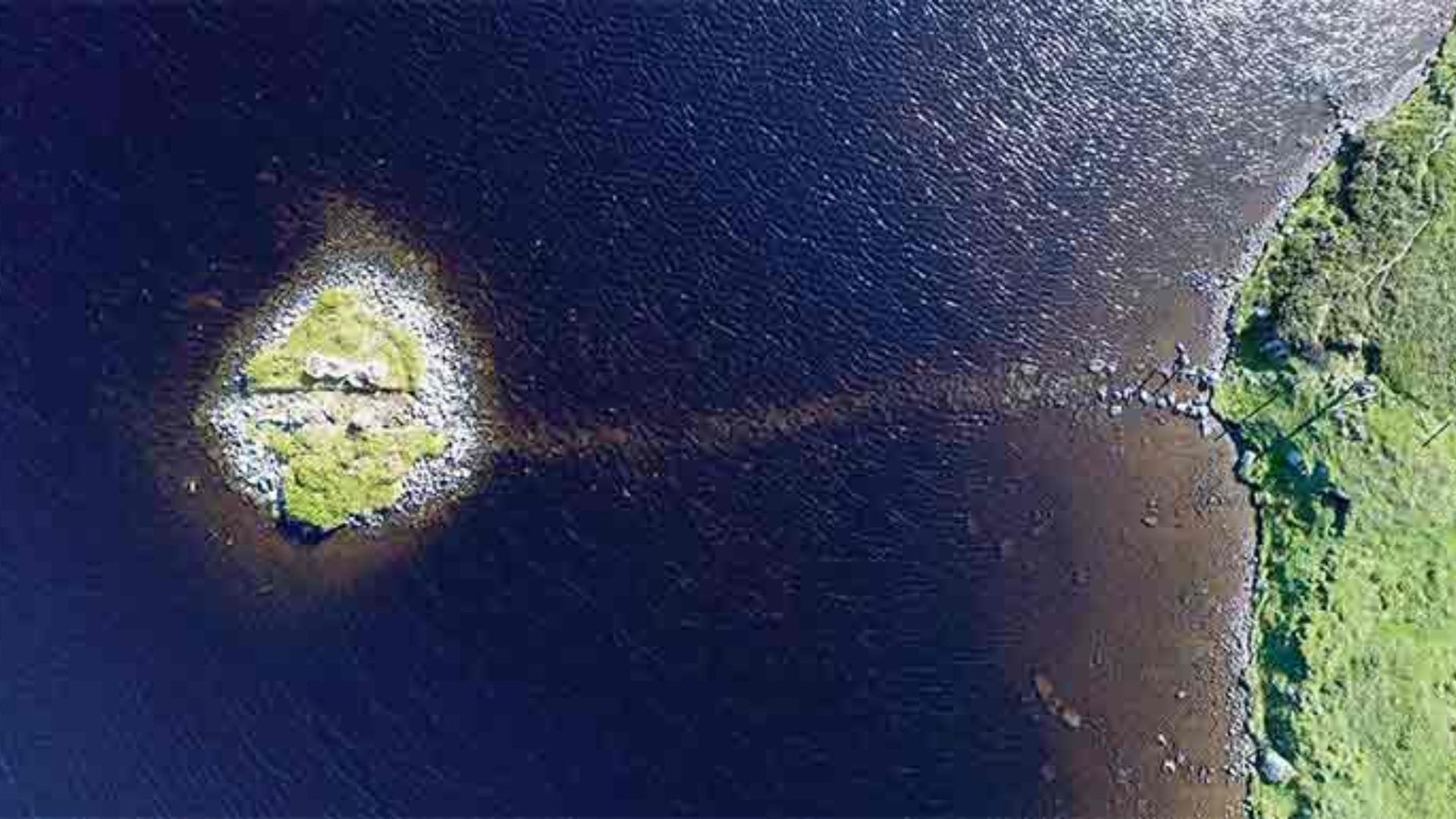
New Delhi: Archaeologists have investigated a ‘crannog’ or small artificial island Loch Bhorgastail, one of thousands that exist in Scottish Lakes. Stereophotogrammetry allowed for studying the island below and above the water line as a single, continuous structure, providing a perspective that could not have been possible using either land or underwater surveys. The researchers have conducted several years of fieldworks, using traditional excavation techniques, coring, sophisticated surveying and radiocarbon dating. The research has revealed the different stages of development of the crannog in Loch Bhorgastail. It was first established over five thousand years ago, making it older than the stonehenge.
The structure started as a circular wooden platform about 23 metres across, topped with brushwood. About two thousand years later, in the Middle Bronze Age, another layer of brushwood and stone was added, before another phase of activity about a thousand years later, during the Iron Age. A stone causeway from the shore to the artificial island is now underwater. Over the years, the researchers recovered hundreds of pieces of Neolithic potter, including jars and bowls scattered in the surrounding water, suggesting that the site was first established before the Bronze Age. The large quantities of pottery often still contain food residue.
Stereophotogrammetry reveals mysterious past of artificial island
The researchers used photogrammetry, a well-established technique of stitching multiple 2D photos taken from different angles into a high resolution 3D model. Fine sediments, choppy conditions and floating vegetation are all challenges for conducting photogrammetry in shallow waters. To overcome these challenges, the researchers used a pair of waterproof cameras with good low-light performance and a wide field of view, providing stereo imagery that compensates for missing or disrupted data. The stereophotogrammertry was controlled using underwater drone technology for centimetre-scale positioning accuracy. A paper describing this innovative new technique has been published in Advances in Archaeological Practice.