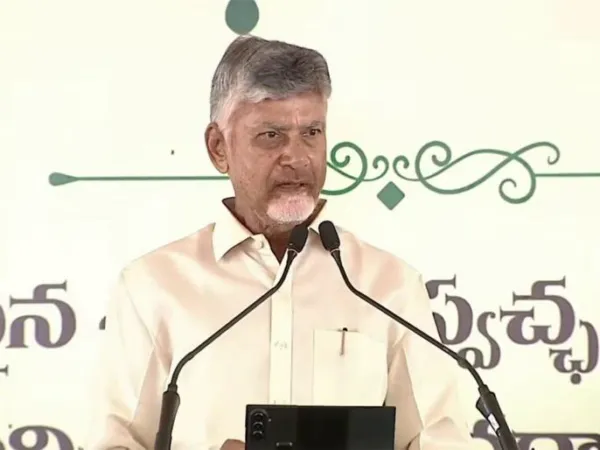
Andhra Pradesh Chief Minister N Chandrababu Naidu on Sunday announced cash incentives for families having a third and fourth child, as part of efforts to address and reverse the state’s declining population trend.
Addressing a public meeting in Narsannapeta in Srikakulam district on Saturday, he said the state government will provide Rs 30,000 for the birth of a third child and Rs 40,000 for a fourth child.
“Population growth is declining. Children should be viewed as the nation’s wealth, not a burden. The government would provide Rs 30,000 for families on the birth of a third child and Rs 40,000 for the birth of a fourth child, as part of efforts to encourage population growth,” CM Naidu said.
Naidu’s latest announcement comes after an earlier proposal in which he had suggested a Rs 25,000 incentive for families having a second child.
The Andhra Pradesh government’s decision to offer financial incentives for families having a third and fourth child has triggered a political debate, with leaders across parties sharply divided over its intent and feasibility.
While ruling party leaders have defended the move as part of a long-term strategy to address declining fertility rates and strengthen future economic growth, opposition voices have questioned its practicality amid concerns over fiscal stress, unemployment, and governance challenges in the state.
Some leaders argued that the policy reflects a broader vision to tackle demographic decline, while others said the focus should instead be on job creation and strengthening industries to manage population-related challenges.
TDP National Spokesperson Kommareddy Pattabhiram said “…The national average of TFR is around 2%… However, only a handful of states like Bihar, UP, and Jharkhand have a TFR above the replacement level of 2.1%… More than 75% of the states in the country are suffering from low fertility ratios, which is very dangerous for the future… That is the reason why today our leader, Chandrababu Naidu, is appealing to people to have more children… the state government of AP has come out with a population management policy… that every family which has a third child will be given a financial assistance of Rs 30,000, and a family having a fourth child will be given a financial assistance of Rs 40,000. This is being done to improve the fertility ratios, which are dropping…”
Telugu Desam Party (TDP) National Spokesperson Deepak Reddy said Andhra Pradesh Chief Minister Chandrababu Naidu emerged as a visionary leader by identifying the long-term demographic challenges facing the state and introducing financial assistance for families having a third and fourth child.
According to Andhra Pradesh’s Chief Minister’s Office (CMO), Reddy said the Andhra Pradesh government is encouraging larger families as part of its long-term development strategy under the ‘Swarna Andhra Vision 2047.’
He stated that the state aims to achieve a Gross State Domestic Product (GSDP) of USD 2.4 trillion and raise per capita income (PPP) to Rs 55 lakh by 2047 and stressed that addressing population decline is crucial to achieving these ambitious goals.
He further said that “Andhra Pradesh is among the first states in India” to proactively recognise the issue and initiate corrective measures well in advance.
He pointed out that while some northern Indian states continue to maintain a Total Fertility Rate (TFR) of around 3, Andhra Pradesh’s TFR has dropped sharply to nearly 1.5. According to him, this declining population trend could create serious demographic and economic challenges in the future, including a possible reduction in the state’s parliamentary representation during future delimitation exercises.
Reddy said the Andhra Pradesh government has taken note of global demographic trends, where several countries are already facing population decline and ageing population issues.
Meanwhile, YSRCP Spokesperson Konda Rajiv Gandhi said, “… The financial system and governance have completely collapsed, debts are mounting, and unemployment is at its peak. Based on these situations, it is clear that fulfilling the promise of Rs 30,000 for the third child and Rs 40,000 for the fourth child is highly impossible. Naidu continues to make such claims to divert people’s attention from his government’s failures.”
Congress leader Udit Raj said, “… It requires certain action, and Parliament must also pass a law. States that control population should receive more budget support, and their seats should not be reduced but increased. The fear of losing seats has created panic in South India, where people worry that their representation will shrink as their population declines.”
Samajwadi Party MP Awadhesh Prasad said, “It is his personal perspective regarding population control… To effectively address the challenges posed by a rising population, the country must actively promote industries; only in this way can the situation be successfully managed. Population growth is a natural phenomenon… Small-scale industries should be established throughout the country, thereby ensuring that the problem of unemployment does not arise in the first place.”
Samajwadi Party MP Shiv Pal Singh Patel said, “…there should be measures to control population growth…it is the biggest problem India is facing today.”