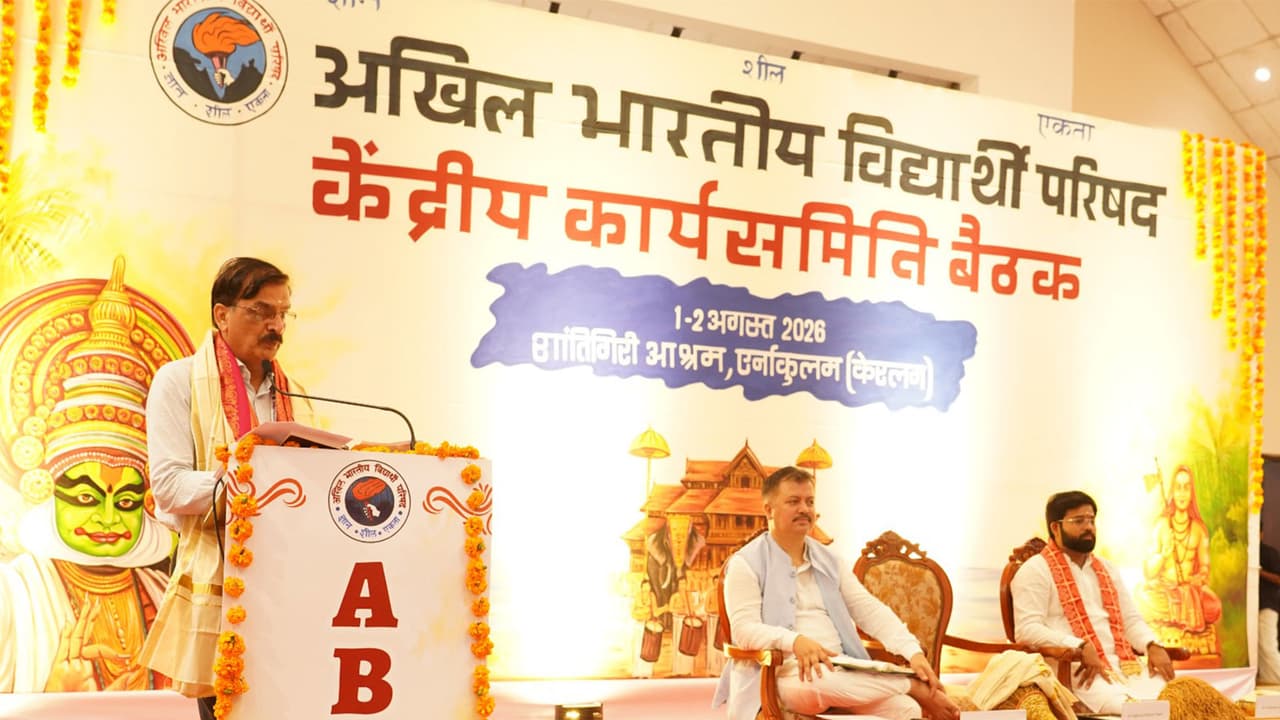
The ABVP’s Central Executive Committee met in Ernakulam, welcoming the anti-paper leak law and discussing the National Pharmacy Commission Bill. Leaders emphasized using dialogue and reforms to address student concerns and channel student power for nation-building.
The two-day Central Executive Committee meeting of the Akhil Bharatiya Vidyarthi Parishad (ABVP) began in Ernakulam on Saturday, bringing together senior office-bearers and representatives from across the country to deliberate on key issues concerning education, organisational priorities, and contemporary national developments. The meeting was inaugurated by ABVP National President Raghuraj Kishore Tiwari, National General Secretary Virendra Singh Solanki, and National Organising Secretary Ashish Chauhan. Delegates were welcomed with Kerala’s traditional Panchavadyam percussion ensemble and the Pulikali folk dance.
Discussion on Key Legislations
During the meeting, the committee welcomed the President’s assent to the Public Examinations (Prevention of Unfair Means) Amendment Act, 2026, describing it as a landmark step towards ensuring greater transparency, accountability, and credibility in the country’s examination system. The committee also discussed the National Pharmacy Commission Bill, 2026, for which the ABVP has submitted recommendations to the Centre, advocating quality-driven, student-centric, and employment-oriented pharmacy education, along with adequate representation of academic experts in the proposed commission.
Meeting to Shape Future Roadmap
Addressing the gathering, Tiwari said holding the meeting in Keralam, the birthplace of Jagadguru Adi Shankaracharya, was significant for the organisation. He noted that ABVP workers in the state had continued to work for student welfare and national interest despite challenges, adding that the meeting would help shape the organisation’s roadmap for the coming months. He stated that discussions would focus on education, organisational priorities, student union elections, membership expansion, national campaigns, and other contemporary issues, while reiterating that student power should be channelled towards nation-building.
Call for Systemic Reforms and Dialogue
Solanki emphasised that students’ concerns should be addressed through dialogue, democratic processes, institutional reforms, and transparent governance rather than violence or political agendas. He said the ABVP had consistently demanded impartial investigations into examination irregularities, strict action against those responsible, and comprehensive reforms in the national examination system.
Describing the anti-paper leak law as a major reform, he maintained that stringent legislation, technological safeguards, and institutional accountability were essential to curb organised examination mafias and protect the interests of honest students.
On the National Pharmacy Commission Bill, Solanki said the proposed legislation represented an important step towards reforming pharmacy education and regulation. He expressed confidence that the ABVP’s recommendations would strengthen the Bill and help create a future-ready, quality-oriented pharmacy education ecosystem aligned with the objectives of the National Education Policy 2020. (ANI)
(Except for the headline, this story has not been edited by Asianet Newsable English staff and is published from a syndicated feed.)