This feels like the season of bus fights.
Just a few weeks back, we witnessed this memorable fight scene inside a bus in Samantha’s Telugu hit
Then Prithviraj Sukumaran took on some goons inside a bus in the climax of , and going by the teaser of Khalifa, there seems to be another, even more violent round inside the vehicle for the same actor.
In Shaji Kailas’ new film Varavu, the hero is introduced through a fight scene involving a bus, as he takes on assassins sent to kill him. Surely, a bad time to be a bus!
In a Malayalam action film, it is also perpetually a bad time to be a chaaya-kada!
Paulson’s Revenge Story
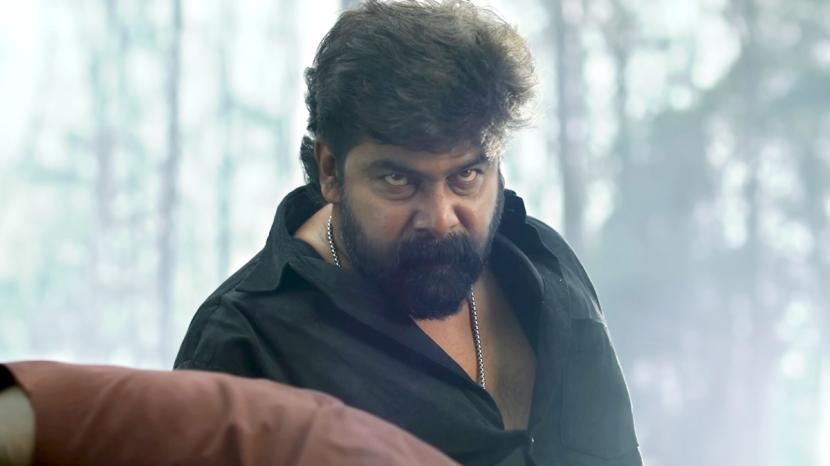
So who is the hero of Varavu? Paulson (Joju George) is out on a 10-day parole after serving four years of a life sentence. The official reason for his parole is to visit his elder sister Daisy (Sukanya), a nun, in his hometown before she leaves for an assignment at the Vatican.
But Paulson has his own secret agenda. He wants to settle an old score against those who sent him to prison for a crime he didn’t commit.
As he goes about his mission, he makes sure the blame for every crime he commits falls on Willy (Arjun Ashokan), his younger brother, who disappeared four years earlier.
Varavu treats the real reason behind Willy’s disappearance as a mystery, but it doesn’t take a child to solve it. You could argue that the makers wanted it to be obvious all along, with Paulson merely trying to provoke the antagonists using his brother. Fair enough.
But when the film finally reveals the full story, there’s hardly any shocking payoff for the audience. I was left wondering why Shaji Kailas chose to hold back that information for so long. Did he really think it was going to land as a major twist?
Shaji Kailas’ Template Filmmaking Style
Scripted by A K Sajan, Varavu contains almost every trademark of a Shaji Kailas film.
A hero returning to his hometown after years away to seek vengeance, who can never lose a fight.
Loyal sidekicks, played here by Baiju Santhosh and Azees Nedumangad.
A powerful villain (Murali Gopy) from an influential planter family.
A temple or church festival sequence, which arrives during the opening credits.
Exposition is delivered through lengthy monologues or conveniently placed flashbacks.
Naturally, it builds towards a grand finale where every villain is decisively defeated.
Oh, and how could I forget? You also need to find space for his faves, Baburaj and Vani Viswanath. Hopefully, the producer got the real-life couple on a combo package because the screenplay certainly didn’t need both of them.
Interestingly, both play police officers, yet they don’t share a single scene. Baburaj returns to the kind of corrupt cop he stopped playing around 15 years ago. A character who has no qualms about hurting women before proudly boasting about his crimes to the hero, just so we know why he deserves a one-way ticket to hell.
Vani Viswanath plays a senior police officer who arrives in the second half to investigate a murder. Unlike her enjoyable comeback in Rifle Club, she has very little to do here, and while her thick Telugu-accented Malayalam suits the character, it can become grating instantly.
Coming back to the director, Shaji Kailas delivered several mass blockbusters through the ’90s and early 2000s. But eventually, his films struggled to keep pace with changing audience tastes, both in content and presentation.
He enjoyed something of a resurgence when Kaduva became a hit. While its screenplay wasn’t much to write home about, there was at least an effort to make the film feel more contemporary. That balance slipped again with Kaappa, which turned out to be a huge disappointment.
In Varavu, you can once again see Kailas trying to modernise his visual style, but the effort doesn’t always succeed. His trademark flourishes, rapid zoom-ins and zoom-outs, criss-cross editing and stylised slow motion, are all present, but they now feel dated.
Combined with a screenplay that also belongs to another era, the overall package simply doesn’t click.
Lack of Emotional Depth and Character Development
The first half remains reasonably engaging because we are still piecing together the relationships and trying to understand what Paulson’s gameplan is. By the second half, once the picture becomes clearer, the film settles into routine mass potboiler territory, complete with more villains, more henchmen (strangely, of all nationalities) and more predictable twists.
The screenplay is especially clueless when it comes to showing how Paulson convinces the police that someone else is behind his crimes. A couple of hearsay statements later, the cops are happily chasing a ghost. This feels silly when it is clear that Paulson is quite the dodgy character, someone who has been convicted (even if wrongfully) of murder, and all troubles begin after his varavu. It’s like no one has a functioning brain in this universe.
Not even the hero, for that matter. Or rather, he is inconsistent about using his brains.
In some scenes, he is highly intuitive, always one step ahead of the villains. In one sequence, he somehow figures out their plan to transport a huge cache of cash and successfully sabotages it.
His enemies wrongfully assume there is an informer in their ranks, yet we are never told how Paulson learned about the operation.
So I assume he is just that smart.
But then he is also foolish enough to believe his increasingly obvious actions won’t have consequences, only for them to backfire on both him and those around him.
This lack of character inconsistency is symptomatic of the biggest problem with A K Saajan’s screenplay. Very little of what happens makes logical sense, and it relies on an age-old revenge template with almost nothing to surprise you.
Varavu also struggles to generate the emotional weight needed to make the revenge story truly land.
The only time we properly see Paulson’s family bonding is during a song, while the remaining interactions are scattered and underdeveloped. Sukanya gets a couple of crucial scenes before the screenplay practically packs her off.
The only genuinely interesting idea is the hero’s 10-day deadline to settle his score. Unfortunately, the film never makes us feel that ticking clock. Apart from Paulson reporting to the police station every three days, the passage of time barely registers.
Casting and Performances
Varavu is definitely more violent than most of Shaji Kailas’ earlier films and, to be fair, he uses Joju George’s imposing frame effectively to make the action scenes convincing.
Sam C S’ score also helps create the right aura around Paulson’s intimidating presence, though there are moments when it becomes louder than necessary.
In terms of casting, it feels as though the makers simply looked at what has been working recently without putting the same effort into writing the characters.
Joju George has excelled in intense roles and has impressed in action films like Porinju Mariam Jose, Antony and Pani, so he gets the lead instead of Kailas regulars like Mammootty, Mohanlal or even recent favourite Prithviraj Sukumaran. The actor is quite good here too, but the material doesn’t do justice to his intensity.
Murali Gopy has proved he can bring gravitas to morally grey characters, so he is cast as the chief antagonist. He is genuinely good as the malicious Medayil Kochettan, and his confrontation with his daughter and her lover in a resort room is among the film’s better acted scenes. Unfortunately, the character eventually slides into a stock ’90s villain and exits in disappointingly routine fashion.
Perhaps in an effort to appeal to younger audiences, Arjun Ashokan and Saniya Iyappan have also been brought on board. The former is little more than an extended cameo, while the latter is simply… there.
Shaji Kailas also seems to have watched and admired ,which perhaps explains why Varavu contains considerably more blood and gore than his usual films.
That might also explain the presence of Abhimanyu Shammi Thilakan, who plays another violent character involved in a particularly brutal sequence where an entire family is massacred. Kailas must have also loved so he brought in Kottayam Ramesh in a similar role of a saarthi.
Deepak Parambol plays the kind of backstabbing character Vijayakumar specialised in a couple of decades ago which earned him the trolling nickname ‘Chathiyan Star’. It is that you have either seen these actors play similar roles in other movies or see their characters in other Shaji Kailas films.
That familiarity, ultimately, sums up Varavu. You’ve seen almost everything it offers before.
That alone needn’t have been a problem, but Shaji Kailas brings very little that feels fresh to the table with either the making or the writing, with only Joju George and Murali Gopy’s performances doing their parts well here.
This simply isn’t the varavu we expected from one of the blockbuster makers of the ’90s.