When buying a new car, most customers pay attention to the model year, variant and registration date. Few, however, check the vehicle’s manufacturing date.
That detail has suddenly become important after a consumer court in Raipur ruled in favour of a owner, holding that the SUV was not E20-compatible because it had been manufactured before India’s E20 compatibility deadline, even though it was sold as a brand-new vehicle more than a year later.
While Maruti Suzuki has said , the case has raised an important question that extends far beyond a single vehicle: Could thousands of customers have unknowingly bought pre-E20 cars after the transition had already begun?
Not all cars were E20 compliant by April, 2023
In April 2024, JSW MG Motor India announced that the Hector had been certified to run on E20 fuel (20% ethanol-blended petrol), aligning with the government’s mandate requiring all new petrol-powered vehicles manufactured from April 1, 2025, to be E20 compliant.
The manufacturing date matters more than the purchase date
India mandated that all new passenger vehicles manufactured from April 1, 2023, under BS6 Phase-II norms, must be E20 material-compatible. The transition was completed on April 1, 2025, when E20 petrol became the standard fuel available across the country.
However, cars are often sold several months after they are built. It is common for manufacturers and dealerships to clear older inventory through discounts, and such vehicles continue to be sold as “new” because they have never been registered.
That means a customer purchasing a new car in April, May, June or even much later in 2023 or even in 2024 could have received a vehicle that was actually manufactured before April 1, 2023.
If so, the car may not have been produced under the mandatory E20 material compatibility norms that applied to newer vehicles.
Why buyers should check their VIN and manufacturing month
The issue is particularly relevant for buyers who purchased discounted stock during the transition period.
If your car was bought after April 2023, it is worth checking the manufacturing month mentioned on the VIN plate or registration documents. A vehicle built in January, February or March 2023 or even earlier but sold months later could belong to the pre-E20 production batch.
That does not automatically mean the vehicle will develop problems or is unsafe to use. Many manufacturers had already begun introducing E20-compatible components before the deadline, and several models were compliant ahead of schedule.
However, if a dispute arises over fuel-system or engine issues, the manufacturing date could become an important factor, as highlighted by the Raipur case.
Maruti case brings the issue into focus
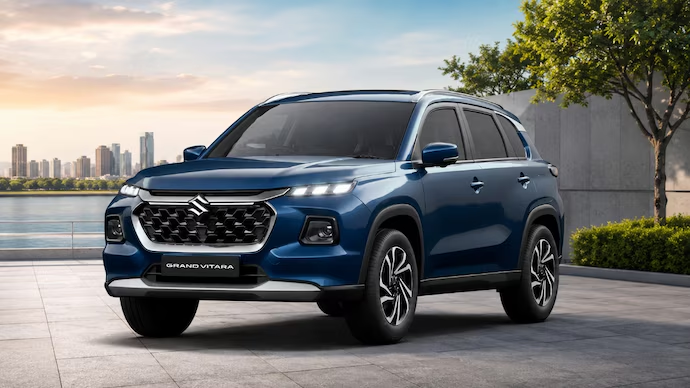
The case involved a Maruti Suzuki Grand Vitara Hybrid that was manufactured in January 2023 but sold in June 2024.
After repeated engine-related complaints, the customer approached the consumer commission. The Commission concluded that the SUV was not E20-compatible and directed Maruti Suzuki and the dealer to replace the vehicle or refund its purchase price, along with compensation.
Maruti Suzuki has strongly disputed the findings. The company said the Grand Vitara is fully E20-compatible, that this was disclosed in the owner’s manual, and that evidence pointed to fuel contamination rather than ethanol compatibility. It has confirmed that it will challenge the ruling before a higher forum.
Could more buyers come forward?
The verdict is not a nationwide precedent, and its findings remain subject to appeal. However, it has drawn attention to an issue that many buyers may never have considered.
During the E20 transition, dealerships across India continued selling older inventory alongside newly manufactured vehicles. Some buyers may therefore have taken delivery of cars built before the April 1, 2023 mandate without realising that their vehicle belonged to an earlier production batch.
If similar owners experience fuel-system disputes in the future, the manufacturing date, not the delivery date could become a key point of examination.
For consumers, the takeaway is simple: If you bought a “new” car during the E20 transition, especially one offered with substantial discounts, check when it was actually manufactured. That date could matter far more than the day you drove it home.