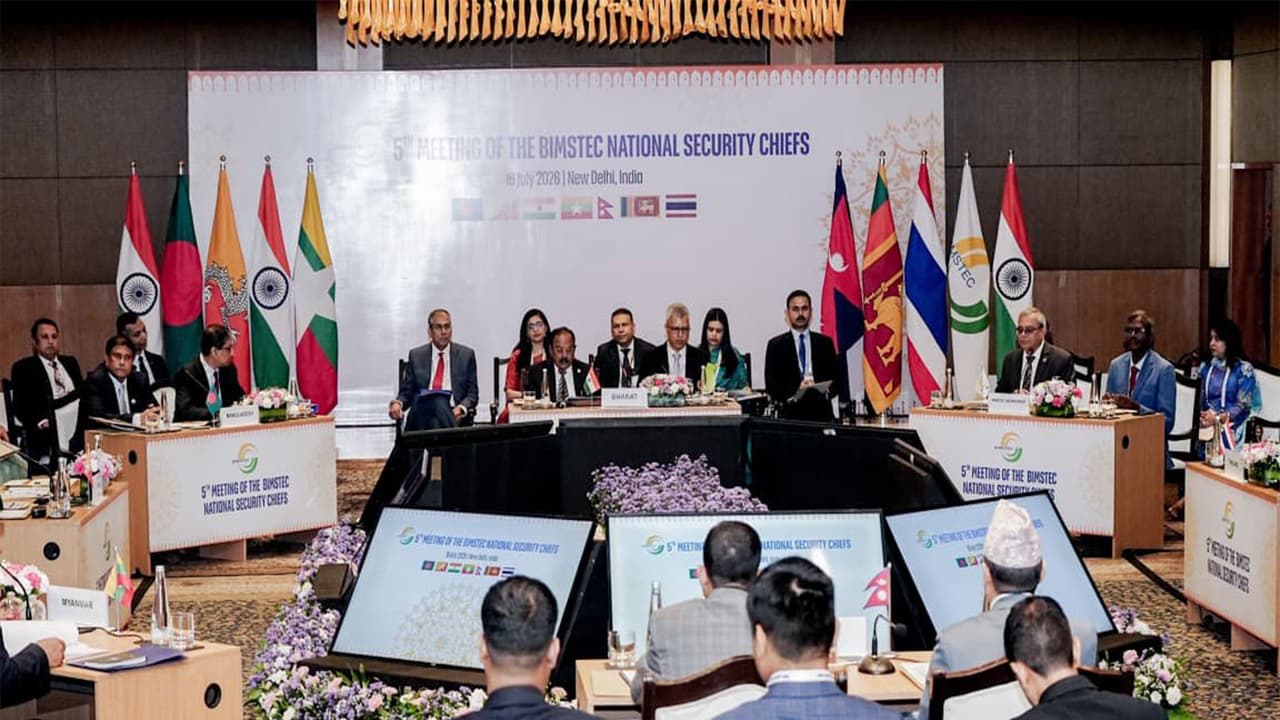
The 5th Meeting of the BIMSTEC National Security Chiefs, chaired by NSA Ajit Doval, reaffirmed commitment to strengthening regional security, focusing on counter-terrorism, cyber and maritime security, disaster management, and emerging threats.
The 5th Meeting of the BIMSTEC National Security Chiefs, chaired by National Security Advisor (NSA) Ajit Doval on Thursday, reaffirmed the member states’ commitment to strengthening regional security cooperation, with discussions focusing on counter-terrorism, cyber and maritime security, disaster management and emerging security threats.
According to an official statement, NSA Doval hosted National Security Advisers and Heads of Delegations from Bangladesh, Bhutan, Myanmar, Nepal, Sri Lanka and Thailand. “BIMSTEC bridges South Asia and Southeast Asia, two of the most significant and vibrant regions of the Indian Ocean. Over the years, BIMSTEC has deepened cooperation in regional security, disaster management, transport and trade connectivity, technological issues, and people-to-people contacts,” the statement said.
During the meeting, BIMSTEC Secretary General Indra Mani Pandey presented a comprehensive overview of cooperation in the security sector and briefed member states on the progress made across various sectors.
Key Discussions and Outcomes
The National Security Advisers and Heads of Delegations discussed “practical and result-oriented solutions” to combat terrorism and organised crime, ensure security in the cyber, maritime and energy domains, enhance connectivity, facilitate efficient disaster management, and tackle new and emerging threats.
The member states also adopted guidelines for the maritime component of humanitarian assistance and disaster relief (HADR), which, according to the statement, “will help BIMSTEC member states to undertake relief operations in the region in an expeditious manner.”
They further endorsed a set of guiding principles for the conduct of maritime law enforcement agencies during interactions at sea. The principles are expected to “outline reference points for increasing predictability and promoting safety during maritime engagements among member states,” the statement said.
As BIMSTEC approaches its 30th anniversary next year, the National Security Advisers and Heads of Delegations reiterated their resolve to enhance collaboration and knowledge-sharing towards strengthening regional security, building resilience and enhancing institutional capacities to address diverse security threats, the statement added.
NSA Doval Calls for Decisive Action Amid Global Challenges
Meanwhile, Doval underscored the need for closer regional cooperation to tackle evolving security challenges, saying the current global landscape marked by conflicts, geopolitical uncertainties and technological disruptions requires BIMSTEC member states to work together and take “decisive actions” for their mutual benefit.
Addressing the fifth BIMSTEC National Security Advisers’ Meeting, Doval said, “We are meeting today in the backdrop of a challenging global landscape. We are witnessing conflicts and geopolitical uncertainties. We are also facing multi-domain security threats, amplified by rapid technological advancements. Disruptions in global supply chains have also resulted in economic hardship for all our countries.”
“In this setting, there’s an urgent need for us to collaborate, take decisive actions for our mutual benefit, and find solutions to mutual discussions and deliberations to the vexed problems that we are all facing,” he added.
Significance of the Bay of Bengal Grouping
Highlighting the significance of the Bay of Bengal grouping, Doval said BIMSTEC unites two of the world’s most dynamic regions and represents a population of 1.7 billion people, around 22 per cent of the global population, with a combined GDP of nearly USD 5 trillion.
“We are united by the Bay of Bengal, not just geographically, but also through deep civilizational and cultural legacies that have evolved over a millennium of shared history,” he said.
About BIMSTEC
BIMSTEC is a key regional organisation that was established on June 6, 1997, with the signing of the Bangkok Declaration. Initially known as BIST-EC (Bangladesh-India-Sri Lanka-Thailand Economic Cooperation), the organisation is now known as BIMSTEC and comprises seven Member States, with the admission of Myanmar on December 22 1997, and Bhutan and Nepal in February 2004. (ANI)
(Except for the headline, this story has not been edited by Asianet Newsable English staff and is published from a syndicated feed.)