During a landmark visit to Israel, PM Narendra Modi addressed the Knesset, receiving a standing ovation and the prestigious ‘Speaker of the Knesset Medal’. He lauded the strategic partnership, historical ties, and future economic cooperation.
It was a day marked by symbolism, warmth and strategic messaging as Prime Minister Narendra Modi began his Israel visit with a moment that captured the spirit of the relationship, a standing ovation inside the Special Plenary of the Knesset. As applause echoed through the chamber, Israeli lawmakers rose to acknowledge the Indian leader, capping his address with the conferment of the prestigious “Speaker of the Knesset Medal”, the highest honour awarded by the Israeli Parliament. The recognition was bestowed for his “exceptional contribution through his personal leadership” in strengthening India-Israel ties, making PM Modi the first foreign leader to receive the distinction.
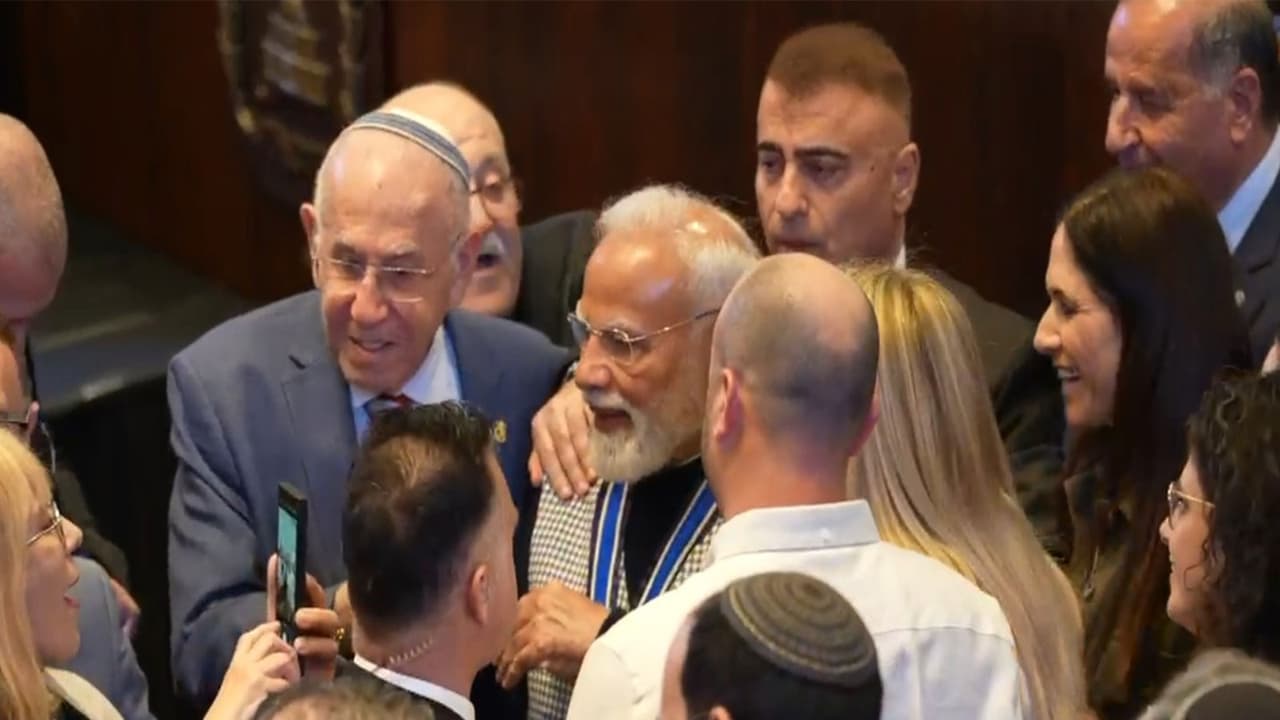
The mood inside the Knesset was not merely ceremonial; it was personal. After the address, Members of the Parliament queued up to PM Modi, exchanging handshakes, selfies, and brief conversations, small gestures that reflected the ease and camaraderie between the two democracies. The moment also carried historical resonance. During PM Modi’s landmark 2017 visit, the relationship was elevated to a “Strategic Partnership”. His latest address reinforced how that partnership has since broadened in scope and ambition.
Invoking Historical and Civilizational Ties
PM Modi’s speech reached beyond contemporary geopolitics, invoking a civilizational bridge that stretches back over two millennia. “Long before we related to each other as modern States, we were linked by ties that go back more than two thousand years. The Book of Esther refers to India as Hodu. The Talmud records trade with India in ancient times,” he said.
He emphasised that Jewish communities have lived in India ” without fear of persecution or discrimination,” preserving their faith while fully participating in Indian society, a record he described as a matter of pride. After India’s independence, he noted, Indian parliamentary debates reflected admiration for Israel’s agricultural transformation of desert landscapes. He recalled how the Kibbutz movement inspired leaders such as Acharya Vinoba Bhave and Loknayak Jayaprakash Narayan.
Deepening Contemporary Cooperation
Addressing contemporary cooperation, PM stressed that “a strong defence partnership between trusted partners like India and Israel is of vital importance” in an uncertain world. He described India as the fastest-growing major economy in recent years, poised to become one of the world’s top three largest economies, while calling Israel a “powerhouse of innovation and technological leadership.” This, he said, forms a natural foundation for a forward-looking partnership.
Trade and Investment
“We are committed to expanding trade, strengthening investment flows, and promoting joint infrastructure development. The Bilateral Investment Treaty signed last year will provide confidence and predictability to our businesses,” he stated.
Cultural and People-to-People Ties
PM also highlighted the growing cultural engagement between the two countries. He noted the expansion of yoga centres across Israel and rising interest in Ayurveda, inviting more young Israelis to visit India to experience its “holistic wellness” traditions. “At the heart of the India-Israel partnership are the ties between our peoples,” he said, inviting Israeli lawmakers to visit India and deepen parliamentary exchanges. He pointed out that the Indian Parliament has established a Parliamentary Friendship Group for Israel.
Community Reacts with Enthusiasm
Members of the Jewish Indian community in Israel expressed enthusiasm over the Prime Minister’s visit. Ori Kadvil, from the Kochi community, praised India’s scale and technological potential, recounting how he was amazed to learn that Indian hackathons host hundreds of teams rather than just participants. “We wish to bring the powers of both of our countries together so we can create marvellous things for both of our people and the entire world,” he said, describing his interaction with PM Modi as “an interesting and joyous event.”
Another Israeli resident, Yarin Didi, lauded the combined strength of Israeli innovation and India’s vast market potential, particularly in emerging fields like artificial intelligence. “I am really proud to be here today… Israel is known to have great talent in terms of AI. But I think India has… The Indian market is thousands of times compared to anything I have personally seen before. Both have the talent and the huge economic potential to get innovation to a larger scale,” Didi told ANI.
A Partnership Rooted in Shared Values
Since diplomatic relations were established in 1992, India-Israel ties have steadily expanded across defence, agriculture, water management, technology and innovation. The 2017 elevation to a Strategic Partnership marked a turning point, and Modi’s latest address to the Knesset reinforced the momentum.
The standing ovation, the historic medal, and the enthusiastic reception from Israeli lawmakers together signalled a relationship that is not only strategic but also rooted in shared democratic values, historical goodwill and people-to-people bonds. (ANI)
(Except for the headline, this story has not been edited by Asianet Newsable English staff and is published from a syndicated feed.)