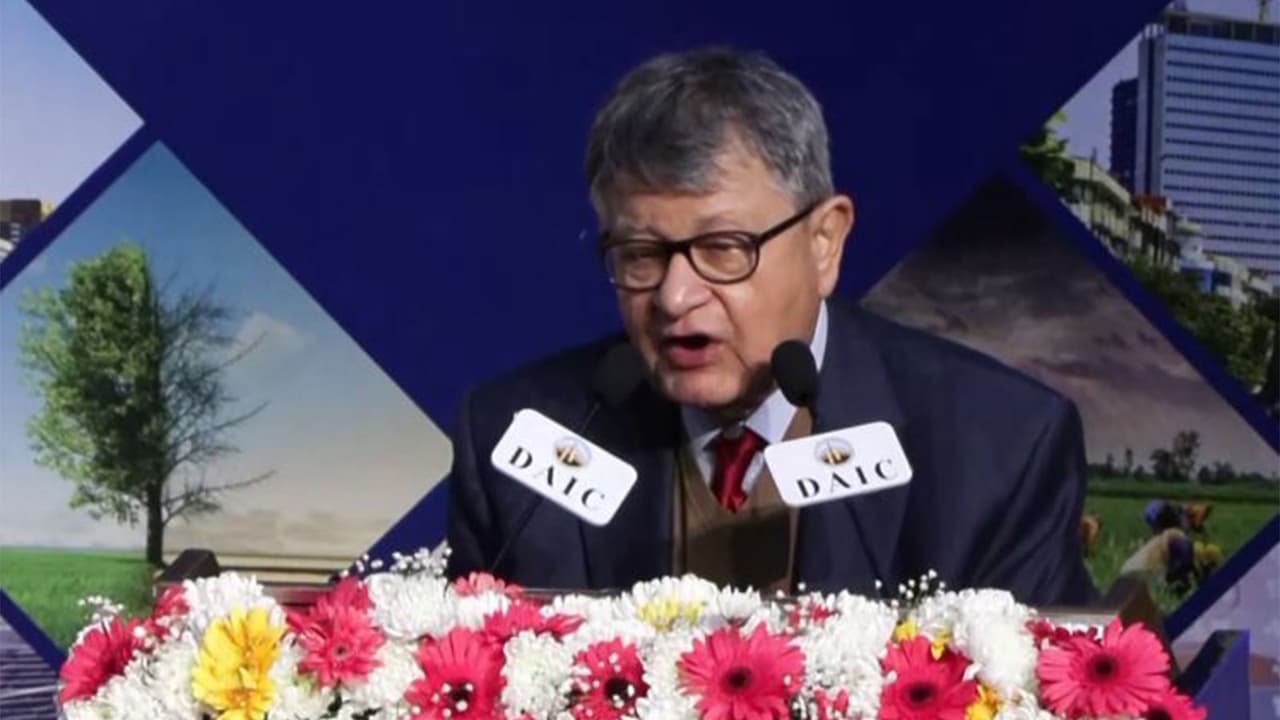
India’s biggest investment challenge is its large-scale urban transition, not industrialisation, said NITI Aayog’s Suman Bery. He stressed that city design and planning will be decisive in shaping long-term energy demand and efficiency.
India’s biggest investment challenge in the coming decades will come from its delayed and large-scale urban transition rather than industrialisation, with city design and planning set to play a decisive role in shaping long-term energy demand and efficiency, NITI Aayog Vice Chairman Suman Bery said on Monday.
“It is not industrialisation that is investment-heavy, it is urbanisation,” Bery said while speaking at the launch of a NITI Aayog report on scenarios towards Viksit Bharat and India’s net zero emissions target for 2070, noting that India faces a “mammoth and delayed” urban transition that will require sustained investment well beyond climate-related spending. Bery stressed on the need for integrated planning of cities, infrastructure and energy systems.
Complementary Goals, Complex Challenges
India has committed to achieving net zero emissions by 2070, while targeting developed-nation status by 2047, the centenary of its independence. Bery said these two goals must be seen as complementary parts of a broader development strategy rather than as competing priorities.
He cautioned that improving energy efficiency alone would not automatically reduce overall energy consumption, pointing to what economists call the “rebound effect”, where efficiency gains are offset by higher consumption as incomes rise.
Bery cited the experience of advanced economies, including the United States, where decades of fuel efficiency standards have coexisted with rising demand for energy-intensive goods, highlighting the limits of technology-led solutions in isolation.
Integrated Planning as the Solution
“The solution is to bake energy efficiency into the system from the start,” Bery said, stressing that urban design, land use planning and transport systems would shape India’s energy consumption patterns for decades.
He said compact city layouts, efficient public transport and well-planned housing could lock in lower energy demand over the long term, reducing emissions without constraining growth.
The Financing Challenge
Bery said that India’s investment challenge is not limited to the energy transition, as rapid urbanisation will also require spending on housing, transport, water, sanitation and social infrastructure. These needs, he said, come at a time when global investment rates have not returned to the highs seen before the global financial crisis.
He added that financing such large-scale investment would require careful macroeconomic management, given India’s long-standing preference to limit its current account deficit to around 2 per cent of gross domestic product.
India’s Transformational Path
Bery said the NITI Aayog’s role was not to prescribe specific policies but to stimulate informed debate on how India balances growth, urbanisation and sustainability.
“What happens in India over the next 25 to 30 years will be transformational for the world,” he said, expressing confidence that India’s institutions and decision-making systems would be capable of meeting the challenge.
The NITI Aayog report released on Tuesday outlined multiple development and energy scenarios, aimed at informing policy choices as India charts its path towards becoming one of the world’s largest economies while managing climate risks. (ANI)
(Except for the headline, this story has not been edited by Asianet Newsable English staff and is published from a syndicated feed.)