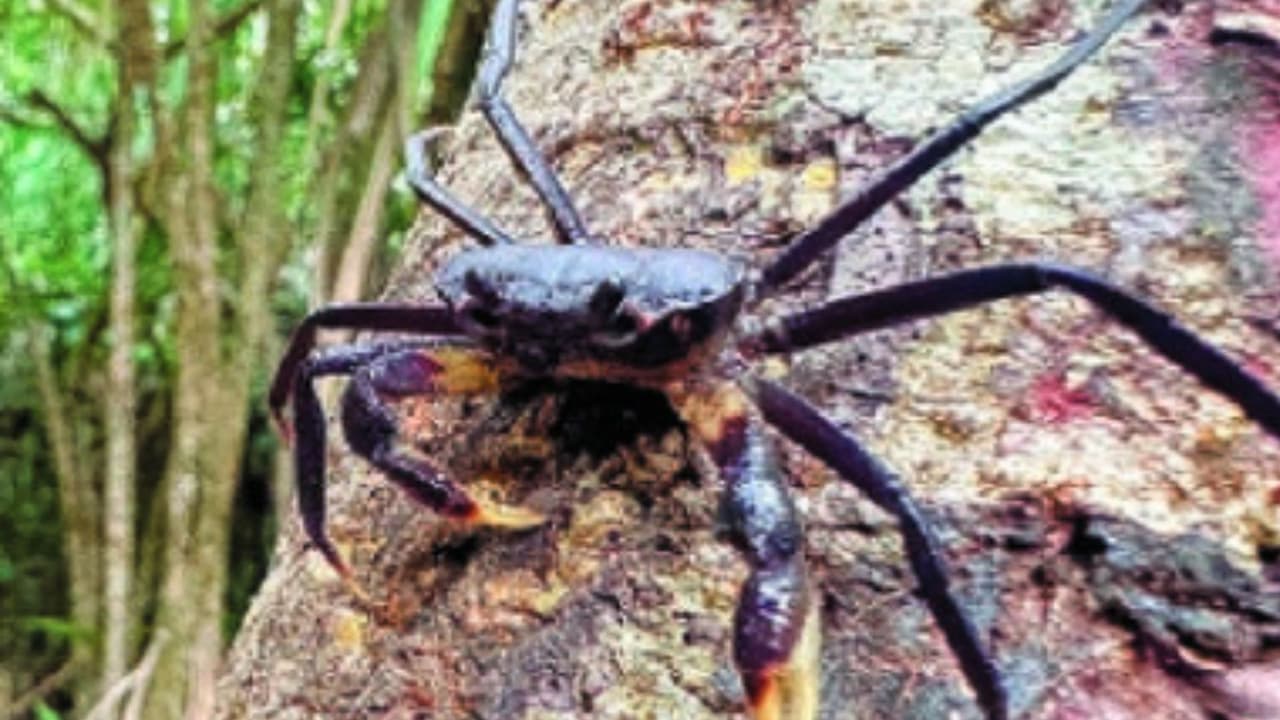
Researchers have recorded India’s only tree-dwelling freshwater crab in Karnataka’s Agumbe for the first time. Previously known only from Kerala’s Agasthyamala Biosphere Reserve, the discovery expands the rare species’ known range in the Western Ghats.
The Western Ghats in Karnataka have welcomed a remarkable new resident. Researchers have recorded India’s only true tree-dwelling freshwater crab, locally known as the Kani Maranjandu, in Agumbe for the first time. The discovery marks a significant addition to the region’s rich biodiversity and expands the known geographical range of the rare species beyond Kerala.
The finding was confirmed through a research study conducted by Joel Correa, Pavan Chikkannarayanaswamy and Vijay Kumar, highlighting the ecological significance of the Western Ghats and the need for further biodiversity surveys.
First Record Outside Kerala
Until now, the Kani Maranjandu was believed to be found only in the Agasthyamala Biosphere Reserve in Kerala. Its discovery in Agumbe marks the species’ first recorded presence in Karnataka, significantly extending its known geographical range.
Researchers say the finding provides valuable insights into the biodiversity of the Western Ghats and suggests that the species may be more widely distributed than previously believed.
What Makes the Crab Unique?
The Kani Maranjandu belongs to the Gecarcinucidae family and is the only known freshwater crab in India that spends its entire life in trees. It can be identified by its long legs, oval-shaped shell, yellow-orange claws and bluish-black body.
The species was previously believed to be completely arboreal, living exclusively in trees. However, researchers in Agumbe observed the crab moving along the forest floor, raising new questions about its behaviour.
They believe the crab may descend from trees during the monsoon in search of a mate or a suitable habitat.
Habitat and Feeding Behaviour
According to the researchers, the rare crab inhabits water-filled hollows in tree trunks within evergreen and semi-evergreen forests. Its diet consists of leaves, seeds, insects and slugs.
The discovery of the species near a Myristica swamp in Agumbe also suggests that it prefers habitats close to water sources.
A Significant Discovery for the Western Ghats
Researchers believe the crab’s elusive, tree-dwelling lifestyle may explain why it remained undetected in Karnataka until now.
Describing the discovery as an important contribution to the understanding of the Western Ghats’ biodiversity, the researchers have recommended comprehensive surveys across the mountain range to study the species’ distribution, ecology, behaviour and conservation status in greater detail.