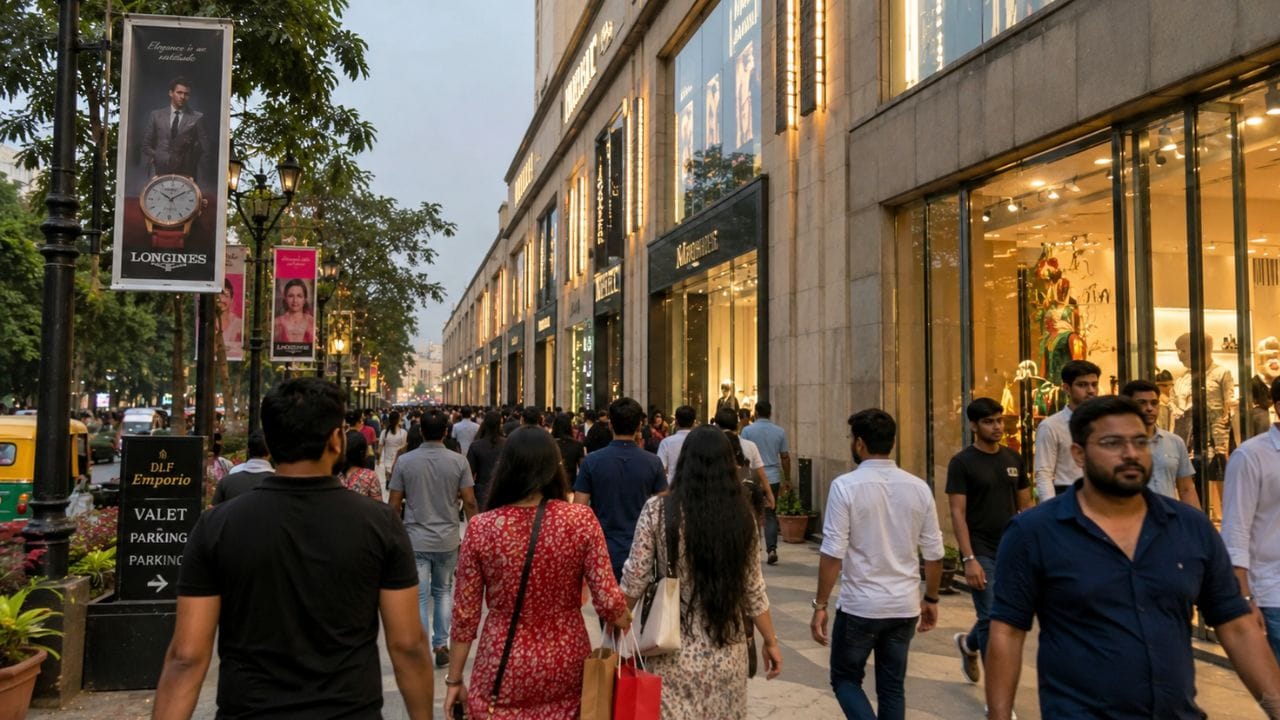
Delhi NCR has emerged as the largest consumption market
Big cities of India are no longer just crowded areas. These cities have become the real engine of the country’s economy. A new report titled ‘Many Urban Indias’ by PRICE and Tata Sons has revealed a shocking picture of Indian cities. The report shows that Bengaluru, Chandigarh and Delhi are at the forefront in terms of earnings. At the same time, Chandigarh, Thiruvananthapuram and Vadodara dominate the domestic expenditure. But when it comes to total consumption i.e. market size, Delhi NCR has left Mumbai and Bengaluru far behind.
Delhi NCR becomes the crown of consumption
The country’s six largest metros together determine almost half (46 percent) of India’s total consumption. These include Delhi, Mumbai, Bengaluru, Kolkata, Chennai, Hyderabad. But Delhi NCR has emerged as the largest consumption market. The annual consumption here is about 126 billion dollars. This figure is almost equal to the total combined consumption of Mumbai and Bengaluru ($134 billion). The main reason for this is the huge number of families living in Delhi NCR. About 75 lakh families live here, whereas only 46 lakh families live in Mumbai. The surprising thing is that the people of Delhi NCR spend 33 billion dollars every year only on transportation. This amount is bigger than the size of the entire market in cities like Pune or Ahmedabad.
100 cities have one third of the country’s wealth
The figures of the report show that less than 20 percent of the country’s population lives in the top 100 cities of India. Despite this, these cities generate one-third of the country’s total income. Cities are divided into four parts based on their population. The average annual income of ‘Big Six’ i.e. cities with population of more than 1 crore is Rs 23 lakh. The average income of cities like Ahmedabad, Jaipur, Surat, Pune (25 lakh to 1 crore population) falling in the ‘boomtown’ category has been estimated at Rs 17 lakh. After this, the average income of Breakout (15 to 25 lakh population) cities is Rs 14 lakh, while the average income of Frontier (5 to 15 lakh population) cities is Rs 12 lakh.
The scope of middle class is increasing rapidly
The middle class is continuously becoming stronger in the Indian economy. In the last decade, the share of families earning Rs 6 lakh to Rs 36 lakh annually has jumped from 29 per cent to 53 per cent. It is expected to reach 60 percent by the year 2030. Hyderabad is at the forefront in this growth. At the same time, the share of high income families earning more than Rs 36 lakh has also increased from 3 percent to 12 percent. Currently, Delhi, Mumbai and Pune dominate this category, but the number of rich families is increasing fastest in small cities like Raipur, Thoothukudi, Kannur.
The biggest relief is that the number of families with income less than Rs 1.5 lakh is continuously decreasing. By 2030, their share in big cities is expected to be only 0.3 percent. This change clearly shows that demand is going to increase in the coming times for every sector, from real estate, retail, automobile to financial services.